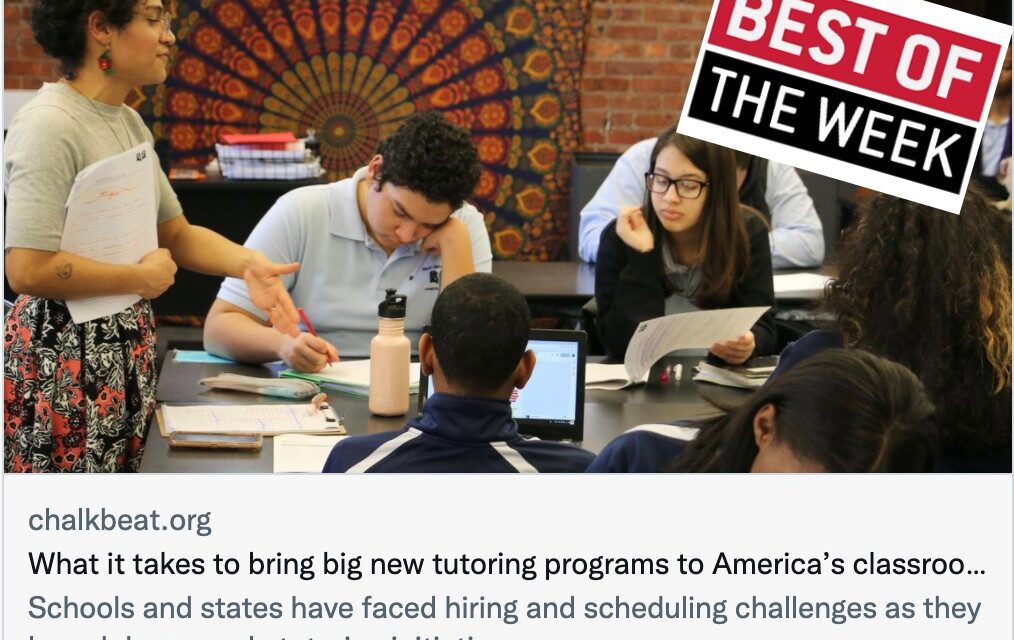
In this week’s newsletter: Schools struggle to get kids back in the classroom and catch them up once they arrive. A local reporter chastises national outlets for not following up on book challenges. And WBUR Boston public radio has finally found a new education editor.
FALLING BEHIND & NOT SHOWING UP
The big story of the week, according to us:
Several recent stories appeared around the topics of enrollment declines, attendance issues, and large numbers of students who need academic help. Tutoring efforts are attempting to catch kids up as quickly as possible, but the road hasn’t been easy — especially when schools are struggling with the consequences of low attendance and enrollment:
🔊 Nearly half of LAUSD students have been chronically absent this year, data show (LA Times)
🔊 Big drop during pandemic caps two decades of enrollment swings in CA schools (EdSource)
🔊 City schools bracing for budget realities of 120K enrollment drop-off (NY Post)
🔊 Sobering test scores show Newark students struggling to recover from learning loss (Chalkbeat Newark)
🔊 Tutoring, a key learning recovery strategy, reaches fewer than 1 in 10 L.A. students (LA Times)
🔊 Tutors in high demand as students try to adjust from remote learning (NBC News)
🔊 Texas schools won’t lose funding for attendance drops during the pandemic (Texas Tribune)
🔊 Texas leaders adjust school funding for districts facing low attendance and budget woes (Dallas Morning News)
WHY’S EDUCATION JOURNALISM STUCK?
New commentary from The Grade
By and large, the education beat is stuck. It hasn’t yet made long-discussed changes in the ways stories are assigned, framed, and reported; the people who write them; and the people who are featured in them. But what’s in the way of progress?
Journalists and observers helped me identify seven obstacles to much-needed changes, among them indifference to informal news sources, a focus on “macro” issues rather than information parents want, and the challenges of engagement and service journalism.
“Perhaps there’s incentive to NOT share or even the playing field,” says S. Mitra Kalita, who notes the lack of diversity among education journalists and describes education journalism as “opaque” to parents.
RAMPING UP TUTORING; ANTI-CRT DEFEATS
The best education journalism of the week, plus a runner-up and some bonus stories.
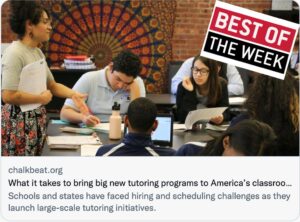
🏆 BEST: The best story of the week is Hiccups and hard lessons: What it takes to bring big new tutoring programs to America’s classrooms by Kalyn Belsha for Chalkbeat. Though it’s been tough for schools to catch kids up after two years of pandemic learning, many of them are trying. Belsha looks into different tutoring programs cropping up around the country and admirably finds some that are working and others that aren’t — a good way to do solutions journalism in my mind. In Arkansas, for example, a teacher is tutoring kids before school and during lunchtime and finding that it’s making a difference. But districts in Chicago and New Mexico are far behind their hiring goals for tutors, making it hard to even get the programs off the ground. Belsha does a good job assessing the promise and hard realities of tutoring, which many districts are using federal COVID funds for. Despite the programs being set up, students aren’t always showing up or getting the extra help they need — a problem that will take more than just money to fix.
🏆 RUNNER-UP: This week’s runner-up is Parental rights bills have been introduced in most states. Teachers are pushing back. by Nadra Nittle in The 19th. Not long ago, Nikole Hannah-Jones lamented that media coverage was focused on proposed anti-CRT and anti-LGBTQ legislation in schools, but failed to follow up when those bills didn’t pass, especially in red states. In this story, Nittle doesn’t gloss over those victories. She points out that similar bills have been introduced in about 35 states over the last year, but so far eight of those bills have already died or stalled out. That includes an Indiana bill that sought to stop schools from teaching divisive concepts, a Utah bill requiring teachers to post lesson plans, and an Iowa bill that would’ve allowed parents to sue if teachers exposed their children to “obscene” materials. While it’s important to report on proposed legislation, it’s perhaps even more important to report on the outcome. The same is true for book ban stories. “If you have a front page story on something, shouldn’t you follow it up?” asked one education reporter who didn’t want to be named. “I think the outcome of the instructional materials review is just as important as the initial complaint.”
BONUS:
🏆 A battle over schools rages in Michigan — and Betsy DeVos is at the center of it (NBC News)
🏆 Shootings shape the debate on school policing (Center for Public Integrity)
🏆 Our Nation’s Teachers Are Hustling to Survive (EdSurge/Mother Jones)
🏆 The rise of smart cameras used to catch maskless students in US schools (Guardian/The 74)
MEDIA TIDBITS
Thought-provoking commentary on the latest coverage.
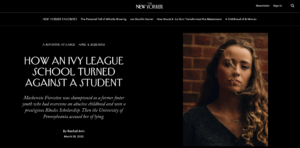
Above: Look to the New Yorker’s Rachel Aviv for a nuanced story about a former foster student whose claims of being first-generation have been challenged. If you’re interested in more, check out the Chronicle of Higher Ed’s story on the same student earlier this year.
📰 THE MEDIA’S ROLE IN THE TIKTOK HOAX: Thanks to the Washington Post, we now know that the notion that TikTok was encouraging kids to slap teachers and vandalize bathrooms was a hoax being pushed by its rival Facebook (Meta). And the Nieman Lab tells us that local news outlets were targeted with the social media campaign Facebook paid for. But the media’s role wasn’t entirely passive. It wasn’t just Facebook that pushed the story. And it wasn’t just local news outlets that ran with it. USA Today, the New York Times, the Washington Post, Associated Press, and other national news outlets all ran stories about TikTok threats to schools, with varying amounts of context and caution. Some journalists seem to understand this. “The ball is in the hands of local news stations and papers,” tweeted FiveThirtyEight’s Maggie Koerth. “Yes this is also for sure a lesson for journalists,” noted NBC News’ Tyler Kingkade. Other journalists weren’t so sure. “This is a chicken-and-egg thing,” tweeted EdWeek’s Evie Blad. And the Hartford Courant’s Seamus McAvoy asked what reporters are supposed to do: “When a half-dozen school districts are telling reporters that they’re worried about a social media trend…is the media supposed to ignore it?”
📰 THIS MIGHT MAKE YOU UNCOMFORTABLE: Too much of the coverage of recent proposals to limit classroom instruction has focused on how educators feel about them rather than what they actually say, according to contributor Natalie Wexler’s most recent piece for The Grade, No, anti-CRT laws don’t actually outlaw lessons that might make students uncomfortable. “These laws are a bad idea, but widespread misreporting of the ‘discomfort’ provision in these laws is making things worse.” She’s not the only one who sees the importance of more accurate coverage. “The chilling effects of divisive concept laws are a legitimate concern,” agrees Chalkbeat’s Matt Barnum. “But reporters have an obligation to describe the letter of the laws precisely.” The New York Times has corrected two recent stories that mis-stated the statutory language.
📰 IS SEL NEXT? NOT REALLY: The recent Washington Post story about pushback against SEL had me wondering about the dangers of national trend stories that lack context and could end up amplifying a relatively small problem into a bigger one. This has happened a lot in recent months when news outlets string together dramatic anecdotes without giving the larger context. (National wave of teacher strike stories, for example, or even anti-CRT and parents rights.) No doubt, there have been some places where SEL is under attack, and some good reporting about what’s happening locally from folks like Carley Lanich at the South Bend (Indiana) Tribune. However, large majorities of parents and educators support SEL, which has been implemented across large swaths of American schools. The pushback might not yet (or ever) really amount to all that much, without help from the media. My recommendation would be to use caution and reach out to CASEL’s Justina Schlund, who wrote about great ways to cover SEL in schools. Her view is understandably pro-SEL, but she can give you context if you’re seeing protests pop up and help you reality-check what’s going on.
📰 SCHOOL LUNCH BLAME GAME: That rarest bird, a heartfelt apology, appeared on Twitter this week when energy journalist David Roberts walked back his sharply critical March 26 Twitter thread about a Politico story on Congress’ failure to extend a school nutrition program that’s provided free lunch to kids. The main criticism of the piece was that it did not highlight Sen. Mitch McConnell’s role in blocking the extension. Roberts complained that the Politico story “should be in a museum somewhere, to illustrate all the dysfunctions of US politics & media in 2022.” A pile-on ensued: ex-CNNer turned media critic Soledad O’Brien tweeted, “Politico sucks,” calling out the journalists who reported the story and describing the story as an “excellent example of a failure to educate the public.” But Politico reporter Helena Bottemiller Evich explained in a thoughtful response that her piece was actually her second on the topic recently — the first, unfortunately, was stuck behind a paywall. “I stand by our reporting here,” Evich wrote, “but I can also understand how this could be confusing for anyone just coming into this story.” Politico education reporter and co-author Jessica Calefati weighed in to note that Politico was one of the few outlets closely covering the school lunch story. (GT)
Looking for media commentary and analysis all day, every day? Follow me at @alexanderrusso.

PEOPLE & JOBS
Who’s doing what, going where.
Above, clockwise from top left: EWA’s Caroline Hendrie, WBUR’s Suevon Lee, the Las Vegas Review-Journal’s Lorraine Longhi, and WBEZ Chicago’s Nereida Moreno.
🔥 Comings and goings: Executive director Caroline Hendrie is stepping down from her position in July after 12 years of leading the organization, and her current and former colleagues had lots of good things to say about her. Education Week’s Alyson Klein said Hendrie is “an incredible journalist and an even better human” and “the best editor I’ve ever worked with.” “I owe my career to @chendrie,” tweeted CalMatters higher ed reporter Mikhail Zinshteyn. “I’m a better writer, thinker, and employee because of her.” And Hechinger Report editor-in-chief Liz Willen said, “Big shoes to fill!”
🔥 More moves: Honolulu Civil Beat education reporter Suevon Lee confirmed she was hired to be the new education editor at WBUR. Lorraine Longhi, an alum of the Arizona Republic and Copper Courier in Phoenix, is now covering education and health for the Las Vegas Review-Journal. And Nereida Moreno, a producer for WBEZ Chicago’s news show Reset, is moving over to the education beat for the station. Bethesda Beat’s Caitlynn Peetz has been promoted to senior reporter. And Washington Post reporter Moriah Balingit is back and looking to get in touch.
🔥 Job openings: USA Today is hiring a K-12 enterprise reporter to replace Erin Richards. KJZZ Phoenix is hiring an education reporter. The Austin American-Statesman is hiring a K-12 reporter. Chalkbeat Chicago is hiring a bureau chief. The LA Times is hiring a higher education reporter. The Oregonian is hiring an education reporter. Voice of San Diego is hiring an education reporter. Check previous editions of the newsletter for other listings that may still be open.
🔥 Recognition: An investigation by USA Today higher education reporter Kenny Jacoby that revealed that the California State University chancellor mishandled years of sexual harassment complaints prompted the university’s board of trustees to adopt reforms. Corey Mitchell and his colleagues at the Center for Public Integrity were named finalists for the Dori Maynard Award for their project on schools calling the police on kids. A job well done to all!
🔥 Book news: Congrats to former LA Times education reporter Sonali Kohli, who has a new young adult nonfiction book coming out soon about teen activists.
EVENTS
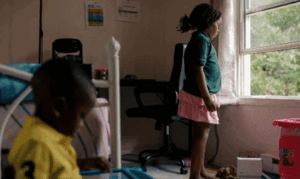
Above: A few weeks ago, I lamented that there weren’t more stories marking two years since schools closed in the pandemic, but this week Chalkbeat put out a great story and photo essay documenting what it’s been like for students across the country. Check it out.
⏰ Upcoming: Later today — yes, today! — EdWeek’s Maddy Will will be on an Ed Reform Now CT panel to talk about teacher pensions and education funding. Don’t miss it. And on April 11, NPR’s Anya Kamenetz will be the keynote speaker at CAIS’ National Leaders Conference, where she’ll speak on leadership for innovation in education
⏰ Resources: Reporting on COVID school spending? Future Ed has collected some data on how schools are spending that money on facilities and operations. The British Medical Journal published a report showing the CDC overestimated COVID deaths among children, noting the wrong figures “have been widely used by media outlets.” And the Fordham Institute has a new report on How to Sell SEL: Parents and the Politics of Social-Emotional Learning. Lastly, there’s an exciting new report out on media collaboration, but, alas, just one of the 155 collaborations mentioned focuses on schools coverage: Images in Quarantine, a project for young people to use photojournalism to document their experiences during lockdown.
⏰ ICYMI: Chalkbeat Tennessee hosted an event yesterday on how the CRT debate and the “culture wars” impact students in the state. Texas Tribune CEO Evan Smith talked to three Texas superintendents about the Republican uproar over the supposed teaching of critical race theory in schools. FiveThirtyEight’s politics podcast discussed how education became a wedge issue (again).
THE KICKER

“Oh you cover education what’s that like”
“Its fine and normal just like normal news and stuff nothing to see here”
Chalkbeat’s Susan Gonzalez wins this week’s “dark humor in education journalism” award with this quote tweet.
That’s all, folks. Thanks for reading!
Reply to this email to send us questions, comments or tips. Know someone else who should be reading Best of the Week? Send them this link to sign up.
Using Feedly or FlipBoard or any other kind of news reader? You can subscribe to The Grade’s “feed” by plugging in this web address: http://www.kappanonline.org/category/the-grade/feed/.
Read more about The Grade here. You can read all the back issues of The Grade’s newsletter, Best of the Week, here.
By Alexander Russo with additional writing from Colleen Connolly.
ABOUT THE AUTHOR

Alexander Russo
Alexander Russo is founder and editor of The Grade, an award-winning effort to help improve media coverage of education issues. He’s also a Spencer Education Journalism Fellowship winner and a book author. You can reach him at @alexanderrusso.
Visit their website at: https://the-grade.org/