“If you work in #schoolPR or #education and you don’t subscribe to @thegrade_, do it now.” — School PR pro Amanda Holdsworth.
In this week’s newsletter: Back to normal in some ways, schools nonetheless face an uncertain path forward. Plus, a deep dive into the numbers behind Burbio, the little-known company journalists’ rely on for school data. And remembering slain education journalist Sierra Jenkins.
SCHOOLS AT A INFLECTION POINT
The big story of the week, according to us:
Students are largely back in school and masks are optional, but it’s still unclear whether things are really heading back to normal. Some kids aren’t doing as well as they had been. Some teachers remain overwhelmed and unsettled. Schools and districts are struggling with short-term staffing challenges and long-term issues. School vaccination rates and policies are all over the place. What comes next is anyone’s guess:
🔊 School Test Scores Start to Rise With Return of In-Person Classes (Wall Street Journal)
🔊 Inside a Chicago high school’s year of uncertainty (Chalkbeat Chicago)
🔊 As schools try to recover, COVID’s toll lingers (Chalkbeat/New York Times)
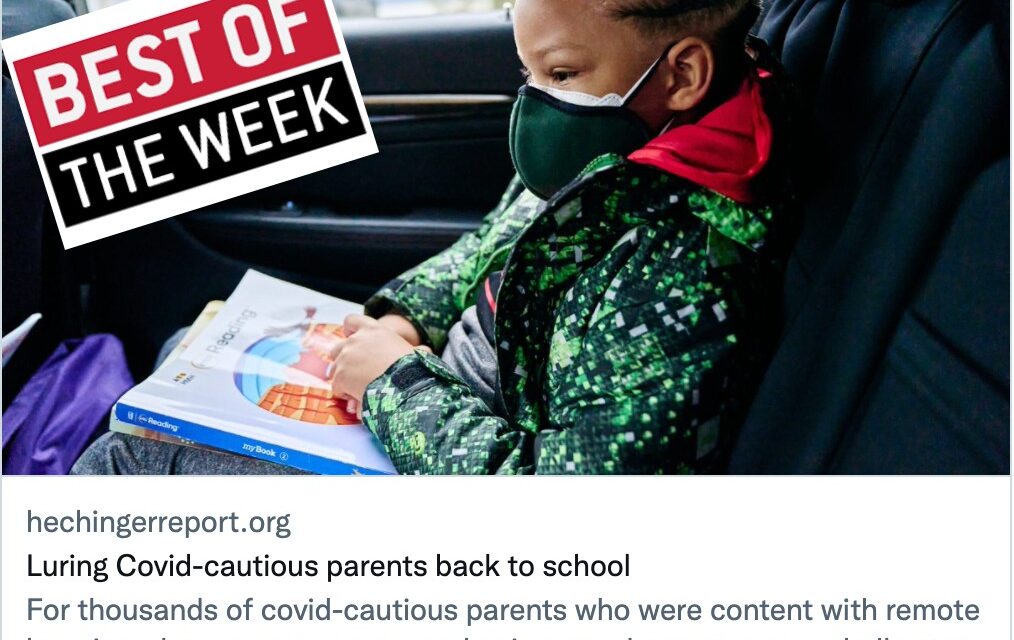
🔊 Districts face difficulty luring covid-cautious parents back to school (Hechinger/Washington Post)*
🔊 Here’s What We Know About the More Than a Million Students Who ‘Never Showed Up’ Last School Year. (EdWeek)
🔊 Understaffing leaves after-school programs with unmet demand (AP)
🔊 Fighting chronic absences in Richmond schools (WRIC)
🔊 Schools Tackle Pandemic Academic Plunge (New Haven Indy)
Other big news: Senate consideration of Supreme Court nominee Ketanji Brown Jackson generated coverage of her educational path (NYT) and debate surrounding teaching about racial inequality in private progressive schools like Georgetown Day (Washington Post, NYT, The New Republic). Teacher strikes have popped up in Minneapolis (with the union and district reaching a deal just this morning) and Sacramento (AP, Minneapolis Star-Tribune, MinnPost, Sacramento Bee, Sahan Journal). Debates over controversial books remain a concern (ProPublica, Washington Post).
*Also our best of the week.

INSIDE BURBIO
New commentary from The Grade
Nearly everybody in journalism has been using Burbio for its weekly school closing and masking data, but few know the history of the company or how it’s grown into a Biden-era data behemoth with a $600,000 CDC contract.
In this week’s new column, health and data journalist Betsy Ladyzhets discovers how Burbio came to fill a data vacuum and raises important questions about how its numbers are generated and used by media outlets.
“Journalists, at minimum, should note that Burbio’s data reflect only a sampling of school districts that is skewed towards larger, urban schools,” writes Ladyzhets. “Every reference to Burbio should include a reminder of the data’s limitations and the government’s failure.”
Thanks to the Columbia Journalism Review’s Media Today, 50Can’s New Reality Roundup, and John Bailey’s COVID-19 Policy Roundup for mentioning our recent work. They’re all great newsletters — check them out!
RELUCTANT PARENTS & COLLEGE ALTERNATIVES
The best education journalism of the week, plus a runner-up and some bonus stories.
🏆 BEST: The best story of the week is Luring COVID-cautious parents back to school by Christina A. Samuels in the Hechinger Report and the Washington Post. In this parent-centered piece, Samuels reports on Prince George’s County’s K-6 virtual learning program that, until it ended in late January, was among the most robust in the nation. As many as 18% of the district’s students were enrolled at one time — and nearly that many students were still enrolled when the program ended earlier this year. Now, many parents — a majority of them Black or Latino — are reluctant to send their kids back to class. Samuels does a great job detailing parents’ concerns, contextualizing Prince George’s unusual experience, and weaving in insights from experts like Columbia’s Sonja Douglass Horsford (whose research deserves more media attention). I’d love to see more stories like this.
🏆 RUNNER-UP: This week’s runner-up is Guiding Young People Not to Colleges or Careers — But to Good Lives by Rebecca Koenig in EdSurge. With the support of the Higher Education Media Fellowship at the Institute for Citizens & Scholars, Koenig spent eight months reporting on alternative pathways to college and focused on how high school seniors view their trajectories. The result is a much more personal and revealing look than we usually get about this topic. Koenig explores the contradictions many prospective college students face: on the one hand they are told that college is necessary, but on the other they are told that it is too expensive and out of reach if they don’t have money or connections or stellar grades. The real strengths of this story are the voices of young people who describe how they are navigating the changing landscape and making decisions about their future. “People can’t tell me what they’re going to college for,” said one student. “But they put themselves in thousands and thousands and thousands of dollars of debt—that doesn’t sound like it makes any sense. That’s like buying a car and not knowing how to drive.”
BONUS:
🏆 Inside a Chicago high school’s year of uncertainty (Chalkbeat Chicago)
🏆 This school wasn’t built for the new climate reality. Yours may not be either (NPR)
🏆 ‘Broken system’ sends North Texas students with disabilities from classroom to courtroom (Fort Worth Star-Telegram)
🏆 CMS third-grade reading scores keep dropping, even after in-person classes return (WFAE NC)
REMEMBERING SIERRA
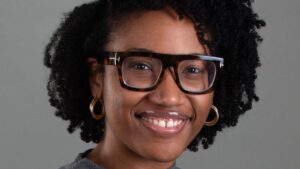
Above: Virginian-Pilot education reporter Sierra Jenkins, who was killed in a shooting March 19.
Tributes and condolences have poured in from those who knew and loved slain education reporter Sierra Jenkins, who covered schools for the Virginian-Pilot:
“I was her mentor and after one meeting with her, I walked away feeling rejuvenated. She was so enthusiastic and had such a drive for journalism and this beat I love. Devastating.” – Lori Higgins, Chalkbeat Detroit bureau chief
“She was everything you’d want in a colleague and reporter. And she had just started. There’s no telling what she could have done.” – Denise Watson, features editor for The Pilot and Daily Press and mentor to Jenkins
“This is a tragic loss of a blossoming reporter with a beautiful spirit who had already begun to make her mark in the industry.” – Dorothy Tucker, NABJ president
MEDIA TIDBITS
Thought-provoking commentary on the latest coverage.
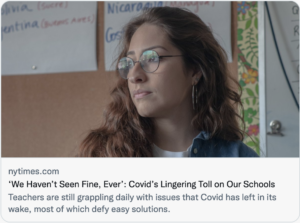
Above: Last weekend’s Chalkbeat/NYT “vibe shift” story.
📰 A MODEL STORY HIGHLIGHTS COMMON FLAWS: There are so many things to appreciate about ‘I Still Just Worry’: 3 Teachers on Covid’s Long Shadow Over American Schools, last weekend’s New York Times/Chalkbeat collaboration. But also several nagging problems.
Commemorating the second anniversary of COVID and schools, the piece does an excellent job capturing the uncertain, fragile moment some schools are in right now, and the insights of caring, experienced teachers. It features detailed observations from local and national Chalkbeat journalists on the ground combined with national distribution from the Times, and it manages to avoid repeating some of the most common and misleading narratives in education news (i.e., mass resignations). In many ways, it’s a model education story.
However, the piece also illustrates several larger problems in education journalism. It’s narrowly focused on the experiences and perspectives of classroom teachers. This reflexive reliance on teachers’ experiences really has to stop. Its three main locations — Denver, Tulsa, and Detroit — tell much the same story, creating a misleading narrative when so many other places (Providence, Miami, Houston) opened much earlier. And the piece attributes many of the current challenges schools are experiencing to the pandemic rather than to government officials’ decisions in response to the pandemic. The pandemic did not close so many schools for an extended period of time without creating options for especially vulnerable students; government officials did (and we allowed them).
📰 WHAT HAPPENED IN THE U.K. WILL LIKELY HAPPEN HERE: Two years after it was given the nation’s highest commendation, a British school serving an immigrant Pakistani population was roiled by an unsigned letter purporting to show that some of those behind the school’s astounding success were grooming kids to become radical Muslim extremists. Media coverage was massive. Multiple government investigations were launched. A handful of educators and advocates were removed, and creepy new anti-radicalization programs were created. But there was no conspiracy. The letter was a hoax, and the scandal was fueled by fears of Muslims, antipathy towards Pakistani immigrants who led the school’s resurgence, and reckless amplification of the story by the media.
We should all learn more about the so-called Trojan Horse Affair, which is now a New York Times and Serial Productions podcast. It’s a great (if horrifying) story, and it seems extremely likely that something similar will happen here if it hasn’t already.
Alas, given recent experiences with fear-based attacks on schools, the media’s aggregate impact will almost certainly be a corrosive one. Even now, after a massive investigation of the scandal, there’s been little self-reflection from U.K. officials or newsroom leaders. In the U.S., media coverage of anti-CRT protests frequently fails to debunk critiques or highlight parents’ high levels of satisfaction with schools. Like The Objective says, journalism is broken. Let’s re-imagine it.
Looking for media commentary and analysis all day, every day? Follow me at @alexanderrusso.
PEOPLE & JOBS
Who’s doing what, going where.
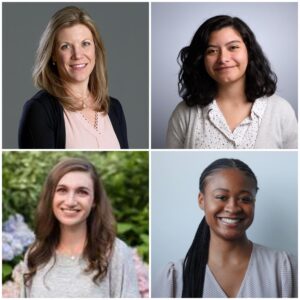
Above: Above, clockwise from top left: USA Today’s Erin Richards, the Austin American-Statesman’s María Méndez, El Paso Matters’ Jewél Jackson, and the New York Post’s Cayla Bamberger.
🔥 Comings & goings: USA Today is losing star education reporter Erin Richards after three years with the outlet. Richards is moving to CRPE to be its editorial director. “Having someone with her reporting chops was crucial to launching USA Today’s education team,” tweeted editor Chrissie Thompson. “And she has worked so collaboratively and supportively with me as her editor — truly a joy.” In other job moves, the Austin American-Statesman education reporter María Méndez is leaving to be a service and engagement reporter at the Texas Tribune., El Paso Matters higher ed reporter Jewél Jackson is heading to the Better Government Association in Chicago to be an education investigative reporter. Cayla Bamberger has left the Connecticut Post to report on education for the New York Post. And Indiana Public Broadcasting’s Jeanie Lindsay is headed to the Seattle Times as a new member of its education team.
🔥 Congrats: The Alabama Education Lab’s Ruth Serven Smith is one of 26 people selected for the 2022 cohort of The Online News Association’s Women’s Leadership Accelerator.
🔥 Job openings: USA Today is hiring a K-12 enterprise reporter to replace Erin Richards. The LA Times is hiring a higher education reporter. EWA is looking to hire a membership manager. The Oregonian is hiring an education reporter. Voice of San Diego is hiring an education reporter. EdSource is hiring an editor and an equity reporter. Chalkbeat Chicago is hiring a bureau chief. The Baltimore Banner is looking for education reporters to cover K-12 and higher education in Baltimore city, county, and beyond. The Arizona Republic is hiring a schools reporter to report on how K-12 issues are affecting kids, families, and teachers. The Boston Globe is hiring a higher education reporter. Politico California is hiring an education reporter.

EVENTS & DEADLINES
Above: The Institute for Citizens & Scholars has announced its latest group of Higher Education Media Fellows, who will write about alternatives to traditional four-year college degree programs. Congrats to all!
⏰ Fellowship opportunities: March 28 is the deadline for the return of the Hechinger Report’s local reporting grant. Winners will receive $3,000 to report an education feature story, preferably in a news desert. You have until April 5 to apply for EWA’s reporting fellowship, where you could get up to $10,000 to pursue a reporting project.
⏰ Events: NBC News’ Tyler Kingkade, the Charlotte Observer’s T. Keung Hui, and Education Week’s Eesha Pendrakar talked about covering efforts to limit teaching about racism for an EWA event yesterday. Coming Tuesday: Investigative journalists Hannah Dreier and Meribah Knight (among others) talk about their award-nominated work.
⏰ Changes: So long to the New York Times’ Amelia Nierenberg, who helped launch and grow the much-admired weekly Education Briefing newsletter over the past two years. Before Leonhardt, it was Nierenberg who took the lead giving NYT readers a calmer-than-average take on education news during an especially tumultuous time. It’s unclear whether the newsletter is going away completely or just transforming — or why Nierenberg is moving to other newsletters within the organization. We’ll let you know when we get some answers.
⏰ Resources: The Institute of Education Sciences’ Mark Schneider presents data about declining high school achievement that started before the pandemic. Reuters reports on a new study out of Italy showing that efficient ventilation in schools can cut COVID transmission by more than 80%. Nearly half of public school teachers had at least one “ghost” student who never showed up last year, according to a new GAO report (h/t Anya Kamenetz).
THE KICKER
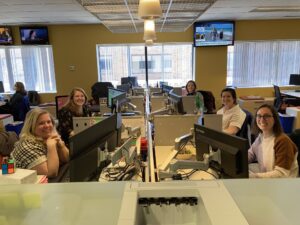
“Feels good to be back in the office!”
Star WBUR education reporter Carrie Jung (top right) is back to work alongside her colleagues.
That’s all, folks. Thanks for reading!
Reply to this email to send us questions, comments or tips. Know someone else who should be reading Best of the Week? Send them this link to sign up.
Using Feedly or FlipBoard or any other kind of news reader? You can subscribe to The Grade’s “feed” by plugging in this web address: http://www.kappanonline.org/category/the-grade/feed/.
Read more about The Grade here. You can read all the back issues of The Grade’s newsletter, Best of the Week, here.
By Alexander Russo with additional writing from Colleen Connolly.
ABOUT THE AUTHOR

The Grade
Launched in 2015, The Grade is a journalist-run effort to encourage high-quality coverage of K-12 education issues.