Practical advice for education reporters, complete with concrete examples including Nashville, Guilford, and Hartford, Connecticut’s high-quality spending plan.
By Karen Hawley Miles, Education Resource Strategies (ERS)
When Congress passed the American Rescue Plan last year, K-12 educators and school district leaders across the nation exhaled in a collective sigh of relief. Finally, they thought, they would have the resources they need to support teachers and students with their urgent recovery needs.
Indeed, school districts educating primarily students from low-income families will have an average of $3,750 more per pupil every year for the next three years — an annual budget increase of 20-35% — as their share of $122 billion in Elementary and Secondary School Emergency Relief funding.
Because of the unprecedented size, scale, and flexibility of these dollars, as well as the short timeline for spending them, communities are counting on journalists to help them evaluate and interpret the plans and actions of their local districts and schools, ensuring the significant challenges of the moment don’t stifle the progress they need and deserve.
To optimize the power of these dollars, especially as the continued struggles with Omicron have disrupted this year’s plans — districts need a coherent strategy for these additional resources that drive both equity and sustainability.
Communities are counting on journalists to help them evaluate and interpret the plans and actions of their local districts and schools, ensuring the significant challenges of the moment don’t stifle the progress they need and deserve.
The challenge of evaluating these plans, even for experienced researchers, is great.
Here, we offer five steps to help assess the quality of districts’ initial ESSER spending and strategy plans, along with district-specific examples (Guilford, Hartford, Nashville) that will help education reporters understand what they’re looking at:
-
Look for alignment, priorities, and specific metrics.
Ideally, ESSER plans will be tied to the goals and strategies already in the district’s strategic plan.
If the connection isn’t clear, reporters should look for evidence that the plan deepens or expands promising efforts already underway to accelerate learning and help all students reach higher learning goals, particularly those with the greatest needs.
District plans should be clear about the targeted learning outcomes. For example, we know that all students have greater learning and social-emotional needs this year, and this is especially true for students of color and those living in poverty, English Language Learners, and students with Individualized Education Plans. Some grade levels and subject areas, like high schools and early literacy, will need extra attention, too. ESSER plans should be explicit about how their investments target these needs.
-
Use expert sources to review and assess planned investments.
Strong plans will focus on research-based, high-impact strategies.
Reporters can turn to a variety of sources to review the evidence behind a particular strategy, including Johns Hopkins University’s Center for Research and Reform in Education, the U.S. Department of Education’s What Works Clearinghouse, and the Annenberg Institute at Brown University’s EdResearch for Recovery project as well as its National Student Support Accelerator on high-dosage tutoring.
Reporters can also compare ESSER plan components to five research-based power strategies we identified to accelerate recovery and redesign efforts.
Even then, the devil is in the details of design and implementation. The research highlighted here provides critical success factors and watch-outs for all of these strategies.
For instance, research shows tutoring can be an effective tactic for boosting student learning. Indeed, most district ESSER plans we have reviewed include some form of tutoring. But all tutoring isn’t equal. For example, research suggests that “high-dosage” tutoring is most effective: at least 30-60 minutes each day, three days a week for at least 10 weeks, in groups of 1-4 students. Keep an eye peeled for less-effective online tutoring, making tutoring optional, or offering only an hour a week.
Similarly, investing in strong curricular materials to help teachers re-engage students and master unfinished learning makes sense. But doing so without also investing in the time and support teachers need to learn the new curriculum likely means the materials will go unused.
We often find these kinds of incomplete investment strategies — a one-time purchase that doesn’t scaffold the innovation or new instructional offering with the additional spending, scheduling, and staffing changes required to implement it.
-
Map whether district plans target students who need help most.
While ESSER dollars can be applied universally across all students or schools, the amount of funding districts receive depends on the number of students they educate who come from low-income households.
In Guilford County Public Schools, for example, one of eight priority areas for ESSER investment is to recruit, retain, and reward highly effective staff, and the district has allocated more than 10% of its overall ESSER budget to that effort. Most of those dollars are headed to high-need subject areas and the district’s lowest performing schools.
In Metro Nashville Public Schools, 20% of their entire ESSER budget is being distributed to schools through the district’s student-based budgeting formula — paired with clear guidance on four categories of allowable uses for those dollars — to ensure additional dollars go to students who need the most help.
The ERS framework for resource equity includes 10 dimensions for unlocking better, more equitable school experiences for students that can also help reporters evaluate how district proposals and actions align to varying school and student needs across the system.
-
Identify how the district is preparing to bring proposed strategies to life.
It isn’t enough for a district to say what they want to do; they also need to share the road map for implementing those strategies in a doable way. That includes clearly defining the roles and responsibilities for both school and central-office staff, the schedule options that will enable implementation, and the support schools need — including changes to existing rules and practices — to bring the plans to life.
For example, many districts are rightly eager to invest in professional learning and collaboration for teachers. To do that well, schools need to be able to rework schedules and teaming structures to embed that professional development time within the school day and ensure it is led by experts like teacher-leaders or instructional coaches. Our elementary and secondary level guidebooks offer blueprints that reporters can use to compare their districts’ staffing and spending plans.
In addition, schools and districts need to measure whether they are implementing strategies as planned, as well as if — and how — they are working for students and teachers. For example, if a district is working to keep their best teachers in the classroom by creating opportunities for them to gain responsibility and earn higher compensation, are they reviewing turnover data to determine which teachers are leaving and why, as well as incorporating employee satisfaction survey results? The most successful ESSER plans will be those that are continuously improved upon and adjusted over time.
Many districts face significant hiring challenges. How are they getting creative about hiring and retention?
-
Does the plan address the end of federal funding?
Many allocations may be one-time investments such as those to address immediate health and safety concerns or exponential growth in student needs and staff supports, as well as temporarily increased expenses due to supply-chain challenges or labor shortages.
At the same time, districts will want to sustain many of the changes they’re funding with ESSER dollars because they pay for practices — such as tutoring or professional learning and collaboration — that were needed before the pandemic. Districts will need to use these temporary funds to target near-term recovery and lay the groundwork for longer-term redesign.
For short-term expenditures, look for evidence that those investments are scaled back effectively before ESSER funds run out. And for new practices to endure, look for evidence that districts are planning for ways to support longer-term redesign and implementation.
Above: Hartford plan. Go here for the full PDF.
Two examples of district plans show how all these steps work together: one with clear outlines in all five areas, and one without.
The leadership team at Hartford Public Schools recognized the importance of using ESSER funds to invest in sustainable strategies for their students and staff, knowing the short-term lifespan of the federal recovery funds. To achieve this, they created a plan with parent, teacher, and community input, identifying their recovery “must wins” to guide them toward high-impact uses of the federal funding.
Hartford outlined which staff positions they would need to hire, what professional development would be required, and the outside help they need to get it done. They clearly link proposed strategies to the research base supporting them as well as how they will target resources to the schools and students who need it most and address the challenge of having fewer expert teachers and more new teachers in the schools with the greatest learning needs.
Finally, the Hartford team identified which spending would be short term and hopefully decline, which spending was aimed at building new understandings or approaches that would also decline, and other spending that they would strive to maintain by shifting resources from other areas of their budget. In the district’s document, we outline additional guiding questions and comments to illuminate these connections.
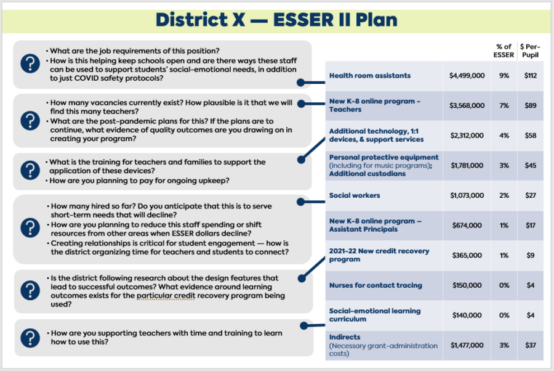
The level of detail found in Hartford’s publicly available documents, however, is not typical. Many district ESSER plans we have reviewed look more like this anonymized example (ESSER II, ESSER III, making it difficult to identify the district’s vision and goals for its efforts. In cases like these, there often is little indication of how investments are being prioritized to support the highest-need students and schools. Where such information is less transparent, we offer a list of questions in the example to guide a reporter’s thinking and follow-up as they dig for more details about the district’s plan.
The level of detail found in Hartford’s publicly available documents, however, is not typical. Many district ESSER plans we have reviewed look more like this anonymized example, making it difficult to identify the district’s vision and goals for its efforts.
Certainly, some districts will launch their efforts with strong plans aligned to their strategic vision that choose some doable starting points for the 2021-22 school year, designed with a longer-term strategy in mind. Others will choose to simply spend the money quickly or equally, rather than equitably, across their system.
Families and communities are counting on journalists to ask the right questions about districts’ decisions and put those decisions in context — offering examples of strategies and solutions that are being or could be employed on behalf of the young people their schools serve.
Done right, ongoing coverage of these district and school efforts can help underscore the need to focus on equity and sustainability, shine a light on what’s working and what isn’t, inspire communities to engage in their schools’ efforts, and ultimately make a real difference for educators and students alike.
Karen Hawley Miles is president and CEO of Education Resource Strategies, a national nonprofit that helps schools and school systems use resources strategically to drive greater opportunities and outcomes for all students they serve. You can find follow ERS on Twitter at @ERStrategies.
Related from The Grade
The scarcity mindset that plagues education news
Smart ways to cover the coming ‘year of ed finance’
ABOUT THE AUTHOR

The Grade
Launched in 2015, The Grade is a journalist-run effort to encourage high-quality coverage of K-12 education issues.