In this week’s newsletter: Voters ousted three school board members in San Francisco. Some schools are going mask-optional now that state mandates are winding down. A new report finds a mismatch between the information parents want and the news that’s being produced. A slew of education journalists are scheduled to appear at SXSW EDU next month.
SCHOOL BOARD RECALL, LOCAL MASK DECISIONS
The big story of the week, according to us:
The big story of the week is Tuesday’s landslide recall of three San Francisco school board members. Unlike other recent school board controversies, this recall effort was fueled by Democratic voters concerned about school closings, school renaming efforts, and admissions changes at a popular high school. School board recall efforts and challenges are on the rise, according to Ballotpedia, though most fall along partisan lines (and usually fall short):
🔊 San Francisco voters recall three school board members (NPR)
🔊 San Francisco votes on city’s scandal-plagued school board (AP News)
🔊 COVID frustrations get San Francisco test: The Note (ABC News)
🔊 Parental fury propels San Francisco school board ouster (POLITICO)
🔊 In Landslide, San Francisco Forces Out 3 Board of Education Members (New York Times)
🔊 Collins, López and Moliga Recalled (KQED)
🔊 Recall puts Mayor London Breed under huge pressure (SF Chronicle)
🔊 Recall Started With a Year-Plus of Virtual Learning (Wall Street Journal)
District masking decisions: Another big story of the week has been the wave of district decisions to stay with mask mandates or go mask-optional, given new freedom. Some examples of the coverage we saw feature Illinois, Washington State, Anne Arundel County (Maryland), Miami-Dade, Atlanta, Boston, Wayne County (Michigan), Camden (New Jersey), Philadelphia, California, Wisconsin, Connecticut, Oregon, Colorado, Detroit, Sacramento, and San Diego.
For more on school board coverage, see MEDIA TIDBITS.

TRANS YOUTH BIAS
& SCHOOL FOIA FANS
New commentary from The Grade
Above: The Atlantic’s cover story about trans youth is featured in this week’s column.
“Media stories about trans people and gender identity often advance misleading and biased narratives,” writes Noah Berlatsky in a new examination of high-profile coverage of trans youth. “One narrative that is reiterated again and again is the idea that social contagion is a key reason why youth question their gender identities,” writes Berlatsky, who provides concrete suggestions for journalists covering trans youth.
Also: It used to be that FOIA was something journalists and investigators used. But lately, parents, academics, and advocates have started using FOIA — handing their findings off to reporters or publishing them on their own. Contributor Greg Toppo interviewed one researcher about her use of FOIA to unearth information about a controversial hotline in Virginia. NB: School FOIA fans are not all conservative-leaning, seeking to fuel culture clashes.
MASK-OPTIONAL & STUDENT VACCINES
The best education journalism of the week, plus a runner-up and some bonus stories.
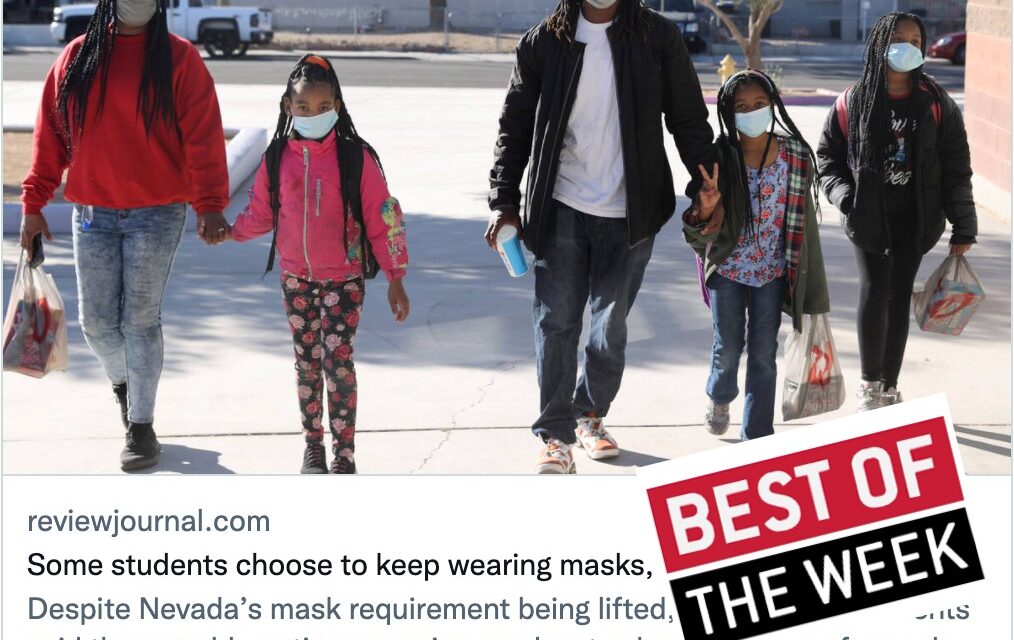
🏆 BEST: The best story of the week is Some students choose to keep wearing masks, others happily put them away by Glenn Puit and Sabrina Schnur in the Las Vegas Review-Journal. I like this story because it gives readers a preview of what mask-optional is going to look like as more state mandates are lifted and individual districts and schools have to decide what to do. Puit and Schnur talked to parents and students at different schools — all with different viewpoints. A pair of high school students said they are used to wearing masks by now and will continue to do so for safety. Meanwhile, a parent walking her son to his elementary school cheered the decision, saying, “no more muzzles.” And a principal warned students not to bully others over their mask choices. This is a story we’ll see more of in coming weeks.
🏆 RUNNER-UP: This week’s runner-up is Bay Area schools in an uphill battle over student COVID shots among Black, Latino families by Kayla Jimenez and Harriet Blair Rowan in the Mercury News. Jimenez and Rowan report that vaccination rates for Black students range from 47-63% and from 49-80% for Latino students. The rates for white students are between 64-80%, and for Asian students it’s above 85%. Attempts to boost those rates have so far been largely unsuccessful, and if nothing changes, thousands of students may not be able to go to school in the fall. Schools could choose to ignore the statewide vaccine mandate, but they may lose out on crucial state funding if they do so. The Mercury News was one of the first to point out the racial inequities that could arise from California’s school vaccine mandate, and this story is an important follow-up.
BONUS STORIES:
🏆 700 Days Since Lockdown (The 74)
🏆 Broward schools took extraordinary steps to hide data breach details (Sun Sentinel)
🏆 In WA, at least 29,000 students can’t be found. (Seattle Times)
🏆 Students need help catching up. Tennessee tries tutoring. (Christian Science Monitor)
🏆 3 not-quite-true claims about the pandemic and schools (Chalkbeat)
🏆 They failed her daughter. Now she wants them to pay for private school (Richmond WTVR)
🏆 District disputes lead-contaiminated water findings (Philly Inquirer)
🏆 Pandemic Continues to Push Young Readers Off Track, New Data Shows (The 74)
🏆 How two Black parents took action (Dallas Morning News)
🏆 What California Can Learn From A Tennessee Pre-K Program That Failed Kids (LAist)
🏆 Four years after Parkland, gunfire on school grounds reaches troubling new peaks (USA Today)
MEDIA TIDBITS
Thought-provoking commentary on the latest coverage.
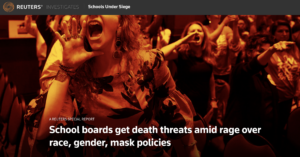
Above: The artwork accompanying Reuters’ disturbing investigation into threats against school board members.
📰 CONFLICTED OVER SCHOOL BOARD THREAT COVERAGE: I am conflicted by Reuters’ new investigation, School boards get death threats amid rage over race, gender, mask policies. I admire the attempt to report and quantify the extent of the threats and present them in all their awfulness. But at the same time, I’m concerned about the heightened language that’s used and the possible over-amplification of 220 events out of a national school system of 100,000 schools. However, some journalists disagree. “Are most protesting parents sending threatening notes? Hurling slurs? Not even close,” tweeted NBC News’ Mike Hixenbaugh. “But that doesn’t mean board members aren’t being inundated with this stuff. It’s happening, and it’s noteworthy.” I just wish that more stories gave readers numerical and historical context — and resisted the temptation to emphasize the most frightening incidents in ways that make them seem ubiquitous. You can raise the alarm without overstating the situation.
📰 FIXING THE MISMATCH BETWEEN PARENTS AND EDUCATION NEWS: Good news. A new study, Keeping up with the ed beat, shows that parents love and value information about schools. The bad news? They say that news coverage is too negative and it doesn’t include enough of the kinds of information that they really want. Those parents who are able to do so are bypassing newsroom-produced coverage to get school information elsewhere. Nieman Lab’s Laura Hazard Owen tweeted that she came away from an interview with one of the authors of the new study thinking journalists have to “get stuff out of the listservs… & into people’s hands.”
Of course, these findings are familiar ones. Dartmouth economist Bruce Sacerdote and others found a strong bias towards negative news during the pandemic. Former journalist and parent John Zhu described parents’ desperation for useful key information in North Carolina. White parents’ use of informal news (i.e., the whisper network) is a phenomenon that parent and author Courtney Martin described in a recent interview with The Grade. Changing journalistic practice towards more useful education news for parents requires confronting entrenched habits and newsroom traditions. So far, these changes have proven elusive. Education news is not the way it is by accident. It won’t change just because it should.
📰 CONTEXT AROUND BOOK BANS & CURRICULUM REWRITES: Kudos to the handful of journalists who are reporting on book bans and the chilling effects on classroom lessons while still giving readers a sense of the thus-far limited impact of the problem. It’s a difficult balancing act to pull off. “So far, [educators] have not triggered wholesale rewrites of the curriculum,” notes a key sentence in a recent Washington Post story. “Few educators have faced prosecution or punishment. Some teachers say they see no changes at all.” According to NPR’s Anya Kamenetz, “this is what we’ve found in our reporting.” Again, it’s good to find and report on the concrete incidents that are taking place, and their real-world effects. But focusing too much on emotions, stringing dramatic anecdotes together, and speculating about possible future effects — all to create a “nationwide” story — is unhelpful. The facts are dramatic enough on their own.
📰 NEWS OUTLETS INVESTIGATING THEMSELVES: The Philadelphia Inquirer published part one of a big series looking at the paper’s role in perpetuating inequality in the city. The first part focuses on newspaper culture, but subsequent chapters will look at coverage. I’ve reached out to journalist Wesley Lowery to see if education coverage will be one of the focuses. Meantime, the Baltimore Sun just issued an apology featuring its editorials about school integration. Check out this piece by Kansas City Star education reporter Mara Rose Williams investigating her paper’s education coverage of the past. And look forward to Justin Murphy’s forthcoming column about Rochester, New York-area papers’ coverage of school integration efforts.
Looking for media commentary and analysis all day, every day? Follow me at @alexanderrusso.

PEOPLE, JOBS, KUDOS
Above, from left to right: The Washington Post’s Perry Stein, the Hartford Courant’s Seamus McAvoy, and Chalkbeat Chicago’s Cassie Walker Burke.
🔥 Job moves: The Washington Post’s DC education reporter Perry Stein is back on the beat after a few months away on special assignment. What’d she miss? Belated congrats to Seamus McAvoy, the Hartford Courant’s new education reporter, who started last month. After nearly four years as Chalkbeat Chicago’s founding bureau chief, Cassie Walker Burke is stepping down to help carve out a new role on the digital desk at WBEZ Chicago public radio. Congrats! Meantime, the Richmond Times-Dispatch is apparently not going to replace Kenya Hunter covering K-12 education, despite the obvious need for a dedicated beat reporter. Boo!
🔥 Awards and impact: The 74 freelancer Bekah McNeel and others took home a silver medal in the Anthem Awards (for purpose and mission-driven work) for their coverage last year of the second pandemic of student mental health. Voice of San Diego education reporter Will Huntsberry and others won a First Amendment Coalition 2021 Free Speech and Open Government Award for their work covering the pandemic. And The 74’s Asher Lehrer-Small’s story last year on a Rhode Island initiative boosting teacher diversity by elevating paraprofessionals inspired a change in Maryland, which he says is now using COVID relief money to establish similar programs. Congrats to all!
🔥 Job openings: The Post and Courier in Charleston, South Carolina, is hiring a daily news reporter for their Ed Lab. The Oregonian is hiring an education reporter to replace Eder Campuzano. The Boston Globe is hiring a higher education reporter, as well as a data journalist and a digital producer for their Great Divide team. EdWeek is hiring a staff writer to cover technology, learning environments, and student well-being, as well as an assistant managing editor. Inside Higher Ed is hiring a higher education reporter. Idaho Education News is hiring a journalist. The Baltimore Sun has an opening for an education reporter. The Seattle Times is looking for an Ed Lab reporter. Politico California is hiring an education reporter. Go get those jobs!
🔥 Let’s hear it for the interns: GBH Boston K-12 reporting intern Olivia Marble had her first byline, with education reporter Meg Woolhouse, looking into equity in allowing quarantining students to livestream their classes. Give her a follow!
EVENTS & APPEARANCES
⏰ Media appearances: Colorado Public Radio’s Jenny Brundin reports on a school board controversy in Colorado’s third-largest school district involving calls to fire the superintendent, a teacher walkout, and a student walkout. Mississippi Today’s Molly Minta was on EWA Radio talking about her story following a skeptical law student who tries out a CRT course and shares what she learned. Chalkbeat NY editor Amy Zimmer was scheduled to appear on WBAI 99.5 FM along with NYC chancellor David Banks.
⏰ Education-related segments: The latest edition of FiveThirtyEight’s COVID Convos series is all about whether it’s safe to lift school mask mandates, featuring a conversation with emergency physician and dean of the School of Public Health at Brown University Megan Ranney. WBUR On Point also had a segment on school masking, asking is it time to end it?
⏰ Resources: As NPR’s Cory Turner reports, the U.S. Department of Education has updated its College Scorecard, meant to help students choose the best school for them. Maybe higher ed reporters can find some helpful stuff in there too. With mask policies in flux across the country, Burbio is tracking which states are doing what.
⏰ Upcoming: EdWeek’s Daarel Burnette will discuss CRT media coverage on March 7 at SXSW EDU. Hechinger Report editor-in-chief Liz Willen will moderate a March 8 panel on whether college is always the best pathway for students. NBC News’ Antonia Hylton and Mike Hixenbaugh, the folks behind the Southlake podcast, will also appear on a March 8 panel about culture wars and schools. And The 74 is teaming up with USC’s journalism school to train new education journalists.
THE KICKER
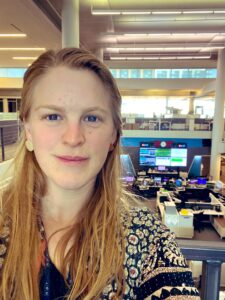
Above: NPR higher education reporter Elissa Nadworny is back in the newsroom co-hosting All Things Considered over the past few days, in case you hadn’t noticed — and doing a great job.
That’s all, folks. Thanks for reading!
Reply to this email to send us questions, comments or tips. Know someone else who should be reading Best of the Week? Send them this link to sign up.
Using Feedly or FlipBoard or any other kind of news reader? You can subscribe to The Grade’s “feed” by plugging in this web address: http://www.kappanonline.org/category/the-grade/feed/.
Read more about The Grade here. You can read all the back issues of The Grade’s newsletter, Best of the Week, here.
By Alexander Russo with additional writing from Colleen Connolly.
ABOUT THE AUTHOR
Alexander Russo
Alexander Russo is founder and editor of The Grade, an award-winning effort to help improve media coverage of education issues. He’s also a Spencer Education Journalism Fellowship winner and a book author. You can reach him at @alexanderrusso.
Visit their website at: https://the-grade.org/