In this week’s newsletter: Districts get creative to keep kids in schools. Reporters share safety tips for in-school reporting. And one reporter on deadline tries to resist her children’s robot distractions.
OPEN DURING OMICRON
The big story of the week, according to us:
The big story of the week is the trend towards education systems rethinking testing, quarantine, substitute teaching, and other requirements in order to remain open through Omicron — with varying degrees of success. A small number have shut down, but the vast majority are staying open:
🔊 School Closures Drop for the First Time This Year (US News)
🔊 Amid COVID surge, these schools have stayed open (USA Today)
🔊 Schools May Be Open—But They’re Struggling (Wall Street Journal)
🔊 Public health experts say schools are safe – but districts struggle to convince parents and teachers (The Guardian)
🔊 States easing substitute teaching requirements to soften shortage impacts (K12 Dive)
🔊 Santa Cruz schools to assume all students have been exposed to COVID (Mercury News)
🔊 Illinois schools could see fewer student quarantines (Chicago Tribune)
🔊 California school districts improve pay, working conditions to ease teacher shortage (EdSource)
🔊 Utah legislative leaders & gov. will now sign off on school closings (Salt Lake Tribune)
🔊 Unvaccinated students in some Mass. schools can go maskless (State House News Service)
🔊 Fulton County Schools making masks optional starting Monday (WSBTV)
🔊 Testing Shortages at Oakland Schools Leave Students and Teachers Frustrated (KQED)
🔊 LA High Schoolers Can Earn Money Tutoring Younger Siblings (LAist)
ENGLISH LEARNERS & HOMESCHOOLERS
The best education journalism of the week, plus a runner-up and some bonus stories.
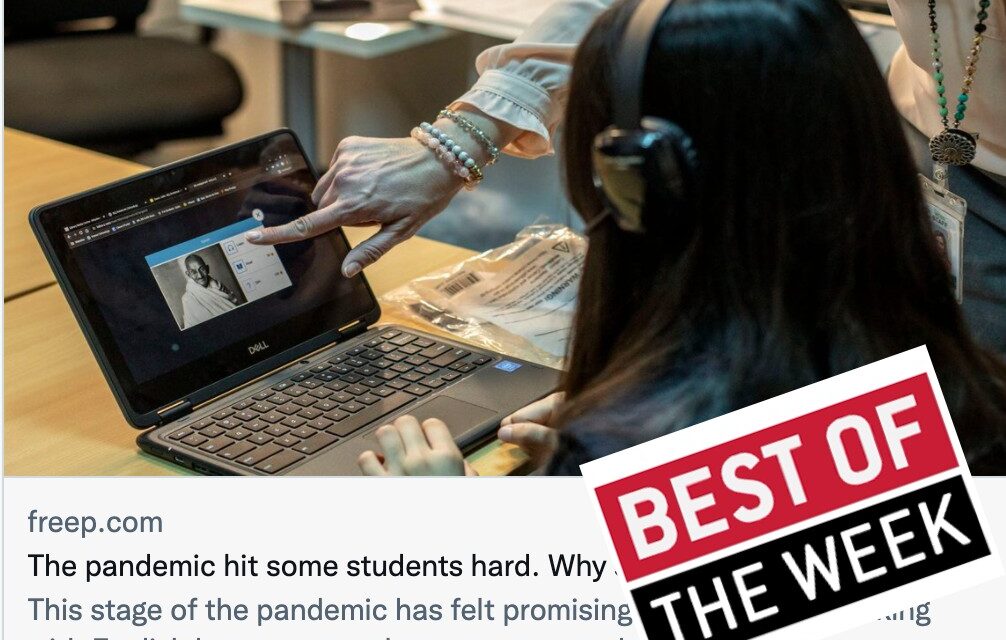
🏆 BEST: The best story of the week is Lily Altavena’s The pandemic hit some students hard. Why some teachers are hopeful for English learners in the Detroit Free Press. Despite all of the setbacks wrought by the pandemic, this particularly vulnerable group of students hasn’t fallen as far behind as many experts believed they would. For this story, Altavena spent time in the classroom — and it shows. She watches English language learners learn about Gandhi and Martin Luther King Jr. and learn the word “unfair.” Many of them seem to be doing quite well. It’s easy for reporters to fall into stereotypes about English learners and focus too much on surface-level metrics, rather than progress. This story does a great job combating stereotypes and oversimplification, and focuses on student achievement and teachers’ efforts to intervene and catch kids up. “Great story,” tweeted The Grade contributor Barbara Gottschalk, who knows a thing or two about English learners.
🏆 RUNNER-UP: This week’s runner-up is The pandemic pushed more families to home-school. Many are sticking with it by Laura Newberry in the LA Times. Nationally, homeschooling rose from 5.4% of families in spring 2020 to 11.1% in fall 2021. The story is similar in California, where the number of families who filed for private home schools with the state more than doubled between the 2018-19 and 2020-21. For this story, Newberry interviewed 10 families in Southern California about why they left traditional schools for homeschooling. Though these parents all made the same decision, their reasoning was vastly different. Some thought COVID measures were too strict, others too loose. Some turned away as debates about critical race theory raged. Others said their kids were not thriving in virtual learning. The thing that united them all? “An overall waning faith in the public school system,” Newberry writes.
BONUS STORIES:
🏆 Parents can be silenced in special education settlements. A proposed bill would change that (WFYI Indiana)
🏆 San Francisco is changing its school assignment system. (SF Chronicle)
🏆 Graduation rates dip across U.S. as pandemic stalls progress (Chalkbeat/AP)
🏆 Report: Climate disasters have a devastating effect on US students (Grist)
🏆 A state-funded pre-K program led to ‘significantly negative effects’ for kids (Hechinger)
🏆 Upcoming elections are a chance to end the CPS-CTU rhetoric (Chicago Sun-Times)
🏆 Q&A With ‘Abbott Elementary’ Star Quinta Brunson (EdWeek)
REPORTING SAFELY IN SCHOOL
New commentary from The Grade
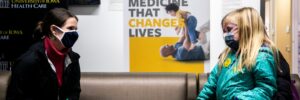
Above: Des Moines Register/Iowa City Press-Citizen reporter Cleo Krejci interviewing a student.
Reporters want and need to get back inside schools to see for themselves what’s going on. More and more are doing it.
In this week’s story, more than a dozen reporters share what they do to stay safe when reporting in schools and board meetings. Their safety practices and experiences are eye-opening. For example:
“Sometimes, I feel like it’s harder for me to build trust with people when I’m wearing a mask, especially if I’m one of the only people in a room wearing one. Still, I’ve made a conscious decision to avoid putting myself at risk.” – Anna Lynn Winfrey (Montrose Press)
“If there was a direct contact exposure, staff and students will be informed, but they may not remember to notify the journalist that popped in for an interview for 30 minutes.” – Sawsan Morrar (Sacramento Bee)
Thanks to all the journalists who shared what they’re doing — and to the Columbia Journalism Review for including the roundup in yesterday’s On The Media newsletter.
MEDIA TIDBITS
Thought-provoking commentary on the latest coverage.
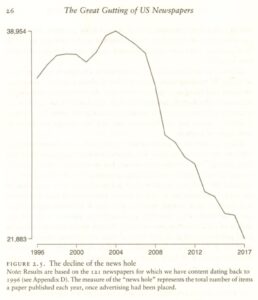
Above: “One out of every three stories written about school boards in 2003 had disappeared by 2017,” according to a thread by Report for America cofounder Steven Waldman. “Among those with less than 15,000 circulation, the average reduction in schools coverage was 56%.”
📰 BEWARE FALSE DICHOTOMIES: In a CJR newsletter this week, Jon Allsop talks about false dichotomies presented in the media, including pro-parent/pro-teacher dichotomies in school closures stories. “Media narratives around school closures, particularly in Chicago, have sometimes ossified into dichotomies — pro-opening schools versus pro-closing them; pro-parent versus pro-teacher — that are clearly oversimplified.” The danger of false dichotomies also comes up in other places, including this new survey from Axios. Respondents were given the choice of “health and safety over in-person learning.” The two are not mutually exclusive. Most people are likely concerned about both learning and safety. I’m guilty of this myself. We can all do better.
📰 MORE INFORMATION, LESS FEELINGS: “Parents of school-aged children need more help than they do stories about how stressed they are,” tweeted journalist Amy Kovac-Ashley in a thread about a recent KPCC LA story about what to do if your kids are sick and you need to stay home from work. Stories about parents being stressed are compelling, Kovac-Ashley argues, but they’re not necessary and don’t provide useful information that readers can use. A good reminder for everyone covering education, I’d argue. Looking for another example? AL.com posted this story about how to become a substitute teacher.
📰 STUDENT-REPORTED STORIES: We saw a bunch of stories “reported” from inside schools relying on student accounts — an effective strategy if you absolutely can’t get inside the school yourself but want to give readers a more detailed, real-world sense of what’s happening. Some examples: Teens share what school looks like during omicron (USA Today), Thousands of Contra Costa Students Stay Home, Citing Omicron Fears (KQED), and How It Feels to Be an Asian Student in an Elite Public School (New York Times).
“I really wanted a ‘pure’ take,” the Globe’s Jenna Russell told us about her story For students in surge, a ‘new normal’ and plenty of worries. The story would have been different if she’d been there, according to Russell. “All those telling little interactions she has along the way with friends and classmates probably wouldn’t have happened if I’d been there listening in with my notebook in hand.” However, Russell notes that she had to pick the student carefully and vetted the student’s account with school officials.
📰 THE RETURN OF THE ASSOCIATED PRESS: On Tuesday the AP announced a new $1 million effort to increase the number of dedicated education journalists from four to seven and to ramp up coordination of efforts with local newsrooms. Read all about it in Axios and Poynter. Also, read the AP announcement and check out the description in the Carnegie Corporation of NY’s database. The AP’s education coverage has been hit or miss in recent years, and its current offerings are a mixed bag. Crossed fingers that the additional resources and staff will make it the invaluable resource that it has been in the past (and that is even more needed now). I’m hoping to interview some of the people behind this initiative and will report back what I learn.
PEOPLE, JOBS, EVENTS
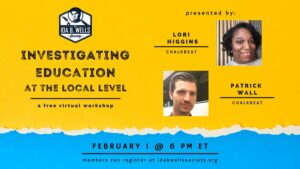
Above: Chalkbeat’s Lori Higgins and Patrick Wall are featured in the upcoming Ida B. Wells Society webinar on covering education on Feb. 1.
🔥 Appearances: The 74’s Beth Hawkins participated in an event with Education Reform Now about what next fall’s recovery will look like and what states are doing about it. The Chicago Tribune’s Tracy Swartz was on CJR’s podcast The Kicker talking about covering Chicago education and why politicians fight back when teachers want to feel safe. The LA Times’ Melissa Gomez was on the paper’s in-house podcast talking about her reporting on kids’ experiences of COVID and school. Watch KPCC LA’s Kyle Stokes talk about PTA fundraising and inequality in Los Angeles on a recent webinar.
🔥 Job openings: EdWeek is hiring a staff writer to cover technology, learning environments, and student well-being, as well as an assistant managing editor. The Baltimore Sun has an opening for an education reporter. The Seattle Times is still looking for an Ed Lab reporter. The Boston Globe is hiring a data journalist and a digital producer for their Great Divide team. Politico California is hiring an education reporter. And WBEZ Chicago is hiring an education reporter. So many staff jobs out there!
🔥 Resources: Find out what different states are doing to help families and students catch up after months of pandemic learning. The EduRecoveryHub provides resources, commentary, and news on states’ education recovery. Also, check out Burbio’s latest data, which shows that the number of schools that went virtual or closed for at least a day last week dropped 38%. Lastly, take a look at this polling brief from the PIE Network showing parents’ views on race and education. Last but not least, Bethesda Beat’s Caitlynn Peetz is starting a newsletter on Montgomery County education news, featuring “weekly deep-dives, analysis, and insights.” You can sign up here. We can’t wait to read it!
🔥 Congrats to former education journalist S. Mitra Kalita and the other co-founders of URL Media, which turned one year old this week! The company works to uplift and financially support the work of community-driven journalism, including outlets like the Sahan Journal, Documented, and the Hatian Times. Belated congrats also to former Chalkbeat and Philadelphia Schools Notebook reporter Fabiola Cineas, who’s been covering race for Vox since last summer.
🔥 Shoutouts: Chalkbeat received a nice mention on the PBS NewsHour for its coverage of high school graduation rates. NPR correspondent Anya Kamenetz has a piece in the Washington Post about the effects of the Omicron surge on caregivers, paid and otherwise.
🔥 New follows: Some are beat reporters, others just occasional ed reporters, but they’re all on my list of new follows: Anna Lynn Winfrey (Montrose Press), Lauren Kaori Gurley (Motherboard/VICE), Hannah Dellinger (Houston Chronicle), Anya Steinberg (NPR), Jimena Tavel (Miami Herald), Hazel Shearing (BBC News), Rosa Ellis (Times Higher Education), Lauren Deppen (Business First Louisville), Emma Folts and Oliver Morrison (Public Source PA), and Michael Lee (Columbus Dispatch). Who’s missing?
THE KICKER

Someone rescue the Philly Inquirer’s Kristen Graham! “Going on two years out of the newsroom and missing it badly today,” she tweeted. She’s trying to get work done but “my children keep sending a farting robot into the room where I’m working. Send help.”
That’s all, folks. Thanks for reading!
Reply to this email to send us questions, comments or tips. Know someone else who should be reading Best of the Week? Send them this link to sign up.
Using Feedly or FlipBoard or any other kind of news reader? You can subscribe to The Grade’s “feed” by plugging in this web address: http://www.kappanonline.org/category/the-grade/feed/.
Read more about The Grade here. You can read all the back issues of The Grade’s newsletter, Best of the Week, here.
By Alexander Russo with additional writing from Colleen Connolly.
ABOUT THE AUTHOR

Alexander Russo
Alexander Russo is founder and editor of The Grade, an award-winning effort to help improve media coverage of education issues. He’s also a Spencer Education Journalism Fellowship winner and a book author. You can reach him at @alexanderrusso.
Visit their website at: https://the-grade.org/