Substitute teaching has played an increasingly important role during the pandemic, which makes accurate and insightful coverage all the more critical.
By Amanda von Moos & Jessie Weiser, Substantial Classrooms
By the time they graduate high school, the average U.S. student will have spent a full year of their education with substitute teachers, as Emma Brown described in her 2015 Washington Post article. For students in high-poverty schools, it’s even higher.
That means that substitute teaching isn’t just an “every once in a while” thing; it’s an integral part of how education happens in our public schools. But it’s rarely treated that way, and it rarely gets the attention or investment it deserves.
This year, with increasing teacher vacancies and quarantine requirements, schools need substitutes to cover even more absences. However, coverage rates — the percentage of teacher vacancies and absences that are covered by substitute teachers — are down dramatically in most places.
As the shortage of people willing to substitute teach has reached a crisis point, we’ve seen more reporting on substitute teaching by local and national writers. As leaders of Substantial Classrooms, a national nonprofit focused on innovation in substitute teaching, we’re glad this topic is finally in the spotlight.
However, very few of the articles about substitute teachers capture a sense of possibility rather than despair. Too often they focus on simply explaining a short-term problem, instead of featuring innovative solutions. As a result, we are seeing basically the same story over and over.
In an effort to inspire more coverage that offers hope and drives change, we’ll highlight three things that most reporting is getting right, followed by four things that most coverage overlooks, among them the relationship between substitutes and equity.
We’ve seen more reporting on substitute teaching by local and national writers. However, very few of the articles capture a sense of possibility rather than despair.
First, areas that most coverage we see gets right:
- When substitute teaching isn’t working, it’s extremely disruptive to students and staff.
Reporters often paint a realistic — and jarring — picture of what happens in schools when teachers are out and substitute teachers aren’t available. Sometimes teachers, administrators, or district staff step in, sometimes classes are combined, and sometimes schools must close until they have enough staff.
Peiyu Lin of the Kitsap Sun effectively captured one scenario in Washington State: “Principal Josh Emmons truly enjoys teaching … But he doesn’t like dropping his principal duties and stepping into a classroom in a rush because there are no substitute teachers available.”
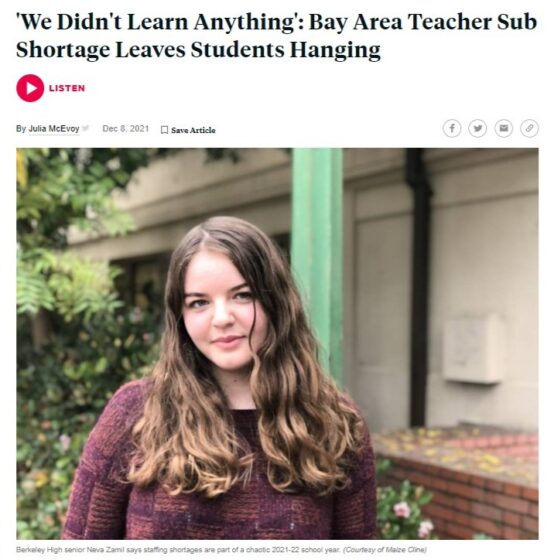
The ripple effects of patchwork solutions spread far beyond a single classroom. For her piece about Bay Area schools, Julia McEvoy of KQED spoke with students, counselors, office managers, teachers, and parents, all of whom are asked to adjust or contribute when subs aren’t available. In short, when substitute teachers are difficult to find day after day — as they are right now — it can be chaotic and destabilizing for the entire school community.
- The job market has changed.
“The staffing shortage has become a defining feature of this school year,” Matt Barnum declares in his excellent Chalkbeat article about the current crisis. As many reporters have explained, with the expansion of the gig economy and the abundant availability of jobs, it has become harder to attract people to substitute teaching.
The original gig workers, subs have flexibility and autonomy, but they’re underpaid and under-supported. These days, people who want to set their own schedules have a lot more options — many with lower risks and higher rewards.
- The shortage of subs is related to the shortage of teachers.
In addition to a decreasing number of subs, there is an increasing number of teacher vacancies that need to be filled.
Many teachers cite burnout as a primary reason for leaving the profession. The sources of this exhaustion are many, but a major contributor is the dearth of substitute teachers. As reporter Keminni Amanor explained in her KXNews piece about the crisis in North Dakota, “When subs are not found immediately, teachers are forced to stretch themselves thin including using their break times for school work.”
It’s cyclical — teachers who are asked to work far beyond their capacity often start to look for new opportunities, contributing to the need for more subs.
We are seeing basically the same story over and over.
For all that reporters are getting right, many articles overlook key dynamics and realities of substitute teaching. Here’s what reporters often miss:
- Coverage rates were low even before the pandemic arrived.
A reporter recently asked us, “When will things get back to normal?” This reflects a troubling yet common misconception that the pandemic is the primary cause of the substitute teaching crisis.
The pandemic has certainly exacerbated the problem, but the legacy system for substitute teaching hasn’t worked for a long time.
Pre-pandemic, national coverage rates were only about 80 percent, on average. That means a LOT of schools have been scrambling to find coverage — and using patchwork solutions — for years.
Anecdotally, coverage rates have dropped by 20-30 percent this year for most districts, so the problem is certainly worse. But getting back to the status quo cannot be the goal.
- Inadequate supply of substitute teachers is an equity issue.
Reporting frequently discusses the substitute teaching crisis as if it affects all schools, and all students, in the same way. Schools with more students of color and lower-income students, even within the same district, typically have lower coverage rates.
For example, WBEZ’s Sarah Karp wrote about Chicago earlier this school year: “On average, schools with majority Black students saw their substitute requests filled 60 percent of the time. Schools serving majority Latino students had a 69 percent fill rate, according to the CPS data. Meanwhile, schools with a sizable white student population, more than 30 percent, had their requests filled nearly 80 percent of the time.”
The most common approach to managing substitute teaching — where subs get to pick where they work each day — both reflects and perpetuates inequality between schools. Bias (both implicit and explicit) can influence where people choose to work, and the places that need the most help can be overlooked repeatedly.
It’s past time to examine and illuminate problematic patterns in school districts and regions and abandon a one-size-fits-all approach in favor of a system that applies an equity lens.
- It’s not just about pay.
Pay increases for subs have been the inspiration for the vast majority of coverage that we’ve read recently. Too often, these articles betray a transactional vision (more pay = more people = more coverage) that doesn’t consider the experience of subs or what’s best for the students that they serve.
As Sara Kerr and Celeste Richie explain in a recent op-ed in The74, “All workers deserve to be paid a living wage. But it would be a mistake to raise pay and simply expect substitute teachers and bus driver shortages to disappear. Rather, establishing better career pathways and better worker supports holds the promise of boosting the quality of these roles, reducing burnout and turnover, longer term.”
Reporters rarely ask or highlight how districts are setting subs up for success after they’ve been hired. The end goal is not just to get someone to sub; it’s to attract, develop, and retain talented subs who are well-equipped to teach our students.
Right now, only 56 percent of subs receive any professional development, and only 11 percent of subs receive any training around classroom management, their core job duty. And most subs, overseen by district HR, don’t have an on-site manager who can provide them with feedback, guidance, or encouragement.
What this means for students is that while a few subs are fantastic — usually because they have prior experience working with kids — others are overwhelmed. Subs need robust support, including professional development and coaching, if we want them to persist in their roles and provide education — not just supervision — for our students
- Innovation is possible & necessary
The substitute teaching shortage will almost certainly continue to be acute as the year progresses, and it won’t disappear when the pandemic ends. There are no quick fixes and making substitute teaching attractive to the modern workforce will require a redesign of the job itself.
Unfortunately, substitute teaching systems have been stagnant and overlooked for so long that many reporters — and their readers — are unable to see how they could change. But it’s essential — and possible — to change the dynamics.
One exception is 2021’s EdWeek article This District Built a Better, More Reliable Supply of Substitute Teachers. Here’s How by contributor Elizabeth Heubeck that provides a concrete example of a innovative and successful approach to substitute teaching: the Warrior Fellowship Program, designed in Central Falls, Rhode Island.
We featured the fellowship in our recent book about reimagining substitute teaching. As Heubeck explains, Central Falls created a unique model in which subs are hired — full time, with benefits — for a one-year program. They get robust training as part of a cohort, and clear pathways into full-time teaching. The subs get stability, support, and community; the districts get a reliable pool of subs and a strong pipeline of future teachers.
Readers need more examples of large- and small-scale innovations to demonstrate that strategic and creative approaches to this problem can make a difference.
We hope to hear the voices of subs at the center of the conversation… and the potential for broad, innovative change.
As reporting continues, we hope to hear the voices of subs at the center of the conversation and see more coverage that reflects the longevity of the problem — and the potential for broad, innovative change.
Ultimately, we hope that this reckoning leads to stronger and more equitable substitute teaching systems for our schools.
Amanda von Moos and Jessie Weiser are leaders at Substantial Classrooms, a national nonprofit on a mission to unlock the potential of substitute teaching. You can reach them online or via @besubstantial.
Previously from The Grade
Social & emotional learning is all the rage; here are 5 smart ways to cover it
Writing better stories about students with disabilities
5 tips on how to cover teacher layoffs
ABOUT THE AUTHOR

The Grade
Launched in 2015, The Grade is a journalist-run effort to encourage high-quality coverage of K-12 education issues.