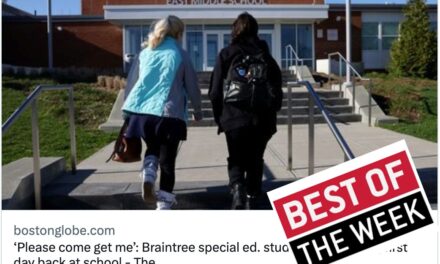
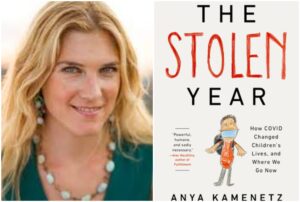
In this week’s newsletter: Some schools are reverting to virtual learning or deploying new testing programs, while others have reopened normally. Chicago’s school stalemate presents a tough challenge for media outlets. And NPR’s Anya Kamenetz releases the cover for her much-anticipated book, The Stolen Year.
OMICRON REOPENING
The big story of the week, according to us:
While a small number of districts in places like Chicago, Cleveland, Detroit, Newark, and Atlanta have delayed reopening, gone remote, or shut down entirely, the vast majority of school systems including those in Washington, DC, LA, Seattle, Connecticut, and New York City have reopened. But it hasn’t been easy. Many schools are struggling with staffing issues, mass testing, mask and quarantine requirements, and communicating effectively with parents:
🔊 What it really takes to keep schools open during the omicron surge (NPR)
🔊 Omicron Surge Hinders School Reopening Plans (Wall Street Journal)
🔊 Schools adapt for return from break as COVID-19 cases surge (AP)
🔊 COVID testing and reopening: Districts plan more rapid testing (USA Today)
🔊 In face of omicron surge, schools push ahead (Washington Post)
SUPERINTENDENTS UNDER SIEGE
The best education journalism of the week.
Note: Includes stories going back into December
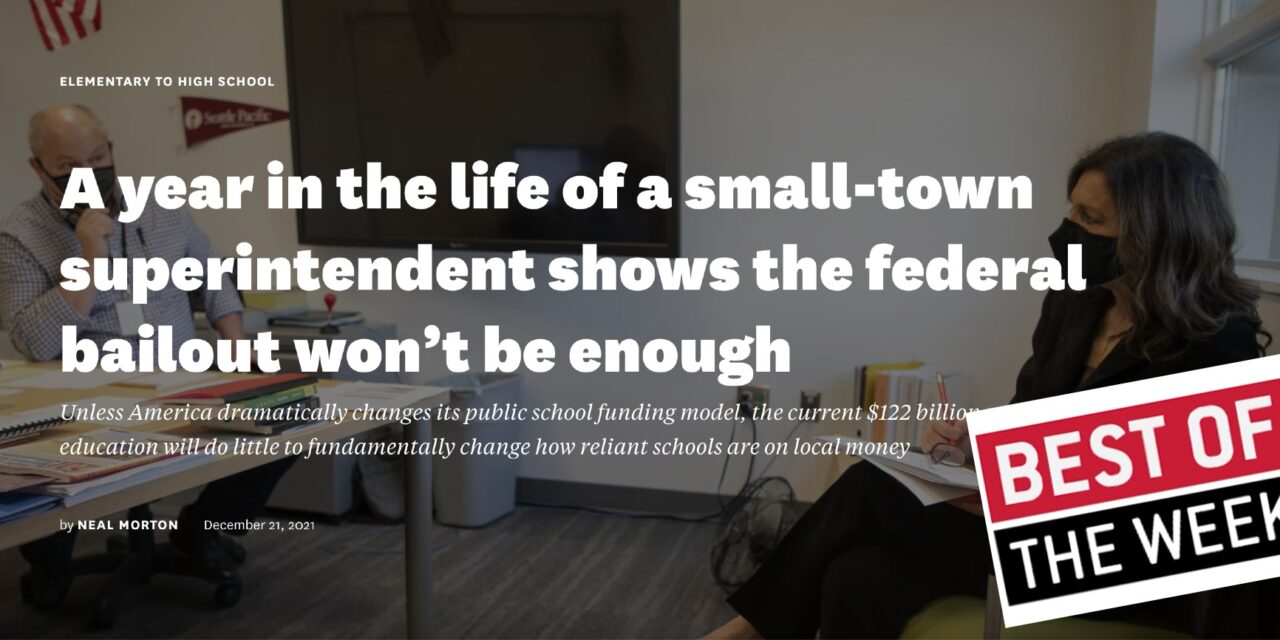
🏆 BEST: The best story of the week is A year in the life of a small-town superintendent shows the federal bailout won’t be enough by Neal Morton co-published in the Hechinger Report and The Guardian. While many stories about the influx of federal funding to schools focus on how schools are misusing federal funding or leaving it on the table at the expense of students, Morton’s story takes a much more nuanced look at what that money can — and can’t — do. He follows a superintendent in Centralia, Washington, as she anxiously watches whether local voters will approve or reject a ballot measure to bring millions of dollars to their schools by renewing an existing property tax. While the federal funding certainly helps, small districts like these are often more reliant on local dollars — and they don’t always get them. “What’s needed is the realization at the state or federal level that the amount of government money required to support schools — both before and potentially after the pandemic — is many times more than what has been spent so far,” Morton writes.
🏆 RUNNER-UP: This week’s runner-up is Inside a Covid-19 School Closing: A Pennsylvania Superintendent Agonizes Over Going Remote by Scott Calvert and Douglas Belkin in the Wall Street Journal. The story offers an inside look at the agonizing decisions superintendents must make as Omicron surges, teachers and staff call out sick, and parents demand students be kept in school. They follow a Norristown, Pennsylvania superintendent who starts the day believing he will keep schools open, only to be forced to reverse course after 115 of the district’s nearly 1,000 employees called in sick. “When we started seeing the numbers climb really across the board — when nurses started dropping out, when we started hearing reports that bus driver absences might become problematic — the sum total of it said: You know what? We need to take a collective pause,” he said. This story is a little too district-focused for my taste, but it does a good job of getting into the decision-making process going on behind the scenes. I’d love to see more like this.
BONUS STORIES:
🏆 D.C. schools test-to-return: Did it work? (The Washington Post)
🏆 Why we could soon lose even more Black Teachers (Hechinger/Time)
🏆 What happens when students remove masks? (Boston Globe)
🏆 As schools reopened, one Colorado school decided against returning to normal (Colorado Public Radio)
🏆 California’s new generation of star college applicants (LA Times)
🏆 The Students Returned, but the Fallout Remained (NYT)
🏆 Advocates fear suspensions could add to pandemic pain (NBC News)
Did someone forward you this? You can sign up here. Or, you can view this newsletter in your browser.

REMOTE REPORTING DOESN’T WORK
New from The Grade
By and large, students and teachers have returned to campus. But too many education reporters haven’t followed.
In this week’s column, I make the case that education journalists need to reject ‘remote’ reporting, the interview- and online-based approach to journalism which is behind too much of the simplistic and polarizing coverage being produced today, especially at the national level.
Go into schools and “you get to see and hear and feel things no dataset or interview with a teacher or administrator can provide,” the Courier Journal’s Mandy McLaren told me.
Without reporters seeing things for themselves, “how can we write with authority?” said an education editor from a national publication.
I’m sympathetic to the challenges of getting into schools, but editors and reporters need to find places that will let them in, start calling out districts that won’t allow access, and stop making excuses. There are great examples of reporters getting inside schools, showing what’s possible.
MEDIA TIDBITS
Thought-provoking commentary on the latest coverage.
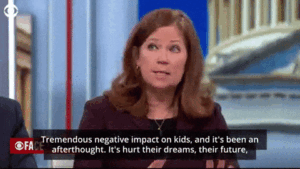
Above: CBS News’ correspondent Jan Crawford unleashed a whole host of reasons why remote learning and the impact on kids was the most underreported story of the year on Face the Nation.
📰 COVERING CHICAGO — DOS AND DON’TS: Lightfoot slams the union for hurting parents. The union slams Lightfoot for not being collaborative enough. Blah, blah, blah. What’s the point of focusing on the stalemated protagonists (or letting folks take unvetted potshots at each other if you’re not going to vet the claims they’re making)? Reporting that would be more helpful: How well did Chicago do at keeping everyone safe this past fall? How does Chicago’s testing program compare to other places like DC or LAUSD or NYC? How are the kids of essential workers and especially vulnerable homes being served?
All that being said, there’s been some strong coverage. The Chicago Sun-Times’ Nader Issa has been producing great stories and helpful Twitter threads: Axios Chicago’s Monica Eng has been putting out helpful information. The Washington Post overview does a good job sketching out the local and national politics. And it’s good to see more coverage focused on the stalemate’s effects on parents and students.
📰 FEAR-MONGERING MEDIA: One of education journalism’s biggest challenges is the tendency towards bad news when it comes to school reopening, combined with a woeful tendency to downplay the effects of keeping kids out of schools. “We journalists tend to be comfortable delivering bad news straight up but uncomfortable reporting good news without extensive caveats,” noted the New York Times’ David Leonhardt recently. Education news headlines this week ratify his observation, along with coverage that emphasizes a handful of shutdowns over widespread reopenings and stories that highlight surging COVID cases without noting the milder effects of the new variant on most people. But at least some journalists are getting clear about the effects of closed schools, and stating it boldly. “For the past two years, Americans have accepted more harm to children in exchange for less harm to adults,” wrote Leonhardt in one of this week’s Morning Briefings. “Data now suggest that many changes to school routines are of questionable value.” The only flaw in Leonhardt’s analysis is that it omits the Times’ own alarmist coverage of school reopening efforts.
📰 REPORTERS UNDER FIRE: At least three education reporters have come under fire online for their social media comments in the first week of the new year. The Detroit Free Press’s Lily Altavena described some “not-so-happy” replies to her school closure accountability story. We “have to ask the hard questions,” she tweeted. The New York Times’ Dana Goldstein was slammed for her efforts to find N95 masks for her preschool-aged child and her deference to the school that requires them. (A more legitimate concern might be the coverage she and others on the education team have produced.) Goldstein’s colleague Nikole Hannah-Jones was berated for her comments on the Chicago schools shutdown — an echo of May 2020, when she was swarmed for “teacher-bashing” comments about the lack of live instruction being provided to students in remote learning. So far, Hannah-Jones appears undaunted. “We did not get into this profession to make people comfortable,” she tweeted.
Looking for media commentary and analysis all day, every day? Follow me at @alexanderrusso.
PEOPLE, JOBS, & MEDIA APPEARANCES
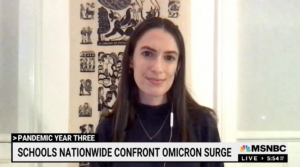
Above: The New York Times’ Dana Goldstein was on MSNBC’s “All In with Chris Hayes” on Monday to talk about Omicron and schools — and how many kids were out of class.
🔥 Media appearances: Education reporters were all over NPR this week. The Wall Street Journal’s Douglas Belkin was on Weekend Edition to talk about how schools were preparing to reopen amid Omicron’s surge, WBEZ Chicago’s Sarah Karp was on Morning Edition to talk about the showdown between the teachers union and the city over returning to remote, and WHYY Philadelphia’s Mallory Falk was on Morning Edition to talk about a rise in COVID cases sparking fears about returning to class. And ICYMI, the Boston Globe’s Naomi Martin made another national television appearance just before Christmas on CBS News, talking about mask-optional policies for vaccinated students in Massachusetts.
🔥 Job moves and honors: US News has a new managing editor for education: Liana Heitin Loewus, who previously edited for Education Week. The Baltimore Sun’s Liz Bowie is the latest veteran journalist to leave a legacy outlet for a nonprofit, but fear not — she’s going to be covering education for The Baltimore Banner. Kayla Jimenez, who wrote many education stories for the Voice of San Diego, has started a new job covering education in the Bay Area for the Mercury News, her hometown paper. The journalists behind NBC News’ Southlake podcast, were honored when The Atlantic named one of 2021’s best podcasts. Congrats to all!
🔥 Who’s hiring: The Associated Press is hiring for a bunch of positions, including an education reporter to report on the effects of the pandemic on schools, an education data journalist, and a news director for the education network. The Boston Globe is hiring a data journalist and a digital producer for their Great Divide team. Politico California is hiring an education reporter EdWeek Market Brief is looking for a senior digital analyst and an assistant managing editor. (See both jobs ads here.) WBEZ Chicago is hiring an education reporter. Chalkbeat is hiring two new story editors to cover mornings and evenings. WBUR Boston public radio is still looking for a new education editor.
BOOKS & RESOURCES
Above: The cover is out for NPR correspondent Anya Kamenetz’s new book “The Stolen Year” available for pre-order now. I know I’m not the only one who can’t wait to read it.
⏰ Reporting resources: It’s not pretty look at it, but the federal Department of Ed’s COVID dashboard shows a strikingly different visual than what we usually see reflected in headlines: nearly all school districts are learning in-person, according to their data. Also, don’t forget to check out Burbio’s weekly updates, including school disruptions and testing requirements, and District Administration’s COVID tracker.
⏰ Good news for local news: Poynter’s Kristen Hare updated her list of 70 local newsrooms that launched during the pandemic, and I spot at least a few who are focusing on education, including the Border Belt Independent in North Carolina, the Harvey World Herald in Illinois, and the Kansas City Beacon. Check out the full list here. Along with the uptick in education beats for Report for America, I’m feeling optimistic about local education coverage in 2022!
⏰ More books: Veteran education journalist and author Clara Hemphill also has a new book coming out, Keesha’s Quest: How to Build an Integrated School. In it, Hemphill follows a Brooklyn PTA president who tries to address segregation and inequality by encouraging parents to keep their kids in the neighborhood school. According to Hemphill, the book “shows how parents today can overcome the legacy of the past by working together across the great divides of race and class.” Just before the winter break, Hemphill wrote an insightful commentary about gifted and talented coverage for The Grade.
THE KICKER
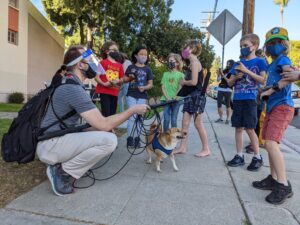
Not all education reporters are back out in the field yet — but KPCC’s Kyle Stokes sure is. We love this great photo he shared of his student interview technique in his year-end round-up on Twitter.
hat’s all, folks. Thanks for reading!
Reply to this email to send us questions, comments or tips. Know someone else who should be reading Best of the Week? Send them this link to sign up.
Using Feedly or FlipBoard or any other kind of news reader? You can subscribe to The Grade’s “feed” by plugging in this web address: http://www.kappanonline.org/category/the-grade/feed/.
Read more about The Grade here. You can read all the back issues of The Grade’s newsletter, Best of the Week, here.
By Alexander Russo with additional writing from Colleen Connolly.
ABOUT THE AUTHOR

Alexander Russo
Alexander Russo is founder and editor of The Grade, an award-winning effort to help improve media coverage of education issues. He’s also a Spencer Education Journalism Fellowship winner and a book author. You can reach him at @alexanderrusso.
Visit their website at: https://the-grade.org/