📌 Welcome! There will be no Friday newsletter next week or the week after (12/24 and 12/31). Have a great break! 📌
In this week’s newsletter: Doom and gloom for schools experiencing enrollment declines and staffing shortages. A heated debate over the New York Times’ coverage of NEA head Becky Pringle. Nominations for the year’s best education journalism are trickling in.
TOUGH DECEMBER FOR SCHOOLS & STUDENTS
The big story of the week, according to us:
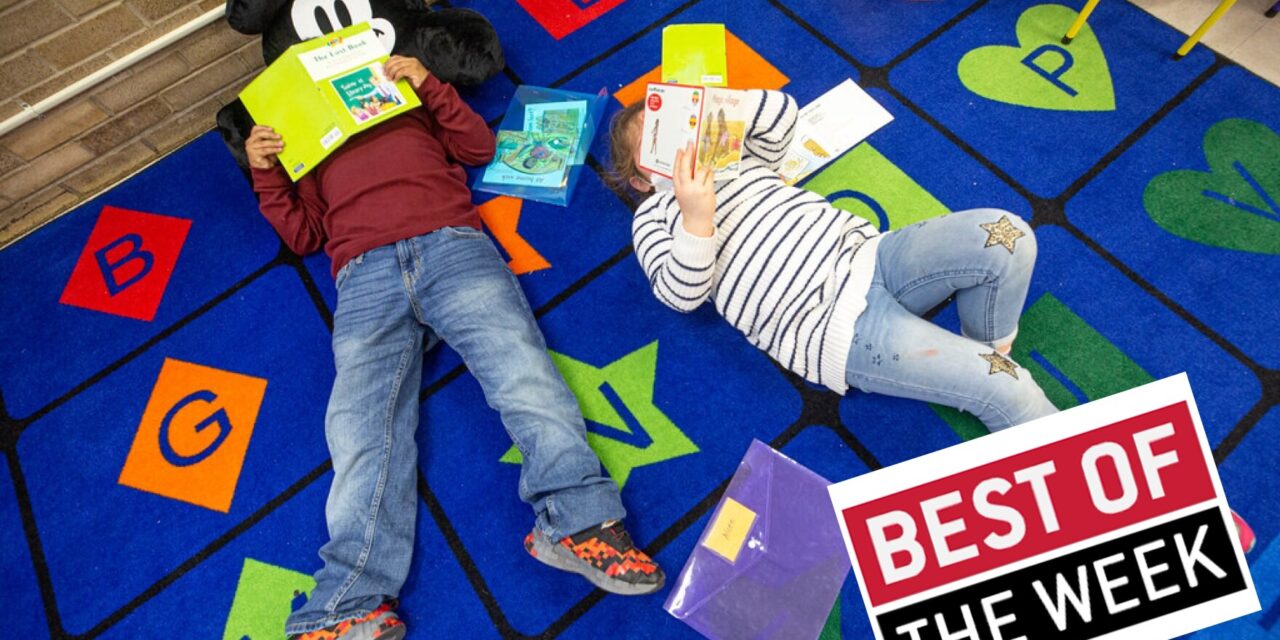
The big story of the week is the beginning of a very tough winter. Schools are experiencing enrollment declines and staffing shortages and preparing for an Omicron surge. Too many kids have not yet become fully reconnected with school or begun receiving the teaching and services that they need. More interruptions loom in the weeks ahead.
🔊 Where are the students? For a second straight year, school enrollment is dropping (NPR)
🔊 Enrollment in DeKalb County schools not yet rebounding from pandemic (AJC)
🔊 CPS Sees Steepest Student Drop in Pilsen and La Villita Schools (South Side Weekly)
🔊 ‘Epic’ staff shortage jeopardizes student safety and learning (Omaha World News)
🔊 Severe teacher shortages persist in Sacramento schools (Sacramento Bee)
🔊 Bill would reduce qualifications needed for some to substitute teach (Chalkbeat Detroit)
🔊 A shortage of special education staff leaves many students without services (WBUR)
🔊 Vaccine mandate being considered for Detroit school district employees (Chalkbeat Detroit)
🔊 LAUSD poised to push back deadline for student COVID vaccinations to fall 2022 (LA Times)
🔊 Schools Are Closing Across the Country Amid COVID Omicron Surge (Today)
🔊 Chicago’s Top Doc ‘Confident’ CPS Won’t Return to Remote Learning Citywide (WTTW)
SEXUAL HARASSMENT & DOUBLE DIPPING
The best education journalism of the week.
Above: Bethany Barnes’ latest story about sexual harassment in K-12 schools.
🏆 BEST: The best story of the week is Tampa teens wanted their school to protect them. Instead, they felt punished. by Bethany Barnes in the Tampa Bay Times. Barnes, a former education reporter who now works on the investigative team, interviewed 22 students at a single high school who said they didn’t feel protected at the school. They told Barnes that reports of rape weren’t taken seriously by school officials or law authority, the school gave inappropriate relationship advice at an assembly, and teachers sometimes crossed boundaries in interactions with students. As one student said, ”Something is broken and students are suffering.” The story sheds light on sexual harrassment in K-12 schools, which Barnes points out has been somewhat overlooked in recent years. And the impact of her story was almost immediate. Following publication, former students and school officials demanded an investigation into the school’s sexual harassment policies at a school board meeting.
🏆 RUNNER-UP: This week’s runner-up is He was hired to fix California schools — while running a business in Philadelphia by Mackenzie Mays in Politico California — her last big story for the outlet before she starts as politics reporter for the LA Times. Mays did some digging on Daniel Lee, California’s first superintendent of equity and one of the highest paid officials in the state’s Department of Education, and found that he has a whole other life on the East Coast. He voted in Philadelphia, where he also owns a home. He owns a Pennsylvania-based psychology firm. And his connection to California? Almost none. “Lee’s 18-page resume shows no prior experience in California or relationships with school districts in the state,” Mays writes. In just three days, the story made a big impact: Lee resigned. This story does what investigative journalism should do — exposing what happened behind closed doors and holding public officials accountable.
BONUS STORIES:
🏆 Inside a rural school district suing Pa. for more equitable funding (WHYY)
🏆 How an Arizona School-Board Controversy Became the Perfect Political Issue (New Yorker)
🏆 The CDC’s Flawed Case for Wearing Masks in School (Atlantic)
🏆 San Diego Unified Schools Are Leaving Millions on the Table (Voice of San Diego)
🏆 Texas has millions for school COVID testing. The money has largely gone untouched (Dallas Morning News)
COMMUNITY JOURNALISM & ‘THREAT ASSESSMENT’
New from The Grade
Above: One of Canopy Atlanta’s community journalism efforts.
Have you ever been curious what education journalism would look like if it was written by and for the communities it serves? According to the folks at Canopy Atlanta, community journalism means stories are sourced from the community, center the people directly affected, are explicitly non-extractive, and — perhaps most important — generate understanding, connection, and trust with the community.
Read about these ideas, see the coverage that Canopy Atlanta has produced so far, and think about what it would mean if more education journalism took on this approach. It’s a whole different thing, done a whole different way.
Also: When it comes to preventing school shootings, there’s no doubt that “threat assessment” is an important strategy to consider — and a good topic for education reporters to explore. However, the controversial approach warrants as much skepticism as curiosity, and that’s where the Washington Post fell short with a recent piece, according to longtime education reporter Maureen Kelleher.
MEDIA TIDBITS
Thought-provoking commentary on the latest coverage.
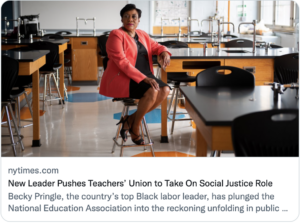
Above: Erica Green’s New York Times profile of NEA president Becky Pringle was the most hotly debated piece of education journalism this week.
📰 HOW TO COVER A TEACHERS UNION HEAD: Every time the New York Times’ Erica Green writes a story these days, there’s a heated discussion. There are lots of reasons for this. Education is full of hot-button issues. Concerns about media depictions of education are particularly high. Green’s admirers — myself included — can be fanatic. So it’s no real surprise that her recent profile of NEA president Becky Pringle attracted a lot of attention. There were many who admired the piece and found it useful. There were many others who found it soft and unfocused, compared to the usual work we get from Green.
We need more, better coverage of union heads that helps readers understand the swirling dynamics that motivate them — and the impact that they have on kids’ school experiences. Just as important, we need to be able to have an honest discussion about a story’s strengths and weaknesses — even when it’s everyone’s favorite education reporter who wrote it. It doesn’t have to happen on Twitter, but it has to happen.
📰 IMPACT OF CHALKBEAT’S UNION CONTRACT: Sixteen months ago, Chalkbeat staffers announced that they had unionized — the first and only education nonprofit newsroom to do so (to my knowledge). On Friday, they announced a contract had been agreed to, making Chalkbeat what’s believed to be the largest non-profit newsroom with a union contract outside of public radio. Initially focused on mitigating potential layoffs, staff interest in negotiating a contract remained strong even after funding threats passed, says Chalkbeat Detroit reporter Koby Levin, part of the organizing and negotiating teams. Employees are no longer at-will. Parental leave, “substantial” salary increases, and comp time are all enshrined in the contract. What are the direct effects going to be? According to Jennifer Bramble, Chief People Officer at Chalkbeat, the new contract covers 30 members of the newsroom and the new salary minimums have immediate effect on the salaries of five journalists. The contract doesn’t address COVID protocols or related requests (including in-person reporting and office attendance), according to Bramble, and it isn’t supposed to have an impact on growth. It’s not clear if the journalists at the other “big” education nonprofits — EdWeek, EdSource, Hechinger, The 74 — will follow suit. So the main effect may be on the work being produced and the well-being of the journalists who produce it. Said Levin: “Healthy and supported journalists produce good journalism.” .
📰 STYLE GUIDES MAKE ALL THE DIFFERENCE: Writing about education is not for the faint of heart when it comes to language and terminological controversies. Do you describe someone as a person with a disability or as an autistic person? Is it OK to refer to a student or educator who identifies as something other than their gender assigned at birth as transgender? Every outlet handles these decisions somewhat differently, based on internal documents called style guides. According to Chalkbeat ME for style and standards Emiliana Sandoval, the Chalkbeat guide is updated up to twice a month. It calls on reporters to use preferred gender pronouns for sources and to avoid using “achievement gap,” because it has potentially racist undertones. What about other trade outlets — and the chances of posting style guides publicly, which some outlets (notably the Associated Press) already do? EdWeek’s Lesli Maxwell said, “Our style task force is deliberating the question of making our EW style guide available to our audience.” Hechinger’s Sarah Garland told us, “We’ll be publishing our style guidelines for writing about race and ethnicity on our website soon.” And the 74’s Steve Snyder told us that the organization has launched a “review and revision process” looking to rework its internal style guide, disclosure policy, and code of ethics.
📰 BEST OF 2021: Congrats to NBC News Mike Hixenbaugh and Antonia Hylton, whose podcast on a critical race theory battle in Southlake, Texas, was named one of the best podcasts of the year by the New Yorker. It “treats an overheated scenario with patience and care,” and its “quiet moments are as powerful as its loud ones.” Meanwhile, Bloomberg Businessweek’s 2021 Jealousy List features some fantastic kid- and school-related work by Nashville Public Radio’s Meribah Knight (described as “powerful accountability work”) and the Washington Post’s Eli Saslow (“an overwhelming pandemic issue told on an intimate scale”). Got more #bestof2021 stories and books to suggest? Add them here.
Looking for media commentary and analysis all day, every day? Follow me at @alexanderrusso.
PEOPLE, JOBS, KUDOS

Above: Clockwise from top left, The Washington Post’s Janel Davis and Adam Kushner, the Atlanta Journal-Constitution’s Susan Hogan and Cassidy Alexander, EdWeek’s Beth Frerking, Politico California’s Mackenzie Mays, the Miami Herald’s Sommer Brugal, and the Boston Globe’s Felicia Gans.
🔥 Job moves: The Washington Post has a new deputy education editor: Janel Davis. She joins deputy education editor April Bethea and education editor Adam Kushner, whose assignment was announced just before Thanksgiving. The Atlanta Journal-Constitution also has a new education editor, former Washington Post editor Susan Hogan, and a new education reporter, Cassidy Alexander, who comes from the Daytona Beach News-Journal. And EdWeek has announced its new EIC, Beth Frerking, who starts next month. Meanwhile, Politico California education reporter Mackenzie Mays announced she’s leaving to join the LA Times to cover state government and politics. Sommer Brugal celebrated her first day on the K-12 beat for the Miami Herald. Boston Globe digital producer Felicia Gans is leaving the Great Divide team to be a digital editor at the Philadelphia Inquirer. Keep an eye out for a job posting for her old position — and also a data reporting job on the team!
🔥 More job openings: Politico California is hiring an education reporter to replace Mackenzie Mays. The Roanoke Times in Virginia is hiring a higher education reporter and a K-12 reporter. The Times-Picayune in New Orleans is hiring an education reporter. WBEZ Chicago is hiring an education reporter. Chalkbeat is hiring two new story editors to cover mornings and evenings. WBUR Boston public radio is still looking for a new education editor. The Wall Street Journal is still looking for an education reporter to cover K-12 schools nationwide.
🔥 Shout-outs and milestones: Shout-outs for all the current and former education reporters who jumped in to help cover the devastating tornadoes in Kentucky and nearby states. We see and appreciate your extra work. Politico education editor Delece Smith-Barrow celebrated her one-year anniversary at the outlet and thanked her colleagues for making it great so far. WBHM education reporter and Report for America fellow Kyra Miles made it to the NPR airwaves for her story on why more Black families are homeschooling. “It’s such a huge career milestone to hear myself say ‘For NPR News, I’m Kyra Miles,’” she tweeted. NPR education intern Mansee Khurana had her piece on free period products in schools featured on All Things Considered. Congrats to all!
EVENTS, RESOURCES
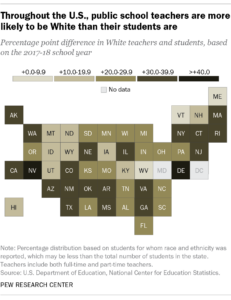
Above: A new report by the Pew Research Center shows that in every single state teachers are more likely to be white than their students.
⏰ Media appearances: Both Cory Turner and Anya Kamenetz had separate segments on NPR about declining school enrollment. The Wall Street Journal’s Ben Chapman was on iHeartRadio’s The Daily Dive podcast to talk about his story on the “tsunami” of behavior incidents at schools. Chalkbeat Detroit’s Koby Levin was on WBUR On Point to talk about the worker shortage in American schools. Freelance education journalist Greg Toppo was on the Getting Smart podcast to talk about his book Running with Robots: The American High School’s Third Century, co-authored with Jim Tracy.
⏰ Resources: The Pew Research Center has a new report out on teacher diversity. The results aren’t pretty. Take a look to find out where your state stands. The Education Trust also has a new report out showing that Black and Latino students are more likely to have novice teachers. And check out this new Global Education Recovery Tracker from Johns Hopkins University, the World Bank, and UNICEF to find out if schools in your area are operating in-person, remote, or mixed — or are closed. And remember to look at Burbio’s weekly school trends, including an update on school closures and mask requirements and school staffing shortages and incentives.
THE KICKER
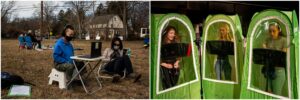
Two of the best photos of the year — left from the New York Times, right from The Atlantic — capture the school experience in 2021. Crossed fingers it won’t be the same in 2022.
That’s all, folks. Thanks for reading!
Reply to this email to send us questions, comments or tips. Know someone else who should be reading Best of the Week? Send them this link to sign up.
Using Feedly or FlipBoard or any other kind of news reader? You can subscribe to The Grade’s “feed” by plugging in this web address: http://www.kappanonline.org/category/the-grade/feed/.
Read more about The Grade here. You can read all the back issues of The Grade’s newsletter, Best of the Week, here.
By Alexander Russo with additional writing from Colleen Connolly.
ABOUT THE AUTHOR

Alexander Russo
Alexander Russo is founder and editor of The Grade, an award-winning effort to help improve media coverage of education issues. He’s also a Spencer Education Journalism Fellowship winner and a book author. You can reach him at @alexanderrusso.
Visit their website at: https://the-grade.org/