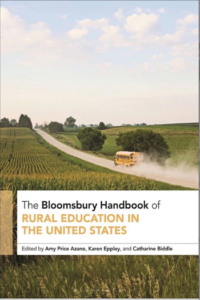
 The Bloomsbury Handbook of Rural Education in the United States
Edited by Amy Price Azano, Karen Eppley, & Catharine Biddle (Bloomsbury, 2021).
Nearly half of all districts, a third of all schools, and about one-fifth of students in the U.S. are counted as rural. In recent years, rural communities have received increased attention (with much hand-wringing about the so-called rural-urban divide) — yet, even now, there are few resources that address rural education and the unique role of schools in rural communities. The Bloomsbury Handbook of Rural Education in the United States fills that gap. The editors, Amy Price Azano, Karen Eppley, and Catharine Biddle, have pulled together diverse rural education voices who have been thinking about policy and practice in rural education for decades, as well as scholars who are relatively new to the field. The result is an approachable, engaging, and thorough overview of rural education, perfect for educators and scholars who may be just beginning to think about this topic.
The first chapters lay a foundation for understanding rural education — how rural is defined, how rural populations and demographics have changed in recent decades, and how poverty affects schools and communities in rural areas. Later chapters provide overviews of specific topics: rural school leadership, labor issues and teacher shortages, school-community partnerships, school consolidation, postsecondary transitions, early childhood education in rural contexts, place-based teaching practices, and the need for trauma-informed practices and school-based mental health services in rural areas.
Importantly, the Handbook explores rural education through a lens of identity and equity, and, as a result, challenges stereotypes that rural schools and communities are homogenous. Chapters focusing on Latinx, Black, and Indigenous communities show the diversity of rural people, geographies, histories, and cultures. The book and its authors also challenge deficit narratives about rural people (and their schools) as backward, simple, out-of-step, or needing reform. Instead, the book explores the complexity of rural places, making it an important resource for anyone concerned about the well-being of rural schools and communities.
Devon Brenner’s latest in Kappan:
ABOUT THE AUTHOR

Devon Brenner
Devon Brenner is assistant vice president for outreach and initiatives in the Office of Research and Economic Development at Mississippi State University, Starkville. She is a co-author of Teaching in Rural Places: Thriving in Classrooms, Schools, and Communities.