How one community is attempting to make up for diminished schools coverage
By Amber C. Walker
Parent Laylah Allen often questioned the policy decisions of the Cleveland Metropolitan School District (CMSD). When she joined The Documenters, however, those questions transformed into action.
“Sometimes you watch from the outside and you’re wondering, ‘What are they thinking? Why are they doing this?’” Allen said.
Now she knows – because she’s covering it through an innovative program that hopes to supplement much-diminished news coverage in the Midwest.
Allen is one of 250 Cleveland-area residents trained as Documenters, a nonprofit program that pays community members to take notes (and often live tweet) at public meetings of the school board, city and county councils, and other municipal bodies.
The notes are then posted on the Documenters website, where they are publicly viewable and searchable.
As legacy newspapers across the country face corporate consolidation and staffing cuts, local K-12 education coverage suffers. Niche publications like Chalkbeat and The 74 have emerged to fill in the gaps, writing stories traditionally covered by education beat reporters at newspapers.
There are also programs like The Documenters that take a different approach. While traditional reporting outlets tend to focus only on the bigger stories, The Documenters’ notes give a more complete picture of what is happening at the school board meetings.
Although Documenters provides a platform for community members to learn more about the institutions that serve them and is a great supplement to schools coverage, it does not necessarily replace having full-time, professional K-12 beat reporters dedicated to the work.
Although Documenters provides a platform for community members to learn more about the institutions that serve them and is a great supplement to schools coverage, it does not necessarily replace having full-time, professional K-12 beat reporters dedicated to the work.
Documenters helps inform the public while bringing its participants to a stronger understanding of local events. The notetakers ay they feel a deeper sense of community involvement and greater awareness of the impact of government decisions on their lives. They see the program as an avenue to spur change in their communities.
“Taking the time to tune into the meetings and take the notes for it, I’ve been able to get a better idea of how the school district operates and what their approach is,” says Allen, who’s been attending meetings virtually because of the pandemic.
The program is the brainchild of City Bureau, a nonprofit newsroom (funded primarily by The Knight Foundation, The American Journalism Project, and The Democracy Fund) based on Chicago’s Southside. City Bureau’s overall mission is to connect journalists with their communities to produce work that is “impactful, equitable and responsive to the public.”
The first Documenters site launched in Chicago in 2018; Cleveland’s program started last May. There are also sites in Detroit and, most recently, Fresno, California.
Unlike reporters, Documenters don’t write stories about the meetings they cover. Instead, they take detailed notes on key points and action items. The notes are then posted on the Documenters website, where they are publicly viewable and searchable.
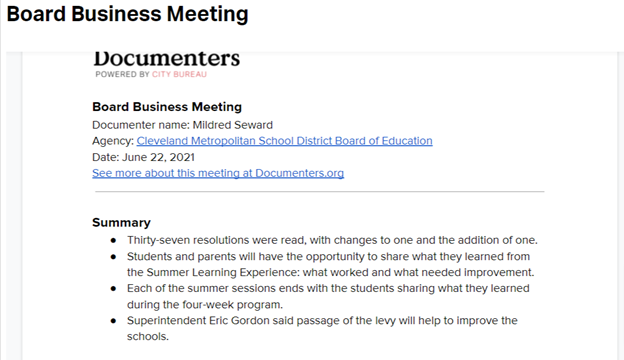
Above: An example of a recent Documenters write-up of a school board meeting.
They are paid at least $56 for each meeting shorter than two hours and more for longer meetings. Of the 250 Documenters trained in Cleveland, about a quarter are active, defined as having been paid for an assignment in the last 100 days. According to City Bureau’s 2020 annual report, there are about 350 active Documenters across Cleveland, Detroit, and Chicago.
They are encouraged to attend meetings that align with their personal and civic interests and that’s what Allen did. As a mother of two and a youth service provider in Cleveland, she is both personally and professionally invested in the educational outcomes of Cleveland-area students.
“I thought [Documenters] was a really cool initiative because it wasn’t just advertised as a paid gig, it stressed the importance of getting information out,” she said. “Along with that, it granted me an opportunity to use a skill that I wasn’t using at the time, writing and compiling information to be shared and disseminated.”
When she learned that Lawrence Caswell was running the program, that sealed the deal.
Caswell “facilitated a data workshop where we looked at employment, health care and other statistics around the city. That made me trust [the program] even more.”
Caswell is a journalist and lifelong resident of Cleveland. Before joining Documenters last year, he worked for ideastream, the city’s NPR and PBS affiliate. Caswell said he’s seen how the media landscape in Cleveland has eroded over time, which makes the need to fill in coverage gaps more pressing.
“We used to be a two-newspaper town and the coverage of government used to be much more extensive even beyond the newspapers,” Caswell told me in a phone interview.
“I remember reading a book about a Cleveland mayoral race in the ’70s. Every meeting had a reporter, every campaign stop…It’s not that way in the city anymore…and it’s not just Cleveland,” Caswell said.
“Public meetings provide an opportunity for oversight and to hold agencies and governmental bodies accountable, but [community members] cannot do that if there is no one covering those meetings.”
Now there’s just one hometown paper – the Cleveland Plain Dealer. And it’s a shadow of its former self.
Now there’s just one hometown paper – the Cleveland Plain Dealer. And it’s a shadow of its former self.
According to the Expanding News Desert, a project at the University of North Carolina at Chapel Hill that tracks changes in local news markets, between 2004 and 2019, overall newspaper circulation in Illinois and Michigan decreased 36 percent and 45 percent, respectively; in Ohio, it was 51 percent, one of the steepest drops in the country.
Consolidation has affected many news outlets. Of the five major newspapers across Cleveland, Chicago and Detroit, three are owned by the two largest chains in the country – Alden Global Capital (The Chicago Tribune and The Detroit News) and Gannett (The Detroit Free Press). Papers acquired by these two routinely cut costs, including layoffs and wage freezes. That’s what happened just last month at the Tribune. The result is often reduced coverage.
The Cleveland Plain Dealer was home to the country’s inaugural chapter of the American Newspaper Guild and, at the turn of the century, employed 350 unionized staffers; today, that number is zero. After a string of buyouts and layoffs, owner Advance Local laid off the last of its four unionized reporters in 2020 and closed the Plain Dealer newsroom. Some staffers were offered positions at Cleveland.com, Advance Local’s much smaller, non-unionized digital platform.
Among those lost from legacy print was Patrick O’Donnell, an award-winning reporter who was laid off in April 2021. Now a freelancer, he covers schools for The 74, which has a much smaller local readership.
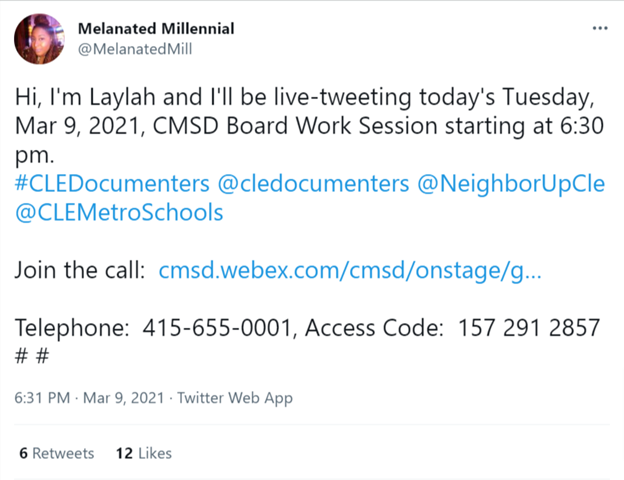
Above: Documenters parent Laylah Allen live-tweeting a recent school board meeting.
O’Donnell’s work with The 74 is not a substitute for the daily K-12 education beat reporting he was doing in Cleveland and throughout the state. He writes less often and the coverage is geared toward national audiences versus the routine stories that don’t make big headlines but that local readers often want to know
“We definitely felt the loss of (O’Donnell’s K-12 education) coverage,” Caswell said.
The Documenters program partners with existing community organizations that share their mission and goals. The Cleveland Documenters program is sponsored by Neighbor Up, an organization that helps community members connect with one another. It also provides grants to residents to fund projects that improve their neighborhoods.
Caswell recruits from Neighbor Up because its members represent a geographically, racially, and ethnically diverse cross section of civically engaged Cleveland residents.
“The city of Cleveland is two-thirds Black and Brown…We are really trying to be purposeful and intentional about that recruitment,” Caswell said.
“I think it’s pretty close to [the racial and ethnic makeup of Cleveland], but we have room to grow, particularly in the Latinx and Asian communities.”
Documenter Layla Allen, who is African American, founded The Missing Link, an organization to help students build healthy skills to cope with stress. Since joining Documenters, she’s gained a better understanding of school board processes and decision making.
The school board “is looking into things and trying to make improvements. Whatever opinions people may have about the school district at this time, hopefully, people can see [their work] through the notes that we take.”
In addition to the notes on the website, Cleveland Documenters leverages Twitter to share meeting highlights with the community. Allen said she prefers to get her news from digital and social sources and uses Twitter to connect with newsmakers and community members in real time, so she obtained Caswell’s OK for live-tweeting school about board meetings.

Above: Allen, Caswell, and O’Donnell
It might not take the place of full-on journalism, but in some cases, Documenters work has helped a parent or changed a decision.
Cleveland Documenters raised the alarm on the lack of regular, formal public comment periods at Cleveland City Council and other public meetings.
Documenters produced an explainer detailing their findings, including difficulties community members experienced when attempting to speak directly to their representatives.
Since then, other outlets have covered the topic and members of the Cleveland City Council have publicly supported adding a regular public comment section to their meetings.
Allen said she hopes this is the first step to make municipal meetings across the region more responsive to community voices.
“I think Cleveland Documenters is definitely going to change the way that meetings are held,” she said.
Previous columns from Amber C. Walker
Education journalism has yet to make good on changes identified during the George Floyd protests
Improving source diversity in education journalism
How personal experiences shaped one journalist’s perceptions
What it’s like being a rookie education reporter
Writing great profiles in the age of remote reporting
Introducing Amber Walker, bringing new insights & voices to The Grade
Previous stories about shifting education coverage
Report For America goes to school
Assessing the surge in Boston-area education coverage
Bright spots in education journalism
A brain drain in education journalism
In Connecticut, fewer reporters, more missed stories
2 education reporters … for a metro region of nearly 8 million people
ABOUT THE AUTHOR

Amber C. Walker
In addition to being a consulting editor and columnist for The Grade, Walker is a multimedia journalist and digital content strategist. You can find her @acwalker620 across platforms.