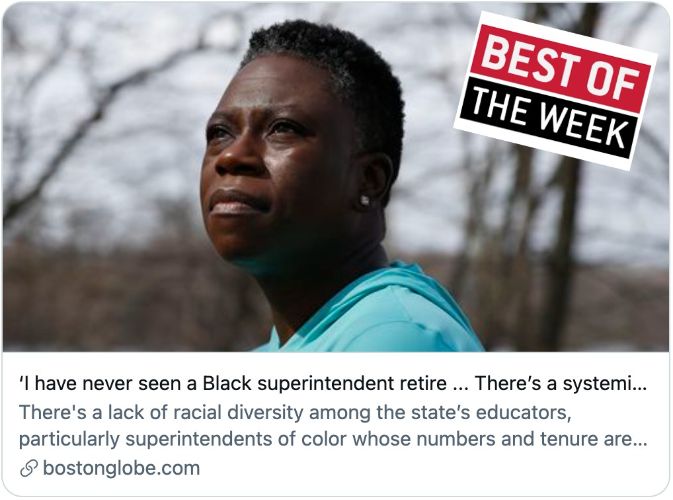
| 🏆 BEST: The best story of the week is ‘I have never seen a Black superintendent retire … There’s a systemic problem’ by Meghan E. Irons in the Boston Globe. Her searing reporting tells us that only 21 of Massachusetts’ 275 non-charter public school superintendents are Black, Latino, or Asian — and more than half have been on the job for less than two years. Why is that? There are several reasons, including that superintendents of color receive less support than their white counterparts and receive harsher job performance reviews — particularly in predominantly white municipalities. One Black superintendent recalled the time a parent told her she was “not on the same intellectual level as other superintendents.” “I cried all the way home,” she said. Another takeaway for Irons? “Superintendents of color do not get the benefit of the doubt in a crisis, including in a pandemic.” It’s a great story on something that’s likely to be happening in other parts of the country.
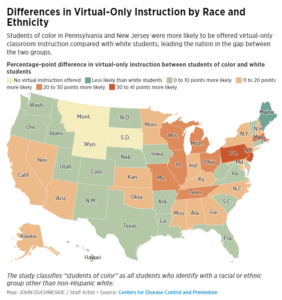
🏆 RUNNER-UP: This week’s runner-up is Pa. and N.J. racial gap in access to in-person learning last year was among the worst in the nation, new report says by Maddie Hanna and Kristen A. Graham in the Philadelphia Inquirer. Using data from a report coauthored by Brown University economist Emily Oster, Hanna and Graham found that more than anywhere else in the country, students of color in Pennsylvania and New Jersey were less likely than white students to have the option of in-person learning last year. The report isn’t perfect — it only looked at the highest population counties, which accounted for about a third of public schools in the two states. But it confirmed what observers had already witnessed throughout the year: “Suburban schools were generally quicker to open in person than urban districts.” The story is a good example of contextualizing a local reopening story with what’s happening nationally, and it has a great interactive map showing the mode of instruction and race in each state. Make sure you check it out.To get daily education headlines and hear about education journalism events, follow @thegrade_.
|
RACE-BASED PANDEMIC OUTCOMES
The big story of the week, according to us.
|
|
ED REPORTERS SHARE ‘ORIGIN’ STORIES
New from The Grade |
|
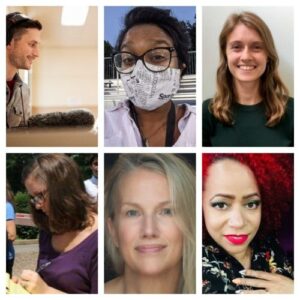
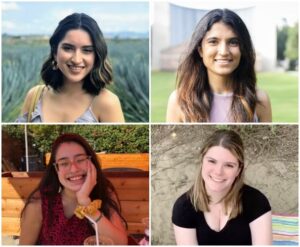
| Above: Clockwise from top left, Ryan P. Delaney, Jenn Smith, Ally Markovich, Nikole Hannah-Jones, Trisha Powell Crain, and Jacqueline Rabe Thomas.
Way back in April, onetime education reporter Jessica Huseman shared a devastating memory from elementary school that haunted her for two decades.
Curious about other education journalists’ memorable classroom experiences, we asked several to share their memories — good or bad — and how these experiences shaped them as reporters.
Some of the responses we received:
“I saw marginalized kids get bullied, and administrators and teachers turn the other way,” said AL.com Ed Lab reporter Trisha Powell Crain. “The only kids who mattered were those who brought glory to the grown-ups.”
One reporter who wished to remain anonymous reflected on their experience being expelled. “I’d never thought about it, but it’s probably affected my reporting. I can’t believe it took me until today to realize why I’m subconsciously attracted to certain stories.”
For more memorable stories from education reporters, go here. Then tag us on Twitter with your own best or worst classroom memory.
|
THE NIKOLE HANNAH-JONES EFFECT
Thought-provoking commentary on the latest coverage.
|
|
|
Above: The Philadelphia Inquirer made a great interactive map to accompany its story about racial gaps in access to in-person learning.
📰 THE HANNAH-JONES EFFECT: She doesn’t really write about education any more, which is too bad for those of us who admire her work. But it’s still important to remember that before the MacArthur “genius” grant, before the 1619 Project, before UNC’s self-immolation — before all of that — star journalist Nikole Hannah-Jones pretty much single-handedly reshaped education journalism around the issue of racial segregation in schools. She brought urgency and power to the beat. She produced a series of standout pieces of journalism. She encouraged a whole new set of journalists to cover schools in new and different ways. Bused across town as a student, she advocated powerfully for school integration as the key to addressing racial inequality in education. But she also chose a segregated school for her daughter and — ultimately — chose an HBCU for the next stage in her career. Read some of the many articles and columns we’ve written about her here. As I’ve been saying all week, I hope that all of us who care about education journalism understand and appreciate all she’s done. It’s really quite amazing.
📰 VACCINATING KIDS: The much-debated issue of kid vaccinations looms over the coming school year. EdWeek reports that the head of the NEA doesn’t support a vaccine mandate for kids or teachers — at least not yet. The NYT reports that time is running out for many eligible U.S. students to get fully vaccinated before schools reopen. But the Chicago Teachers Union has set a goal for kids to get vaccinated, and the district is going to ask parents about their children’s vaccination status. The new CDC guidance is out just now. See coverage from the AP, ABC, WSJ, and the NYT.
📰 DON’T MAKE TOO MUCH OF LOUDOUN COUNTY: The wealthy Virginia school district is an understandable focus for news coverage like Politico’s Could a School-Board Fight Over Critical Race Theory Help Turn Virginia Red? and the Washington Post’s How and why Loudoun County became the face of the nation’s culture wars. But it also illustrates a problem in how education gets covered, according to AL Education Lab editor Ruth Serven Smith. “This is a crucial topic and a fascinating test case for the current culture war,” notes Serven Smith. “BUT the editorial instinct that people will only care about education issues if cast as part of a national horse race makes me scream.” She also notes that reporters shouldn’t overstate the likelihood that CRT will flip the area Republican. For more tips on how to cover the CRT debate, go here.
📰 ‘DELTA VARIANT PANIC’ & MISLEADING PERCENTAGES: There’s lots of discussion about the Delta variant, which is more easily transmitted than the earlier versions of COVID-19. But it’s important not to fall prey to “Delta variant panic,” according to this SF Gate op-ed from a prominent public health expert: Delta variant panic could cause more harm than good. For more background, see EdWeek’s How Does the Delta Variant Figure Into Schools’ Opening Plans? And check out public health officials’ insights in an interview with Atlantic contributor Emily Yoffe headlined What We Got Wrong (and Right) About COVID-19. While you’re at it, consider this reminder from Poynter that reporting the percentage of infections that are young people is a misleading way to present what’s happening. The Friday NYT writeup of the CDC guidance gets lots of things wrong.
Did someone forward you this newsletter? You can sign up here.
|
PEOPLE, JOBS
Who’s going where & doing what?
|
|
| Above: Clockwise from top left, education reporter interns Aydali Campa Lopez, Pooja Salhotra, Emma Talley, and Mia Alva.
🔥 Interns rule! Summer is the time for journalism interns and fellows to shine, and these interns are on fire. Aydali Campa Lopez got her first byline in the Wall Street Journal this week with a story on summer school makeovers. Chalkbeat NY intern Pooja Salhotra recently wrote about a student who got into one of NYC’s top high schools — and wished she hadn’t. San Francisco Chronicle metro intern Emma Talley has been writing education stories with Jill Tucker, including one about two Marin schools forced to integrate after years of segregation. And EdSource intern Mia Alva contributed to her first story with the California publication on how colleges are preparing for incoming freshmen after a year of learning loss.
🔥 Jobs: The 19th is hiring an education reporter to “tackle the gender and racial disparities, challenges and success stories in our nation’s K-12 schools, as well as the pipeline to post-secondary education.” St. Louis Public Radio is hiring an education reporter to replace Ryan P. Delaney, who is now writing for the National Center on Education and the Economy, according to his Twitter bio. The Wall Street Journal is hiring a national education reporter to cover K-12. The 74 is hiring a senior education reporter focusing on policy, equity, and solutions. The News-Press and Naples Daily News in Florida are hiring an education reporter. Another outlet with multiple openings? Chalkbeat. Connecticut Public Radio is hiring an education reporter. The Education Writers Association is hiring a program specialist. Colorado Public Radio is looking for a health, education, and justice editor. And applications for the CalMatters College Beat fellowship are due Sunday. The part-time, flexible, paid fellowships are open to student journalists in California.
🔥 New roles: Tracy Swartz is now covering education for the Chicago Tribune after reporter Hannah Leone took the buyout. Former Connecticut Mirror education reporter Jacqueline Rabe Thomas, whom I profiled for The Grade back in October, has officially joined The Accountability Project team at Connecticut Public Radio. The team will report on education, the economy, business, housing, and government. Congrats to all!
|
BOOKS, PODCASTS, EVENTS
What just happened & what’s coming next?
|
|
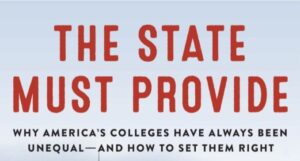
| ABOVE: The Atlantic’s Adam Harris will have his new book out next month, The State Must Provide, which is all about college inequality. Details here. Order now!
⏰ Podcasts you missed: The most recent edition of Vox’s The Weeds podcast features former education reporter Libby Nelson talking about No Child Left Behind, the controversial George W. Bush-era relic of bipartisan education reform, and how it connects to today’s CRT debate. (No time for podcasts? Here’s Matt Yglesias’ Twitter thread exploring the connection).
⏰ Also: “For 30 years, US News & World Report has been using a secretive formula to rank the best colleges and universities in the United States,” notes a recent episode of Malcolm Gladwell’s Revisionist History podcast about “the rankings game.” Since the beginning, the US News list has been enormously influential, lucrative, and controversial.
⏰ And: The NYT’s Trip Gabriel was a guest on The Daily last Friday, talking about the furor surrounding CRT, based on his story (with Dana Goldstein) about the conflict.
⏰ New and expanded: Congrats to South Carolina’s Post and Courier, which announced the creation of an Education Lab to promote deeper schools coverage over the next three years. The Post and Courier joins AL.com, the Dallas Morning News, and a slew of other mainstream outlets that have created nonprofit ed labs inside larger news organizations. Read about the trend here. Also: There’s a new nonprofit news outlet that covers education, the Tennessee Lookout. Check it out.
⏰ Coming soon: Sign up now for Education Week’s July 13 Seat at the Table event, Critical Race Theory: Understanding the Debate, featuring Stephen Sawchuk and Andrew Ujifusa. Reimagining Education TC is thrilled to have Nikole Hannah-Jones as its keynote speaker at #RESI21 July 12. And pencil in August 11, when a new podcast arrives from APM Reports on who’s teaching our kids.
| H/T to Sacramento teacher and blogger Larry Ferlazzo for making an education version of the Gulf Fire meme. |
|
|
That’s all, folks. Thanks for reading!
Read more about The Grade here. You can read all the back issues of The Grade’s newsletter, Best of the Week, here.
By Alexander Russo with additional writing from Michele Jacques and Colleen Connolly. |
|
|
|
|
|
|
|
|
|
|