0
(0)


PLAYING CATCH-UP
While some districts are still doing hybrid, remote, and part-time instruction, many others are ramping up plans for summer school, tutoring, and other approaches to help kids regain ground after the interruptions and inadequacies of the learning they’ve received this past year and a half.

🔊 Parents worry children are falling behind but approve of Newsom’s handling of education, poll finds (LA Times)

🔊 The debate over how to handle kids’ “lost year” of learning (Vox)

🔊 De Blasio’s budget would earmark $500M for testing and tutoring (Chalkbeat)

🔊 How Educators Are Approaching Summer Learning This Year (Education Week)

🔊 Despite Some Recovery of Learning Lost During Pandemic, Test Results Reveal Large Gaps (The 74)

🔊 Abbott, state leaders announce $11.2B in funds are headed to Texas schools to aid pandemic learning loss (Dallas Morning News)

🔊 Summer School Is More Important Than Ever. But Teachers Are ‘Fried’ and Need a Break (Education Week)

For other big stories this week, see Media Tidbits two sections below.

2 SCHOOLS IN NJ
The best education journalism of the week, plus a runner-up or two.
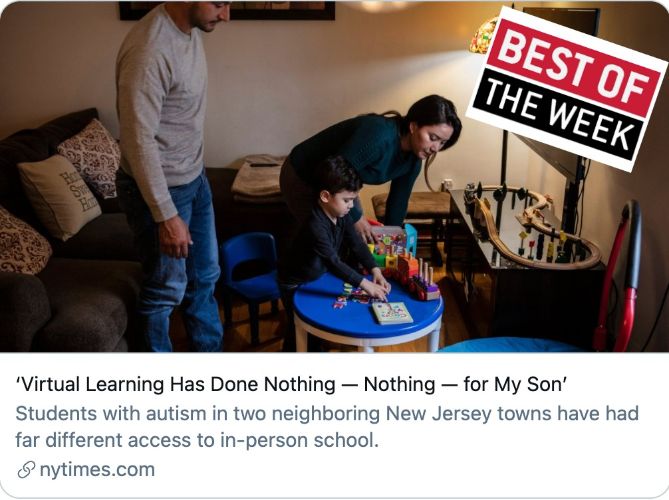
🏆 BEST: The best story of the week is How 2 NJ Schools With Similar Covid Cases Are Reopening by Tracey Tully in the New York Times. I’m a sucker for comparison stories, and Tully looks at two similar districts just five miles apart to highlight the VERY different experiences that special needs kids have had in those schools this last year. In one district, kids with autism have had about 100 hours of in-person instruction since the beginning of the school year. In the other district, they’ve had 700 hours. Parents are blaming it on an uneven reopening strategy with too much flexibility granted to districts by New Jersey Gov. Phil Murphy. This is not an isolated dynamic, writes Tully. “As has happened across the country, the districts made radically different choices about whether and how to reopen.”🏆 RUNNER-UP: This week’s runner-up is The wires may be there, but the dollars aren’t: Why millions of California students lack broadband by Jackie Botts and Ricardo Cano in CalMatters. Botts and Cano interviewed more than 30 students, teachers, researchers, advocates, and education leaders and found that nearly a third of students in rural areas lacked reliable internet access, including many poor and immigrant families. They found that affordability and broadband availability were two of the main culprits. As California lawmakers attempt to close the digital divide, parents worry their kids will never be able to catch up after a year of remote learning. One teacher said she feels like a nurse in a war zone trying to save these kids: “They’re bleeding out, but I’m behind the fence and I can do nothing to help them.”

BONUS: Another story out of California also caught our attention this week. In Behind the Fight to Reopen San Marcos and Oceanside Schools in Voice of San Diego, reporter Kayla Jimenez looks at two of the only large school districts in the area that have neither resumed in-person classes full time nor decided if they will do so before the end of the year.

To get daily education headlines and education news events, follow @thegrade_.

COVERING SCHOOL READING PROGRAMS
New from The Grade

Literacy is one of the most difficult topics to cover in education journalism. But it’s a critical task that’s not going away anytime soon. And, over the past year, a handful of skilled education reporters have shown us how to do it.

In this week’s new column, education reporters at Chalkbeat, the Boston Globe, and EdNC tell The Grade contributor Colleen Connolly how to report and write about district literacy efforts: digging into district and state policies, knowing how to pick apart research studies, and being careful not to blame classroom teachers for what they find.

“For me, it’s been helpful to look at this as a leadership problem more than ‘teachers are incompetent,’” says Chalkbeat’s Ann Schimke, “because I don’t think that’s the case.”

For more on covering literacy, check out our roundup of past stories we’ve published on this topic, including a column from guest writer Colette Coleman on the need for more coverage of  Black kids’ literacy and a Q&A with Emily Hanford on why reading went under the radar.

Belated thanks to Politico’s Shia Kapos for including my latest column (Five questions about Adam Toledo’s education) in her excellent newsletter last week.


MEDIA TIDBITS

Thought-provoking commentary on the latest coverage.

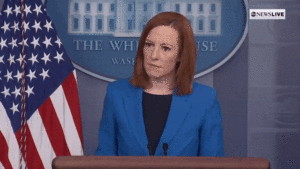
Above: Early in the week, ABC’s Karen Travers asked Biden press secretary Jen Psaki: “If the buildings are open, but the students are still learning remotely a significant portion of the time, does the president view that as a success?” Psaki’s response, in part: “We have every confidence we will be over 50% of schools open five days a week.”

📰  LACKLUSTER COVERAGE OF BIDEN’S SCHOOL REOPENING DEADLINE: Given Biden’s latest education proposals and the lack of definitive reopening data, perhaps it’s not a surprise that there wasn’t all that much coverage of whether the White House met its pledge to get more than half of all elementary schools open within 100 days. As far as we know, many millions of kids still aren’t back in schools, and many more are back only part time, receiving limited in-person instruction. The 74 gave Biden credit for meeting the goal, based on helpful but likely overstated Burbio numbers. The Associated Press gave Biden a grade of “partially met” for his reopening pledge. Politico did a pretty good job focusing on the racial gaps among returning kids, though I think that angle has been overplayed somewhat. (The Washington Post also focused on uneven progress.) In what might have been the strongest attempt to address the question, ABC News covered the White House press briefing where Jen Psaki ducked the question on whether the 100-day goal had been met. Media coverage of reopening risks has been a major problem. But education journalists seem to have moved on to other topics.

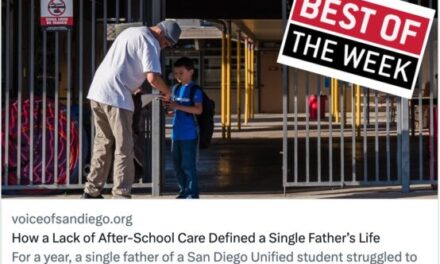
📰  UP NEXT: TRACKING DISTRICT SPENDING: One of the central tasks for education reporters over the next few months is going to be figuring out how to report on districts’ efforts to spend the new federal money they’ve been receiving — and any additional money that comes along. One part of the challenge is documenting how districts spent the CARES Act money they got during the first year of the pandemic. (According to Voice of San Diego, county schools spent a majority of its funding on employees.) Another part is documenting how the latest wave of federal relief funding is being spent. (Mainstreet Nashville has covered the district’s award of an $18M no-bid contract.) The coverage will succeed or fail based on how well reporters contextualize the numbers as part of overall district spending and how specific they can get in detailing the concrete effects of the spending and the people involved in making the improvements happen. One smart way to go: Compare and contrast your district’s progress against that of a demographically similar counterpart.

📰  REPORT FOR AMERICA IS EVERYWHERE (AGAIN): Congratulations to Rebecca Griesbach and Savannah Tryens-Fernandes on joining the Alabama Education Lab at AL.com in partnership with Report for America (RFA). They’ll join senior reporter Trish Crain and education editor Ruth Serven Smith in June. But they’re far from alone. Other education reporters in RFA’s newest cohort announced this week include A.V. Benford at CapRadio & Sacramento Observer, Anna Bryson at Henrico Citizen, Laura Onyeneho at the Houston Defender Network, Becca Savranskey at the Idaho Statesman, Madeline Thigpen at The Atlanta Voice, Rafael Garcia and Maria Benevento at The Beacon, Kyra Miles at WBHM, and Dustin Bleizeffer at WyoFile. And the total number of education reporters in RFA (including those staying on from last year) is now 21, according to Rachel Rohr, director of training and service at RFA. Over the past couple of years, RFA journalists have produced several strong pieces, including for the AP. Last fall, contributor Colleen Connolly wrote about how they have been filling in holes in education coverage across the country. Earlier this month, RFA reporter Becky Zosia Dernbach won EWA recognition for the Sahan Journal covering education being provided to Minnesota’s immigrant and refugee communities.

PEOPLE, JOBS
Who’s going where & doing what?

Above: WFYI’s new Indianapolis-focused education team is all staffed up now. Led by managing editor Eric Weddle (top left), the team includes (L-R top) project manager Holly Edgell; reporters Dylan Peers McCoyElizabeth Gabriel, and (L-R bottom) Lee Gaines; community engagement specialist Tasha Gibson; and digital editor Lindsey Erdody.

🔥 Hired: Anne Vasquez will be the next executive editor of EdSource after Louis Freedberg announced he will move into a role more focused on writing and reporting. Vasquez has been with EdSource for 2.5 years and is currently the director of content and strategic initiatives.

🔥 Jobs: We’re told that the Boston Globe is looking to hire a replacement for education editor Sarah Carr, who won an O’Brien Fellowship that will allow her to dig deep next academic year on education equity. The Houston Chronicle is hiring a suburban education reporter (presumably to replace Shelby Webb, who recently left to cover energy tech). The Austin American-Statesman is hiring a higher ed reporter. Chalkbeat is hiring reporters in Indiana (to replace Dylan Peers McCoy) and Tennessee (presumably to replace Laura Faith Kebede, who’s leaving to focus on telling stories about history).

🔥 Recognition: Listen to what Tristan Ahtone, the editor in chief at The Texas Observer, has to say about winning the 2021 George Polk Award for Education Reporting for his High Country News article “Land-Grab Universities,” coauthored with Robert Lee. The New York State comptroller’s office followed NY Post education reporter Susan Edelman’s 2019 coverage of the hazardous and unsafe conditions at a school for special needs kids with an audit of 29 schools that confirmed Edelman’s reporting. And Pulitzer Prize-winning MacArthur “Genius” NYT reporter Nikole Hannah-Jones has been named Knight Chair in Race and Investigative Journalism. Read more about the move here.

Did someone forward you this newsletter? You can sign up here

EVENTS
What just happened & what’s coming next?

Above: The EWA’s national conference, virtual again this year, starts Monday afternoon. The agenda is here.

⏰ ICYMI: LAT’s Sonali Kohli, Chalkbeat’s Nicole Avery Nichols, and NYT’s Eliza Shapiro talked about how kids will catch up after a year of disrupted learning at a CUNY journalism event on April 27. We’re looking for a video of the event. Watch Epicenter NYC’s S. Mitra Kalita, WURD Radio’s Sara Lomax-Reed, and Scalawag magazine’s Cierra Brown Hinton for the first of many special media roundtables from URL Media. The topic? White Media/Black Pain. And KPCC higher ed reporter Jill Replogle hosted a virtual Q&A on “how to start a new career.”

⏰ The Ida B. Wells Society has another paid remote internship opportunity, this one with the Associated Press. The deadline is May 14. Their internship with USA Today has a deadline of May 1.

⏰ The LAT’s Melissa Gomez wrote a post for Save Student Newsrooms where she talked about her days at the Independent Florida Alligator (not so long ago) and called for more support for student journalists: “Never underestimate a journalist who learned how to report in a student newsroom.”

⏰ Check out Odessa, Part 4, the finale of the NY Times four-part series tackling the public health crisis that became a mental health crisis at Odessa High School.


THE KICKER

These student-made mock New Yorker covers made their rounds on Twitter this week, and these are two of our favorites. Which are yours? (h/t Anya Kamenetz)

That’s all, folks. Thanks for reading!

ABOUT THE AUTHOR

Alexander Russo

Alexander Russo

Alexander Russo is founder and editor of The Grade, an award-winning effort to help improve media coverage of education issues. He’s also a Spencer Education Journalism Fellowship winner and a book author. You can reach him at @alexanderrusso.

Visit their website at: https://the-grade.org/

How useful was this post?

Click on a star to rate it!

Average rating 0 / 5. Vote count: 0

No votes so far! Be the first to rate this post.