Breakout stars, big surprises, and mysteries in this year’s Education Writers Association national journalism awards.
By Alexander Russo
On Tuesday, the Education Writers Association (EWA) announced the winners of its national awards for 2020, recognizing the “top education journalism in the United States” from among 350 entries.
“The entries emerged during a turbulent year that presented exceptional obstacles to newsgathering,” according to the announcement. “Yet the winners, finalists and other entrants persevered and delivered compelling stories in groundbreaking ways.”
Now, I have issues with the EWA contest, most notably that it doesn’t allow for the recognition of journalism that hasn’t been submitted to EWA.
And, despite the enormous effort and abundant talent on display here, last year’s crisis exposed serious flaws in education journalism that remain unaddressed. (For more on that, see my recent interview with Amanda Ripley.)
Still, the 15 winners and finalists in seven categories include some breakout stars, surprises, and a lot of high-quality journalism.
“They did this during a pandemic,” tweeted Chalkbeat’s Susan Gonzalez. “They did it with kids. They did it through chaos, tears & uncertainty. They did it b/c they cared.”
Indeed. What an important, horrible time to be an education journalist.
Congratulations to all of those involved in producing and judging the work that’s recognized here.
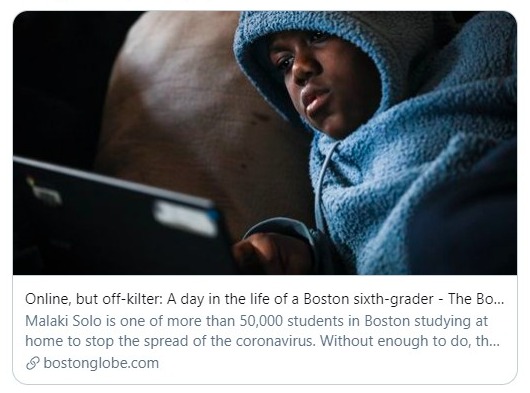
The breakout star of this year’s awards for me is Bianca Vázquez Toness, who joined the Boston Globe education team when it was expanded two years ago.
“Nearly all of her pieces were told not only through on-the-record accounts of families but also supportive documents and data that illuminated the depth and scale of the problem,” according to the EWA write-up for Beat Reporting (Large Newsroom). “That powerful combination has routinely forced state and local leaders to rethink their policies and practices.”
Indeed, Vázquez Toness was among the first reporters to depict how limited remote learning was for many kids, and how inadequate the district’s offerings were compared with other places like Providence.
A former radio reporter whose work sometimes reminds me of WBEZ Chicago’s Linda Lutton, Vázquez Toness gives readers access to important voices and tells great stories.

The big surprise of the awards for me has to be the Washington Post’s Hannah Natanson, the local education reporter who won the News (Large Newsroom) category for her coverage of Fairfax, Virginia, public schools, located just outside Washington, D.C.
In a series of stories EWA describes as “deeply sourced investigation into how, and why, one of the nation’s top school systems was caught surprisingly unprepared for the push to move its instructional programs online amid the COVID-19 pandemic,” Natanson put the much-admired school district in the spotlight and never let district officials and educators off the hook.
Natanson’s Fairfax coverage won out against digital divide coverage from a team from the Chicago Tribune and ProPublica IL as well as a team of her fellow Post reporters who wrote about bullying and discrimination in schools during the Trump administration.
It was an especially busy year for Natanson, who also did a lot of work covering the Black Lives Matter protests in D.C.
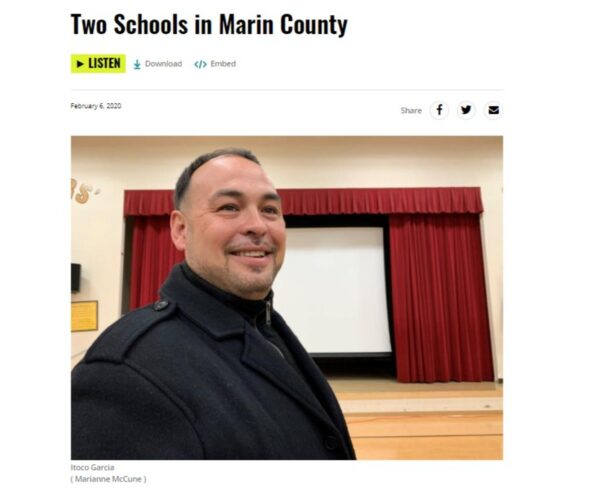
Not a surprise, but well-warranted nonetheless, is the win for the hour-long segment Two Schools in Marin County in the Audio Storytelling (Larger Newsroom) category.
Aired as part of WNYC’s United States of Anxiety, Two Schools tells the story of a liberal Bay Area enclave plagued by pervasive school segregation and inequality. Reported by Marianne McCune, the piece examines the contradictions of action and echoes some of the insights of another 2020 podcast, Nice White Parents, which came out a few months later.
“Great tape, great voices throughout, and good writing make this one of the best pieces I’ve heard about the incredibly complex issue of school segregation,” noted one of the judge’s comments.
The follow-up to Two Schools in Marin County came out just recently, and if you aren’t moved to rethink school integration by listening to it, then we can’t be friends.
In terms of misses, there are some obvious ones, though we have no way of knowing whether they were submitted to the EWA contest.
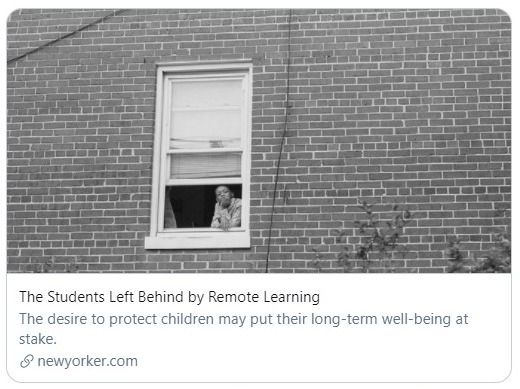
Though she’s a finalist for her Hechinger Report feature, I’d argue that Casey Parks’ New Yorker story The New York City Schools That Didn’t Close also deserves recognition. Ditto for Alec MacGillis’ The Students Left Behind by Remote Learning for ProPublica and the New Yorker. And it’s hard not to notice that the New York Times’ Nice White Parents is not included here.
In terms of full-time education teams, I think that the Wall Street Journal education team put out a lot of strong work in 2020. EdWeek deserves a special award for its heroic school closing map, among other things. And while NPR’s COVID comic won out for visual storytelling and its journalists are finalists in at least one other category, I thought correspondent Anya Kamenetz did a particularly good job covering the reopening story and was sad not to see her name.
Again, it’s entirely possible that stories just weren’t entered.
A few other items of note:
- I’m glad to see so many reporters and stories from trade publications and online newsrooms like The 74, EdSource, EdSurge, CALmatters, EdNC, Hechinger Report, and Chalkbeat included among those recognized.
- If there’s a controversial pick among this year’s winners, it might be Samantha Shapiro’s New York Times story, The Children in the Shadows, which won for Features (Large Newsroom). I would probably have given the award to The Test of Their Lives , Laura Meckler’s Washington Post piece about kids trying to finish their AP class and pass the test.
- Sahan Journal’s Becky Zosia Dernbach might be the first reporter to be named a finalist (for beat reporting) after just six months on the job. The Sahan Journal reporter’s coverage, Education in Minnesota’s Immigrant and Refugee Communities, includes stories about a teacher of color losing her job and first-generation college students struggling to complete college applications.
The grand prize winners will be announced at EWA’s national seminar, held early next month. They include the Fred Hechinger award, the Eddie Prize (for the best writing on getting underserved students to and through college), and Moskowitz Prize (for outstanding beat reporting).*
*Correction: The Eddie is not limited to higher education coverage, as written in the original version of this column, and the career achievement prize named after longtime Baltimore Sun education reporter Mike Bowler will not be given out at this year’s conference.
Related:
The 14 most memorable pieces of education journalism of 2020
The EWA awards process is broken. Here’s how to fix it.
ABOUT THE AUTHOR

Alexander Russo
Alexander Russo is founder and editor of The Grade, an award-winning effort to help improve media coverage of education issues. He’s also a Spencer Education Journalism Fellowship winner and a book author. You can reach him at @alexanderrusso.
Visit their website at: https://the-grade.org/