Despite last summer’s promises, not enough progress has been made toward creating diverse, anti-racist education newsrooms where Black reporters feel safe sharing their workplace experiences.
By Amber C. Walker
It’s been 10 months since the death of George Floyd at the hands of the Minneapolis Police Department and the Black Lives Matter protests that spread across the nation.
In that time, several newsrooms across the country have publicly reflected on how they can create more inclusive workplaces for their Black staff members.
In August, Maribel Perez Wadsworth, publisher of USA today and president of News at Gannett, published an op-ed referencing George Floyd’s death as a catalyst for the company to hire more journalists of color.
Following a high-profile gaffe of the New York Times editorial section in June 2020, the paper released a February report examining the Times’ shortcomings in terms of its newsroom culture and diversity, pledging to increase representation of Black and Latinx people in leadership by 50% in the next four years.
Among education news outlets, Chalkbeat’s cofounder and CEO Elizabeth Green released a statement announcing the publication added and explicitly anti-racist stance to its core values.
How have we seen education outlets make good on last summer’s promises, and in what ways are they still falling short?
Chalkbeat hired Nicole Avery Nichols as their editor in chief at the beginning of this year and recently partnered with the Reynolds Journalism Institute on its source diversity initiative.
Education Week promoted Daarel Burnette II to assistant managing editor, and Delece Smith-Barrow joined Politico as their education editor.
It’s a start, but far more is needed.
Even if news outlets have the money to keep hiring – an uncertain scenario – bringing on more journalists of color still won’t make newsrooms more anti-racist unless leadership grows more willing to listen to, trust, and yield power to Black reporters.
Bringing on more journalists of color still won’t make newsrooms more anti-racist unless leadership grows more willing to listen to, trust, and yield power to Black reporters.
These calls for newsrooms to do better in terms of their coverage and treatment of Black employees are not new. Far from it.
Alex Neason of the Columbia Journalism Review wrote about these newsroom “apology packages” in her January 2021 piece, “On Atonement,” where she did a deep dive into the history of how newsrooms have responded to charges of racism and the lack of meaningful follow-up.
Neason said she was inspired to write her piece after Black staffers at the Los Angeles Times took to Twitter shortly after George Floyd’s killing to bring awareness to disparate treatment they endured in their newsroom. In her piece, Neason stresses that Black reporters are often agitating for better editorial approaches to covering Black communities and treatment of Black reporters long before the news event that usually triggers the release of an apology package.
“These are really old problems,” Neason said in an interview with The Grade. “The vocabulary has changed, but we’re talking about the same things. We’re still talking about people being underrepresented in mastheads, work environments not being hospitable to people of color and other marginalized backgrounds, what stories we pursue and how we perceive them, and what the consequences of those decisions are for people from the marginalized communities that we’re supposed to be serving as news outlets.”
“The news events might shift, so it’s George Floyd or it’s Trayvon or it’s Ferguson, but the inequities are structural and the structures in journalism have not changed, so the problems haven’t changed either.”
Considering the cyclical nature of these complaints and the long history of American racism, it’s difficult for newsroom leadership to argue a lack of awareness. I suspect it is an unwillingness to cede power or space to Black colleagues.
It’s difficult for newsroom leadership to argue a lack of awareness. I suspect it is an unwillingness to cede power or space to Black colleagues.
While Black reporters have historically been at the forefront of agitating their newsrooms, calling on your employer to do better requires a great deal of bravery or job security, which Black reporters may not have in their workplaces.
As I prepared to write this piece, I reached out individually to more than a dozen Black K-12 education reporters working at large, national outlets and local newspapers across the country.
I also put an all-call out on my personal Twitter page, which was retweeted by the Grade and a few others.
I even offered off-the record interviews for Black journalists who were willing to speak candidly with me.
Some journalists didn’t respond at all — despite multiple attempts at making contact via email. Others declined without explanation.
A few journalists expressed interest in speaking with me but asked that I to reach out the communications team at their outlets, which declined on their behalf.
Some cited reluctance to speak while collective bargaining organization efforts were ongoing at their publications.
A couple wanted to avoid any possible retaliation.
Some spoke of burnout given recent high-profile incidents in their newsrooms.
Another said they did not have anything to add to the story.
For all these efforts, I was able to get just one Black education journalist to speak with me, on the record or off.
For all these efforts, I was able to get just one Black education journalist to speak with me, on the record or off.
Unsurprisingly, she works for an organization that has prioritized building an inclusive newsroom since its inception that could serve as a useful model for other publications.
Lori Higgins, bureau chief for Chalkbeat Detroit, said Chalkbeat is a rare example of an organization that does a great job of embodying its mission in the day-to-day operations of its newsroom.
She credits Chalkbeat for creating space for both staff and audience to share their feelings during difficult events.
“We can’t say that we are an organization that writes about equity in education and not lead by example when it comes to the way we operate,” Higgins said in an interview with The Grade.
“We’re having really deep conversations as a group to talk about how people are feeling,” Higgins told me. “I’ve never worked at a news organization that has done that and I’ve been in this business almost 30 years now.”
Higgins said there have been times when the industry has acknowledged its shortcomings and tried to improve, but those declarations resulted in limited change for Black reporters in newsrooms.
At Chalkbeat, Higgins said she feels her perspective is valued.
“I came up during a time where there was this big effort to get more ‘minorities’ into journalism. There was all this recruitment…But there was no discussion or motivation to understand the value that these diverse individuals are bringing to your news organizations and that they have a perspective that should be listened to,” Higgins said.
“[At Chalkbeat] my perspective was valued from the get-go. I can say that I’ve never felt that before in any news organization that I’ve worked at.”
“My perspective was valued from the get-go. I can say that I’ve never felt that before in any news organization that I’ve worked at.” – Lori Higgins, Chalkbeat Detroit bureau chief
While I am heartened to hear about Higgins’ experience at Chalkbeat, I’d venture to say this is not the norm for Black education reporters, considering that so many were hesitant to speak with me — as well as my own personal experience covering K-12 education in a predominantly white newsroom.
As a Black reporter, there is a level of fear that your grievances could not only be ignored but that speaking out could result in strained relationships with colleagues or your work life becoming so untenable that you leave entirely.
I remember testing the waters early on in Madison by making the case to capitalize the “B” in Black in our stories. I defaulted to writing the “B” in my stories, but noticed it was switched to “b” when they were published. When I prodded my editor about why, she referenced the style guide. Despite pushing back on the issue, nothing changed.
At the time, I was a young journalist in my first full-time reporting role. I did not think any of the other journalists in the newsroom would back me if I continued to push the issue, and my direct boss had already said the newsroom was not willing to make the change.
I had to evaluate if the issue was worth the risk of coming off as difficult to work with, and ultimately decided that it was not. But the incident made me less inclined to try to meaningfully improve the culture of the newsroom. I figured if I could not get them to even consider such a small change, they were not ready to hear about any deeper systemic issues that may have affected the newsroom.
In retrospect, I wish I had been more vocal. The longer I’ve been in the workforce, the more I’ve come to realize how important both the work itself and the culture of a workplace are when I decide to be a part of a team. However, this perspective came after gaining more professional experience, rank, and confidence in my work. As well, now that I’m self-employed, there is a certain sense of comfort in being able to choose to work with entities that exemplify my values.
It appears from some recent articles that The Cap Times followed in the footsteps of some other publications in the region (and across the country) that are now capitalizing the B in Black, although I could not find any public announcement detailing the decision.
In retrospect, I wish I had been more vocal.
George Floyd’s killing was a catalyst for newsrooms to consider both small and systemic reforms to create more hospitable workplaces for Black journalists.
There are some signs of bigger changes being considered by newsrooms. Many newsrooms are consulting experts’ help to realize this vision.
Martin Reynolds is the co-executive director of the Maynard Institute for Journalism Education, which offers a course called Fault Lines designed to help journalists realize and address their implicit biases across race, gender, sexual orientation, class, generation, and geography — as well as consider how they might serve as agents to dismantle systemic racism in their newsrooms.
Through his work, Reynolds is able to see some of the pain points around race that journalists face in newsrooms. And he told me that Black journalists may have been hesitant to speak with me because of potential backlash from their employers that would come from making their grievances public.
“I think the reason black journalists aren’t willing to get on record is because it’s dangerous,” Reynolds said in an interview. “There have been some courageous young people doing it, but why should they risk their careers and the perception that they are troublemakers, when the reality is they don’t actually have the power to make the change?”
“I think they’re being cautious because they have the most to lose.”
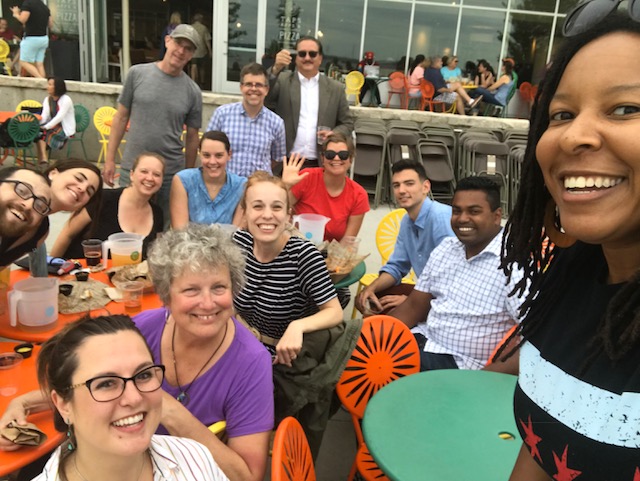
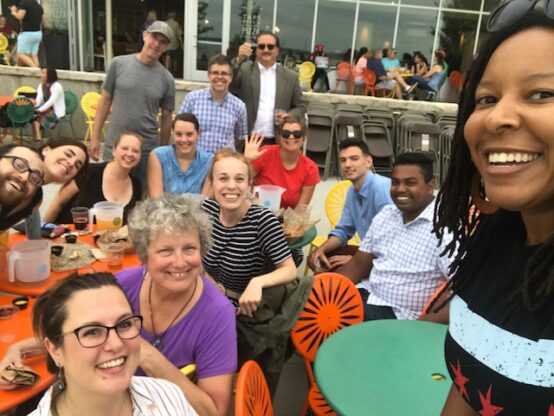
Above: Walker and some of her colleagues at Madison’s Cap Times. From her 2018 essay, What it’s like being a rookie education reporter)
Since June 2020, Reynolds said there has been an uptick in newsrooms of all sizes and structures seeking Fault Lines training. Although the will is there, the issue might be execution, including the cost of moving forward.
“While there seems to be a greater desire on the part of news organizations, there are varying levels of actual capacity to do things. The big issue people often bring up is hiring, and because the financial model is still under deep stress, (news organization leaders) say ‘we can’t hire our way out of this,’ ” Reynolds said.
“Even when organizations, particularly newspapers, were making money hand over fist and they could’ve hired their way out of it, they didn’t. So there needs to be a much longer-term strategy.”
Reynolds said more newsrooms are expressing a desire for an anti-racist framework and considering what it looks like to dismantle white supremacist structures, versus simply a focus on diversity, equity, and inclusion.
“That unto itself is a tectonic shift and one that I did not think we would see, and it certainly has enabled us to reposition how we advise news organizations.”
Last October, The Maynard Institute announced Vision25: Building Racial Equity in Newsrooms, which, in partnership with Open News and the Online News Association, aims to recruit 22,000 journalists (or 25 percent of the field) to join the movement to build anti-racist organizations. Vision25 will focus on coaching C-suite leaders, organizing editorial staff, and facilitating collaboration opportunities for journalists committed to racial equity.
Reynolds said that in order for an ambitious project like Vision25 to work, white newsroom leaders must be willing to sacrifice some of their power. “I just think that the key pieces here are the need for white people in power in these institutions to really check in on themselves and their privilege, their whiteness,” Reynolds said.
“They need to actually understand the business case for why building an institution of belonging is actually good for the growth and sustainability of the enterprise; and (after that’s realized) what are the specific strategies and steps to do this?”
Previous columns by Amber C. Walker
What it’s like being a rookie education reporter
Introducing Amber Walker, The Grade’s new columnist & editor
How personal experiences shaped one journalist’s perceptions
Writing great profiles in the age of remote reporting
Improving source diversity in education journalism
Related stories from The Grade
Racial inequality in schools and newsrooms
Diversity in education journalism 2020; not nearly good enough
A brain drain in education journalism
A star reporter explains why she left journalism — and ways to fix education news
ABOUT THE AUTHOR

Amber C. Walker
In addition to being a consulting editor and columnist for The Grade, Walker is a multimedia journalist and digital content strategist. You can find her @acwalker620 across platforms.