A study of three RPPs reveals how tricky it can be for researchers and practitioners to negotiate new kinds of professional relationships.
Since they first came onto the scene, roughly two decades ago, research-practice partnerships (RPPs) have shown real promise in helping school districts, with assistance from the research community, to analyze and respond to the most pressing problems they face, whether those problems have to do with teacher development, student behavior, school climate, parent engagement, or any other aspect of K-12 education. On the whole, as Cynthia Coburn, William Penuel, and Caitlin Farrell describe in this issue of Kappan, studies of RPPs have been encouraging, suggesting that they’ve helped school systems to sustain improvement initiatives over time, include more diverse perspectives in decision making about local policies and practices, and connect with other school systems to share what they’ve accomplished. Both the research and the practice communities have benefited from RPPs that have made research more useful and readily applicable than in the past.
But at the same time, it has also become clear that RPPs tend to face certain challenges, having to do with managing turnover and reorganization of partnership members, communicating their findings within “useful” time lines, securing long-term funding, and, as we describe in this article, creating trusting and professional relationships between practitioners and researchers.
Practitioners and researchers live in different professional worlds, each with its own institutional language and norms, hierarchies, incentive systems, and approaches to solving problems.
Intuitively, practitioners and researchers seem like natural teammates, since each has knowledge and expertise that can inform the other’s work. But in reality, these collaborations can sometimes turn out to be anything but smooth sailing. Practitioners and researchers live in different professional worlds, each with its own institutional language and norms, hierarchies, incentive systems, and approaches to solving problems. Before joining an RPP, they may have never interacted with each other at all, much less collaborated intensively on long-term projects. Our own research has shown that some amount of interpersonal tension is more or less unavoidable in RPPs. And if these partnerships are to be successful, participants will have to understand this tension and find ways to navigate and overcome their professional differences.
Same aim, different designs
Over the last five years, our team at the National Center for Research in Policy and Practice (NCRPP) has studied how school district leaders use research in making instructional decisions and setting policy, as well as how research partners support this work. As part of that larger research project, we also designed a smaller study focusing on the ways in which RPPs try to “bridge” the very different professional identities and backgrounds of the researchers and practitioners who participate in the work.
For this smaller study, we decided to examine three partnerships that differed in their design. To select them, we looked for RPPs that were comparable in at least two ways: They had to be particularly well established (with partners working together for three or more years), and they had to be engaged in trying to solve a similar problem in their schools (in this case, how to improve mathematics instruction). Further, to see whether different kinds of partnerships foster different kinds of professional relationships, we chose study sites that exemplified the three most common types of RPPs. One was a networked improvement community (in which specific practices are studied across a number of districts to see how they play out in differing contexts and conditions), one was a design research partnership (in which a district works with researchers to design and test out new policies, programs, and curricula and to evaluate the results), and one was a research alliance (an ongoing partnership between a district and an independent research organization).
We studied these three RPPs over two years, from 2016 to 2018. In all, we observed 63 partnership meetings, conducted 122 surveys and 133 interviews, and analyzed 58 of the partnerships’ major products and artifacts, such as RPP meeting materials, peer-reviewed journal articles, conference presentations, and other codesigned tools and routines. (Note that we’ve changed the names of the partnerships for this article. For a more complete discussion of findings, see Penuel et al., 2016, 2020).
A networked improvement community
The Eastern Ridge Networked Improvement Community (NIC) was organized by a county office of education in a state with many small rural districts. The county office served as a regional hub for educational services and regularly worked with district leaders and teachers on instructional initiatives. The partnership also included a well-known mathematics education researcher, as well as an intermediary organization that has experience supporting the work of NICs. The goal of the network was to bring together teachers, district leaders, and math instructional coaches from a number of rural districts, and have them work alongside researchers to study and improve their use of Common Core-aligned practices in elementary math classrooms.
A design research partnership
The Cypress Design Partnership brought together university researchers and a mid-size urban school district. The partnership initially formed with the assistance of an individual from a nonprofit organization who acted as a broker, finding researchers who could tie their research agendas to the district’s needs. The partnership focused on adapting a model of professional learning in which teachers analyzed video recordings of their students’ discussions of mathematics problems to identify effective ways to help students strengthen their reasoning and problem solving. The model had been tested in other districts, and the partnership’s work involved modifying the model, examining the modifications, and developing tools to support learning within the model.
The researchers had previously collaborated with the district in a grant-funded project to develop and begin implementing this professional learning model. The original project ceased in 2012, but when new funding became available, the project was relaunched in 2016. This new partnership built on the previous work by convening district curriculum leaders, teacher leaders, and researchers to implement the previously studied model in professional learning sessions and make changes to the implementation along the way in response to the partners’ findings.
A research alliance
The Aspen Research Alliance was a long-standing partnership between a university research center and a large urban school district. During our study, it was focused on a project to identify and study how teachers and schools were implementing the district’s plan for new mathematics and science standards, and to explore links between their instructional practices and student outcomes. The study also looked at how changes in practice were associated with district-provided professional development and other strategies for promoting implementation.
Of the three RPPs we studied, the Aspen Alliance was the closest to a traditional arrangement between researchers and district leaders, in that the researchers conducted a study, analyzed the data, and shared a findings report with district leadership to inform their ongoing policy making. But unlike many traditional arrangements of this kind, these researchers made a concerted effort to be responsive to local needs, rather than pursuing their own interests. Thus, they posed research questions, collected data, and generated findings that were meant to shed light on a specific problem that the district had identified and was eager to solve.
Essentials of productive participation
The three RPPs varied as to the particular mix of partners they included (e.g., whether principals had a seat at the table, whether teachers were involved, whether graduate students participated, which district staff participated, and so on), and they differed in the ways they engaged with ideas, tools, and research findings. The RPPs varied also in the frequency with which partners came together and their reasons for doing so. For instance, there were more frequent meetings and collaborative work sessions in the Cypress Design partnership and Eastern Ridge NIC, where district leaders and researchers co-designed and co-planned their research studies, while meetings were less frequent in the Aspen Alliance, where district leaders listened and responded to researchers’ ideas early in the process, but then proceeded to carry out the jointly designed study on their own.
Despite the differences in the frequency of interactions, though, all three partnerships brought researchers and practitioners together for shared planning and debriefing sessions at a minimum, if not for more sustained collaboration. A majority of the practitioners from all three partnerships reported that they appreciated the formal debriefings, in particular. For instance, a practitioner from the Cypress Design partnership said that not only did the researchers provide valuable information and feedback — sharing their raw findings and explaining their interpretations of the data — but they seemed willing to engage with local educators and district staff on more equal terms than they had in the past. It’s encouraging, she added, to know that “not every interaction between district leaders and external partners is about doing interviews and giving information to research partners.” In her view, these debrief sessions allowed researchers and practitioners to become genuine collaborators, working together to bring to life a specific piece of research in their local context and hypothesize about the factors contributing to the findings.
In short, all three RPPs were alike in that they brought researchers and practitioners together at the same table, asking them to collaborate in designing a research project and interpreting the results. Further, our interviews and survey data showed that many participants had a favorable view of the partnership, describing it as, at least in part, a healthy and mutually respectful exchange among professionals. And yet, our data also suggest that all three RPPs struggled with particular kinds of interpersonal tension, as well.
Synchrony and trust
RPPs are an opportunity for researchers and practitioners to build professional relationships that otherwise might not exist, perhaps because of hierarchical barriers (e.g., between teachers and district leaders), geographical distances (e.g., between rural districts), and institutional boundaries (e.g., between universities and school districts). In the partnerships we studied, we saw new relationships form within and across all of these divides — and the rural teachers in Eastern Ridge NIC, who tend to have few opportunities to work with partners outside their region, were especially likely to describe this as a tangible benefit of the RPP.
Key to all of these relationships were synchrony and trust. In fact, synchrony — the degree to which researchers and practitioners were able to “sync up” their work to one another’s needs — was significantly associated with influence on policy and practice. For instance, one of the most common tensions we observed in our study had to do with the length of time required to conduct and report on a study. To researchers, spending months on a project may seem perfectly normal, but for practitioners who need solutions to immediate problems, that schedule can render the project useless.
On the other hand, practitioners cannot realistically expect an RPP to design a study, conduct it, analyze the findings, and share them within, say, a couple of weeks. Partners need time to identify their most urgent needs, solicit ideas and suggestions from people who have very different professional roles and perspectives, and, perhaps most critically, establish trusting relationships. In the interviews we conducted, researchers and practitioners alike described trust as essential to the success of these partnerships. As a district leader in the Aspen Alliance put it, “When you’re really, really collaborating so much, it takes a lot of trust. A lot of assuming ‘we’re all in this together’.”
Most important, partners singled out the need for researchers and practitioners to acknowledge that they have very different professional vocabularies and ways of talking about similar issues. To build and maintain trust, then, partners must constantly remind themselves to be explicit, define their terms, and make sure that at the end of every meeting, everybody shares the same, clear understanding of the RPP’s next steps, especially who is supposed to do what, and when.
A district leader from the Cypress Design partnership noted that once partners learned to avoid jargon and insider terms and to make sure they really understood each other, then it became much easier to trust each other. Even informal interactions, such as a few minutes of conversation before dinner or during rides from the airport, became important opportunities to strengthen their bonds. And once the participants became certain that their concerns, opinions, and priorities had been heard, then they became much more willing to give each other space to do their part of the work independently:
The more we built trust, and trusted each other, [we] gave each other voice and responsibilities, and said, “OK, it’s yours. I trust you. Whenever you’re ready with it, show it to me.” We ourselves experienced that whole cycle. . . . All those little things build trust, and then that’s when they can really do the work.
Mutual influence and learning
Our findings suggest that when RPPs are designed to encourage certain kinds of professional interactions, partners are more likely to take up and apply the ideas generated by the partnership. Across all three partnerships, the more time partners devoted to one activity in particular — analyzing data together — the more likely they were to use their research findings, later on, to inform policy and practice.
Sometimes partners scheduled formal meetings to collaborate on analyzing their research data, and sometimes they did this in informal settings, such as ad hoc dialogues or at planning sessions when both practitioners and researchers were present. More important than the setting, though, was the fact that all three of the RPPs created opportunities for professionals with different areas of expertise (teachers, school and district administrators, and researchers) to share their differing perspectives on what the data could mean, how it should be interpreted, and what implications for practice could follow. Further, we found that this sort of bridge building was especially valuable when it connected not only practitioners and researchers but also practitioners who represent multiple roles within districts, large ones in particular. RPPs were most successful in translating their research into program and policy decisions, especially ones that touch on multiple levels of the system, when diverse participants came together to analyze the data.
Although much of the discussion about RPPs focuses on how they affect practice, advocates of RPPs contend that these collaborations can serve as a learning opportunity for all partners, not only practitioners. And the lessons that researchers take away from the work can have a much more direct benefit to teachers and districts than one might expect. The more time they spend immersed in the daily work of schools, the more researchers learn about what it will take to apply their research expertise effectively in the specific context. For instance, in the Eastern Ridge NIC, a research partner emphasized how valuable it was to be able to draw upon county leaders’ nuanced understanding of the local schools:
They had a lot of both local knowledge that we didn’t have but, also, knowledge of the actual teachers. They, also, were the ones able to meet with them every time they had these network meetings. They were researchers for us, also, in lots of ways.
Because the designs of the Eastern Ridge NIC and the Cypress Design partnership offered more frequent opportunities for participants to interact, compared to the Aspen Alliance, it’s no surprise that we saw more of this kind of dialogue at those two sites. We suspect that, as a general rule, when RPPs feature frequent and ongoing chances for researchers to tap the knowledge of local partners, the better they are able to tailor their work to the local context. In turn, that can make the data collected and analyses generated more relevant, informative, and compelling to their educator partners.
Informing educators’ decision making
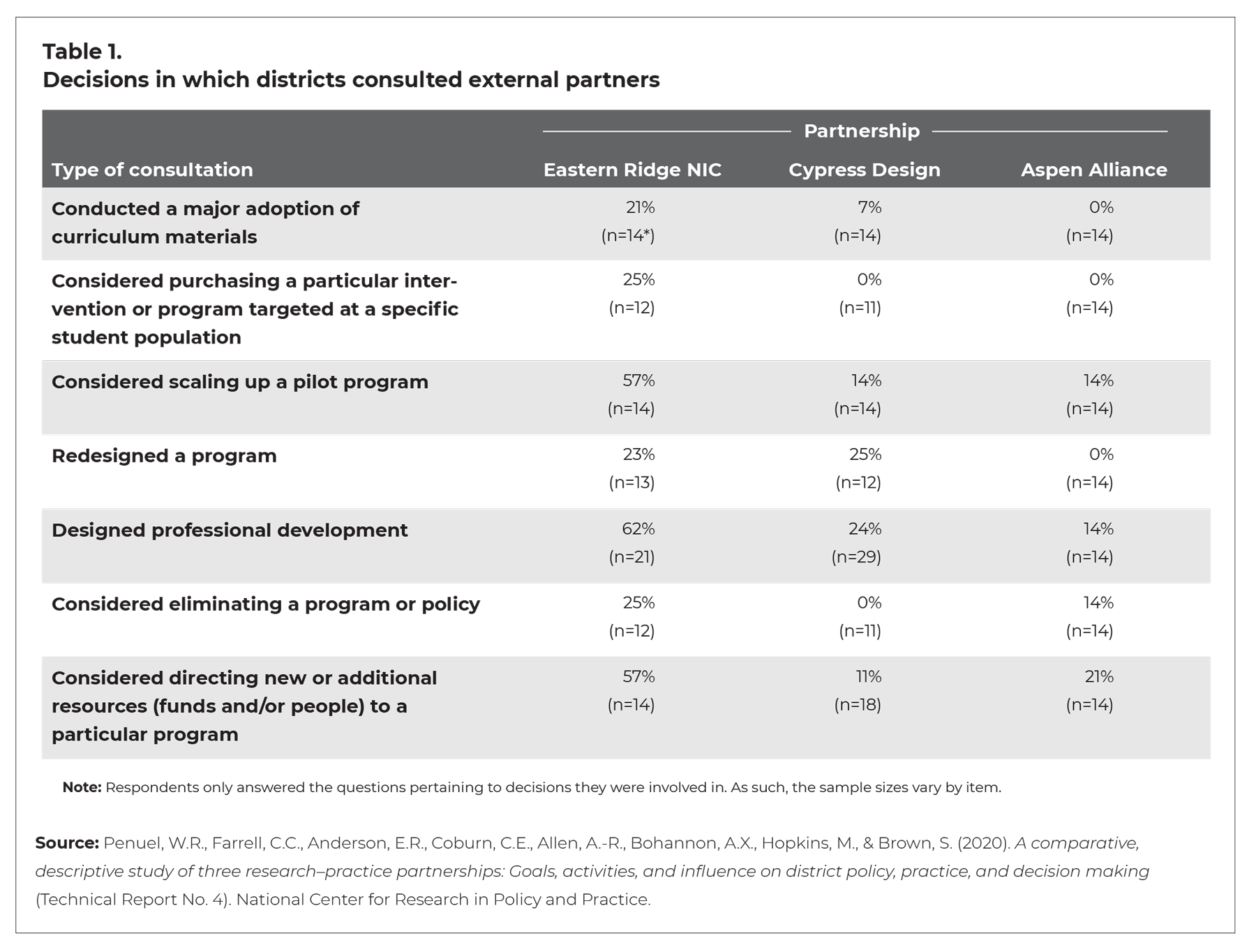
Although research partners in all three RPPs had influence over education leaders’ decision making, the specific areas of their influence varied (see Table 1). For instance, more than half of the district leaders in the Eastern Ridge NIC who were involved in decisions related to designing professional development, scaling up a program, and allocating program resources reported that they consulted their external partners. Because the NIC served as a hub for multiple districts and the study focused in part on the network itself, instead of a specific project, there were likely more opportunities for ideas to spread than in other models. A smaller percentage of leaders in the Cypress Design partnership consulted their external partners, and the most common areas where they sought support were in redesigning programs and professional development design. Leaders in the Aspen Alliance were generally the least likely to consult their partners, and the area where they were most likely to seek support was resource allocation.
In both the Eastern Ridge NIC and the Cypress Design partnership, external partners were directly involved in designing (and in some cases delivering) professional development; their expertise, as well as the trust built up through the RPP, put them in a position to influence professional development in the partner schools and districts. In both cases, the RPPs themselves became a new professional development infrastructure within partner districts. The research partners in Aspen Alliance were not involved in the design or delivery of professional development but, rather, maintained a more traditional role of studying it.
Finding a niche
The Cypress Design partnership also seems to offer an especially promising example of how an RPP can — by leveraging the trust its partners have developed, its attention to the local context, and its proven influence on decision making — become firmly embedded in its district, creating a lasting relationship.
During the period of our study, their work involved a series of three linked workshops where teachers focused on a rich mathematical problem, considering it first from the learner’s perspective and then from a teacher’s point of view. During the first workshop, teachers collaboratively solved a selected math problem and developed plans for teaching it to their students. After the workshop, teachers had their students solve the problem in class, and their lessons were videotaped. In the next two workshops, the group members watched and discussed clips from the lessons, focusing on how to elicit and build on student thinking and exploring a variety of teaching practices to respond to student thinking. However, while the Cypress partnership focused specifically on mathematics instruction, it soon became clear that this model — helping school-based leaders to strengthen their capacity to facilitate effective professional development — could easily translate to other problems of practice within the district. This seems like a promising sign that the partnership will have long-term value and offers an example of how RPPs could be especially beneficial for districts with limited access to outside resources and human capital.
Creating foresight through hindsight
It should come as no surprise that when bringing together collaborators from different organizations, tensions can emerge, and the longer partners work together, the more likely they are to encounter dilemmas and pressure points. Among the most common challenges are turnover of partnership members, differences in the time lines of researchers’ and educators’ work, and getting the right people at the table to act on the partnership’s findings. As our NCRPP colleagues Melia Repko-Erwin and Mary Quantz (2018) point out, working together through relationship challenges like these can make a partnership stronger. We’ve observed that the RPPs that manage to overcome these differences are also the ones that seem to exhibit the degree of synchrony and trust that translate to success. Ultimately, these partnerships are more likely to persevere through inevitable subsequent tests of adversity, perhaps because they have shared histories and memories of successfully recovering in the past.
One thing we know to be true is that professional relationships matter. Many policy makers and school and district leaders are, during the current pandemic, grappling with some of the toughest challenges and decisions of their careers. What would it look like for them to have a network they could turn to in this moment? RPPs will not have an answer to every problem, but they can serve as infrastructures to support district leaders and inform researchers in mutually beneficial ways. And the growth of RPPs gives us a more expansive range of models we can learn from. As we continue taking stock of existing RPPs, we can consider the best and most effective ways to build bridges between those with the knowledge, experience, and position to address some of our most pressing challenges in K-12 education.
References
Coburn, C.E., Penuel, W.R., & Farrell, C.C. (2021). Fostering educational improvement with research-practice partnerships. Phi Delta Kappan, 102 (7), 14-19.
Penuel, W.R., Briggs, D.C., Davidson, K.L, Herlihy, C., Sherer, D., Hill, H.C., Farrell, C.C., & Allen, A-R. (2016). Findings from a national survey of research use among school and district leaders (Technical Report No. 1). National Center for Research in Policy and Practice.
Penuel, W.R., Farrell, C.C., Anderson, E.R., Coburn, C.E., Allen, A.R., Bohannon, A.X., Hopkins, M., & Brown, S. (2020). A comparative, descriptive study of three research–practice partnerships: Goals, activities, and influence on district policy, practice, and decision making (Technical Report No. 4). National Center for Research in Policy and Practice.
Repko-Erwin, M. & Quantz, M. (2018, October 29). The top three challenges research-practice partnerships in education face, and how to overcome them. Education Week.
ABOUT THE AUTHORS

Stephanie Brown
STEPHANIE BROWN is an assistant professor of education at York College of Pennsylvania. She is a coauthor of Steps to Schoolwide Success: Systemic Practices for Connecting Social-Emotional and Academic Learning .
Annie Allen
ANNIE ALLEN is a research associate at the Institute of Cognitive Science at the University of Colorado Boulder.