Over the past 12 harrowing months of the pandemic, what stories told us startling new things, moved us most, or changed the way we thought about things – for better or worse?
By Alexander Russo
The first school-related COVID story that I’ve been able to find was this Washington Post story about some schools canceling planned travel to China. We didn’t know it then, but it was going to be a long, long year for education coverage.
Since last year’s school shutdowns, education journalists have worked madly to cover the effects of the pandemic on kids and schools. However, only a handful of stories have turned out to be memorable in the long term, telling us something new or unexpected, contradicting the conventional wisdom of the moment, or moving us emotionally.
These aren’t just good stories, or even remarkable ones. They aren’t necessarily the stories that education reporters admire and share with each other. But they have dominated the conversation, changed minds, changed the course of events, for better or worse. Some of them have been extremely controversial.
Related: 10 pieces of education journalism that defined the past decade
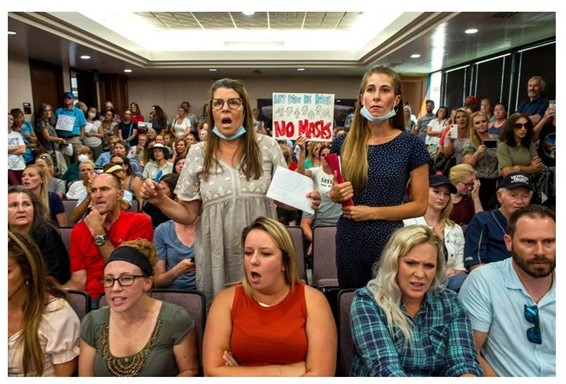
Above: Right from the start, school shutdowns and mask requirements were controversial. This memorable early image comes from the Salt Lake Tribune’s story: In separate rallies, Utahns protest mask mandate and demand in-person classes.
EDWEEK SAVES THE DAY BY TRACKING SCHOOL CLOSINGS
For a brief, intense period in March, EdWeek’s school closing map was all we could look at: Map: Coronavirus and School Closures in 2019-2020. Few will forget how, during an extremely chaotic time with no centralized sources of information, EdWeek went to the mats, creating a useful tool for education reporters and others who required constant updating and who knows how many people-hours.
THE WASHINGTON POST BRAVELY QUESTIONS SCHOOL SHUTDOWNS EARLY
While some schools were still shutting down, the debate that would consume most of the following year was already starting. With this little-noted March 2020 story, States are rushing to close schools. But what does the science on closures say?, the Washington Post’s Laura Meckler was among the first and only mainstream education reporters to question the benefits of shutting.
I still remember first reading it and thinking how brave it was – bravery that education reporters would need as the debate heated up higher and higher over the summer and fall. It would not be Meckler’s only memorable outing.
NPR & THE NEW YORKER REMIND US THAT SOME SCHOOLS NEVER CLOSED
Even as most schools were officially closed, there were handfuls of places where kids were being educated, usually by volunteers, many of them hourly workers.
Casey Parks wrote a lovely piece about The New York City Schools That Didn’t Close in the New Yorker. Anya Kamenetz had previously written about for NPR: What Parents Can Learn From Child Care Centers That Stayed Open During Lockdowns.
These stories were startling reminders that in-person education was something that could be accomplished, that it was possible, even as most schools were shuttered and many of us were hunkered down in our homes.
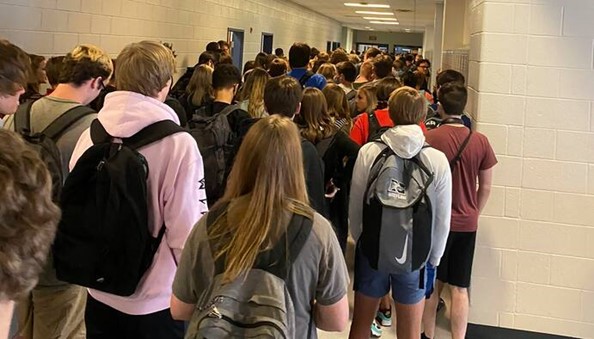
Above: Remember this image of the crowded hallway full of unmasked kids at North Paulding High School in Georgia? Of course you do. It went viral in August, covered by the New York Times, Washington Post, and many other outlets.
THE NEW YORK TIMES OBSESSES OVER CONTAGIOUS KIDS, SCHOOL OUTBREAKS, & DYING TEACHERS
Some of the past year’s K-12 COVID coverage is memorable for how bad it was, how exaggerated, misleading, and narrowly focused it could be. How fear-amplifying it could be, how reckless. Several of these stories came from the New York Times.
For example, there’s July’s NYT story Older Children Spread the Coronavirus Just as Much as Adults, New Study Finds, which stated that school reopenings would trigger more outbreaks. A month later, the Times published a new story stating that the preliminary findings might not hold up, but there was no correction and the perception that kids were super-spreaders who would infect teachers and family members was set.
Camps, crowded hallways, quarantines. Stories based on scary anecdotes dominated late summer coverage as the school year started. Stories like the New York Times’ 1,193 Quarantined for Covid. Is This a Successful School Reopening? implied reopening schools would lead to immediate outbreaks and large-scale transmissions, which we now know did not pan out.
The urge to exaggerate teacher dangers and deaths has been impossible to resist, as shown in A Dying Teacher, Worrying Over Students to His Last Breaths. The story notes that large numbers of teachers aren’t dying, and that school transmission has been minimal. But the storyline is just too good to pass up.
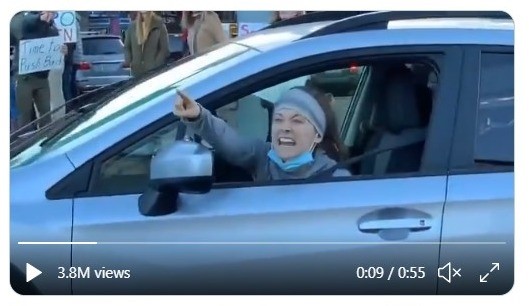
Above: The debate over keeping schools closed became highly politicized and dominated by fear and anger. When views conflicted, emotions rose to painful levels: Teacher suspended for screaming, gesturing at anti-lockdown protesters in Bend.
THE WASHINGTON POST AND OTHERS COVER SUCCESSFUL EARLY REOPENING EFFORTS
The Washington Post’s Laura Meckler was again one of the first national education journalists to report on the tentative success of school reopening efforts: Opening school buildings has not spread the coronavirus, early data shows.
She wasn’t alone, and some of the reporters who covered this story actually went into schools to see what was happening first-hand.
These early reports of tentative successes at reopening countered coverage in other outlets suggesting that reopening would result in outbreaks, shutdowns, and deaths.
PROPUBLICA AND THE NEW YORK TIMES FEATURE DISENGAGED, NEGLECTED, & UNDERSERVED KIDS
In what has to be the most-read and most-discussed K12 COVID story of the year, ProPublica’s Alec MacGillis’ feature story The Students Left Behind by Remote Learning in the New Yorker highlighted the disengagement and neglect that many vulnerable kids in Baltimore and elsewhere were experiencing during the prolonged remote learning period.
For many readers, this was a bracing look into the inadequacy of remote learning programs being provided to vulnerable kids, especially when parents had to work outside the house.
Then Erica Green’s January NYT story Surge of Student Suicides Pushes Las Vegas Schools to Reopen forced readers to think about the emotional well-being of students left learning from computers for almost a year. There was tremendous pushback against the story, questioning the surge in suicides and the connection to school shutdowns, and subsequent efforts such as ProPublica’s recent story about student suicides in New Mexico had to be careful about describing the numbers and making connections.
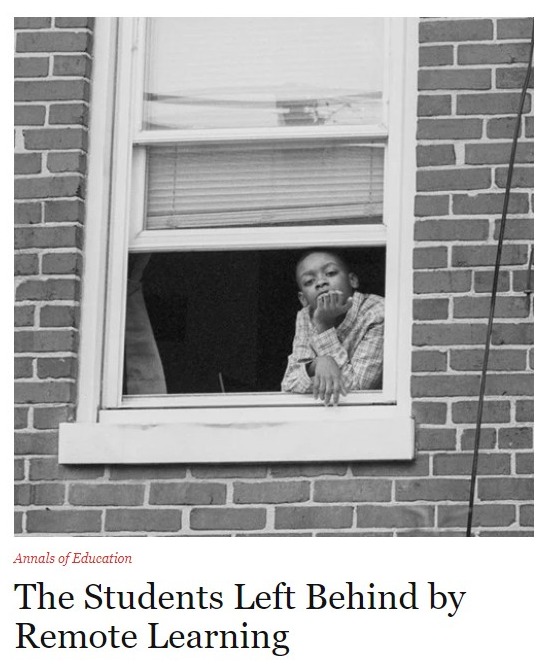
Above: This memorable New Yorker/ProPublica story by Alec MacGillis about a Baltimore child’s remote learning experience is likely the most-discussed K12 COVID story of the past 12 months.
THE TIMES AND POST ADDRESS PARENTS’ HESITANCY ABOUT RETURNING TO SCHOOL
One of the biggest stories of the year was the debate over parents’ hesitancy on sending their kids back to school – despite the inadequacy of remote learning for most kids.
One of the most memorable pieces that captured this debate was Melinda Anderson’s New York Times opinion piece, ‘You’re Out of Your Mind if You Think I’m Ever Going Back to School’. Another was Perry Stein’s Washington Post piece In D.C. wards hit hardest by covid-19, sending kids to school is a risk some parents won’t take.
Safety concerns have played a big role – especially in places where in-person learning was not already being offered – as well as previous experiences with inadequate education and racism in the schools.
VOX AND SLATE HELP EXPLAIN TEACHERS’ ANGER AND FEAR
While not strictly an education story, one memorable piece that helped explain the anger, fear, and attitudes of teachers during this period was Vox’s America’s middle class doesn’t really exist, which features a New Jersey teacher who feels economically vulnerable and financially overstretched.
Class anxiety among teachers is also featured in Noreen Malone’s Slate story about the excruciating conflict between educators and affluent parents:” How the school reopening debate is tearing Brookline, Massachusetts, apart.
KQED STRUGGLES TO COVER THE CONFLICT IN BERKELEY
It wouldn’t be journalism if there wasn’t at least some controversy about coverage, and KQED’s recent foray into covering the Berkeley school reopening debate generated a memorable piece of journalism, After Leading School Closures, Berkeley Teachers Union President Spotted Dropping Daughter Off at In-Person Preschool, though not necessarily in the best way.
The breaking news story featured a controversial video segment that made the local union leader look hypocritical and generated viral coverage. But then the station removed the video, saying it was distracting and unhelpful to readers.
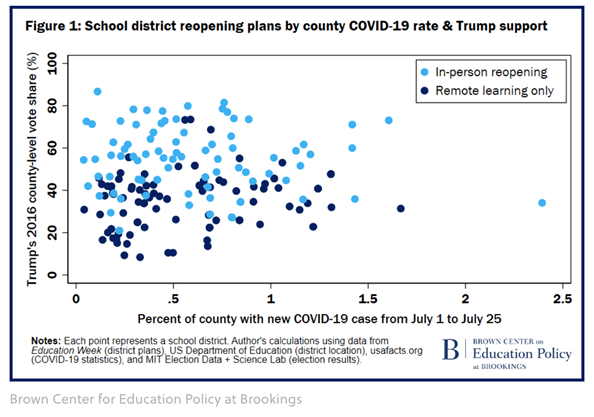
That’s my list of the most memorable K-12 COVID stories of the year. They’re not necessarily the best. (You’ll note that most come from national outlets rather than local ones.) But they’re the stories that grabbed the most attention — the stories that shaped the debate. If there are other examples that fit the category, share them here or tweet them at me.
RELATED FROM THE GRADE
The 14 most memorable pieces of education journalism of 2020
10 pieces of education journalism that defined the past decade
How to avoid writing needlessly alarmist school reopening stories
Progress — and challenges — at the Washington Post
ABOUT THE AUTHOR

Alexander Russo
Alexander Russo is founder and editor of The Grade, an award-winning effort to help improve media coverage of education issues. He’s also a Spencer Education Journalism Fellowship winner and a book author. You can reach him at @alexanderrusso.
Visit their website at: https://the-grade.org/