0
(0)
BEST OF THE WEEK
The week’s best education journalism, all in one place.

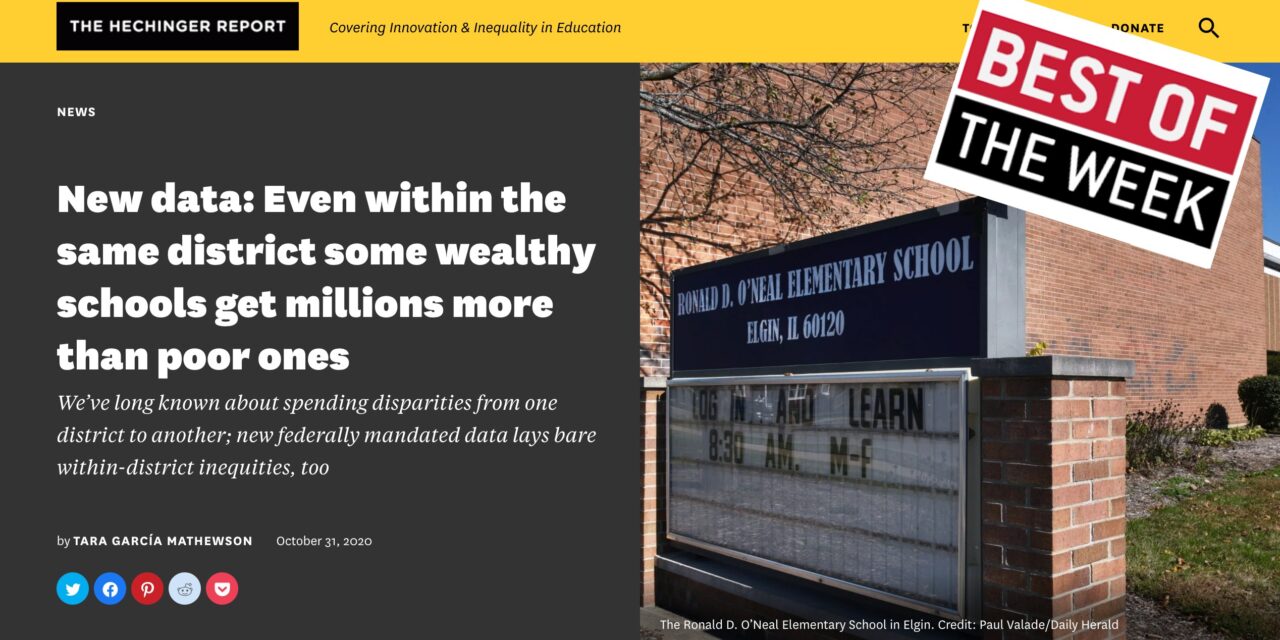
🏆 BEST: The best story of the week is New data: Even within the same district some wealthy schools get millions more than poor ones, in which the Hechinger Report’s Tara GarcĂ­a Mathewson analyzes school-level financial data and uncovers the role districts play in determining how much money each school gets. “Hechinger’s analysis found multimillion-dollar funding disparities between schools in the same communities.” The main factors contributing to these inequalities? Small schools, magnets, and clusters of experienced teachers migrating to wealthier schools. It’s an important, structural issue that’s been plaguing school systems for decades. The story includes an interactive tool to track down the numbers in your district.

🏆 RUNNER-UP: We love this debut story by Dallas Morning News Education Lab reporter Talia Richman, who reports from inside an 8th-grade classroom to get voices we often don’t hear, at least at election time: those of students not old enough to vote. She found very engaged, largely Black and Latinx students and a teacher helping them navigate the anxiety and facts in a contentious time. It’s personable and detailed and humanizing.  We could all use more of that in our journalism and in general.

🏆 HONORABLE MENTIONS:

3 WAYS TO MEASURE SCHOOL REOPENING TRENDS

It’s not easy trying to track the school reopening process nationally. There’s no EdWeek map to make things easy, like there was in the spring when schools were closing down.

One source says that 38% of kids attend districts that offer in-person education. Another says it’s half that. A third source says something completely different. None of these sources is ideal. Each is imperfect and should be used carefully. The data seemingly conflict in major ways. But this week’s column from me explains how these data sources may help you and your readers understand what’s going on.

HOW DO WE GET BLACK KIDS’ LITERACY TO MATTER? HAVE MORE JOURNALISTS COVER IT.

Earlier this week, contributor Colette Coleman wrote about the need for more coverage of Black student literacy, even in the middle of a worldwide pandemic.

“The pandemic has brought unprecedented issues in education. They deserve coverage,” Coleman writes. “But Black students’ literacy does, too, especially since virtual learning is only exacerbating an already dire situation.”

The 2019 Nation’s Report Card from the National Assessment of Educational Progress (NAEP) found that just 15% of Black 8th graders were at or above reading “proficiency,” and last week’s update shows that high school seniors didn’t do much better.

MEDIA TIDBITS

Thought-provoking commentary on the latest coverage.

Above: How is the election impacting education? The 74 has a nice roundup of all education-related election news at the local, state, and national levels.

📰 MIXED MODES ARE MAINSTREAM: According to the latest EdWeek survey, nearly 2/3 of district administrators report that they’re taking a hybrid approach to providing education lately, mixing in-person and remote learning. Full-time remote and full-time in-person learning are much less common, at 19% and 16%, respectively.

📰 CONVENIENT CASE NUMBER STORIES: As more school COVID data become available, a lot of local news outlets are publishing regular case counts, including the Boston Globe and the Boston Herald, which mostly rely on data released by the state. While it’s tempting to write those weekly stories, reporters need to be careful about contextualizing data that are still incomplete. A few months ago, I addressed this problem in a column about the wrong way to write about K-12 COVID cases. And in another column, I offered suggestions for how to cover COVID cases in schools in a smart way, including knowing how to distinguish between cases, quarantines, and outbreaks and following up on the early dramatic stories. Careful! When it comes to COVID case numbers, convenience kills.

📰 POLLS AND POLARIZATION: If public opinion polling is as broken as it appears from Election Day results so far, do we need to rethink some of the school reopening debate, which has relied heavily on poll results? It’s worth a thought. Meantime, this week’s events have been a powerful reminder to exercise caution around coverage of poll results. Tuesday’s events are “a disaster for the polling industry and for media outlets and analysts that package and interpret the polls for public consumption,” notes The Atlantic’s David A. Graham. But that’s not the worst of it. And polls aren’t the only problem, notes occasional education writer Amanda Ripley in the Washington Post. “We’re watching the world out of different portals,” writes Ripley in a piece headlined We’ve created cartoonish narratives about people in the opposite party. “We are increasingly seeing a tiny, distorted slice of reality, dominated by extremists.” I’d argue that the polarization Ripley describes is happening in education, regardless of political affiliation. Your job as a journalist is to keep the cartoonish narratives and extremes to a minimum rather than amplifying them.

📰 TEACHER RETIREMENTS: Teacher layoffs and retirements are a favorite media storyline, even though the numbers often don’t pan out quite as dramatically as predicted. Has there been a massive wave of teacher retirements this year, as was widely anticipated in the press over the summer? So far at least, the data say no, according to Chad Aldeman and Alex Spurrier in The 74. You may recall that Aldeman wrote a piece for The Grade over the summer about smart ways to cover teacher layoffs. Remember what they say: If your mother says she loves you, check it out!

Missed some previous editions? You can see the archive of past newsletters here. 

PEOPLE, AWARDS, EVENTS 
Who’s going where & doing what?

Above: Congratulations! NY Daily News education reporter Michael Elsen-Rooney garnered the 2nd-place 2020 Katherine Schneider Journalism Award for Excellence in Reporting on Disability for his story Two Boys with the Same Disability Tried to Get Help. For more stories on how to write great stories about students with disabilities, see Amy Silverman’s contributions to The Grade: How to quote more students with disabilities in education news and Writing better stories about students with disabilities.

🔥 Books & Events: Freelancer and The Grade contributor Danielle Dreilinger is getting excited about her new book, “The Secret History of Home Economics,” due out in May 2021. “Just admiring my last name in block print on the first page of my first book’s digital advance reading copy,” she tweeted.

🔥 NPR reporter Anya Kamenetz is set to discuss her book, “The Art of Screen Time: How Your Family Can Balance Digital Media and Real Life,” on Nov. 17. More details here. Meantime, Publishers Lunch has announced that Kamenetz has inked a deal for her next book, titled “The Lost Year” and billed as “the story of how COVID slashed open the last real safety net America has — public education — and exposed the anti-child fault lines of our society.” Congrats!

🔥 Jobs: The Hechinger Report plans to replace Bracey Harris, who is now a national reporter at NBC News. They are hiring a senior editor, too. Hannah News Service is also hiring an education reporter.

🔥 ICYMI: The Fund for Investigative Journalism hosted an event on investigative education stories, featuring freelancer Rachel Cohen, the Voice of San Diego’s Kayla Jimenez, and Chalkbeat’s Dylan Peers McCoy. It was moderated by WSJ’s James Grimaldi. You can watch the one-hour virtual forum with insights, lessons, and tips for reporting here.

Did someone forward you this newsletter? You can sign up here. 

THE KICKER

Courier Journal education reporter Mandy McLaren, who became a journalist after being a teacher, surfaced her first byline ever for this tense election week. “Four years ago I had my first ever byline and this was the headline I wrote and MAN WAS I WRONG.” She’s not the only one.

That’s all, folks. Thanks for reading!

ABOUT THE AUTHOR

Alexander Russo

Alexander Russo

Alexander Russo is founder and editor of The Grade, an award-winning effort to help improve media coverage of education issues. He’s also a Spencer Education Journalism Fellowship winner and a book author. You can reach him at @alexanderrusso.

Visit their website at: https://the-grade.org/

How useful was this post?

Click on a star to rate it!

Average rating 0 / 5. Vote count: 0

No votes so far! Be the first to rate this post.