Education news outlets and teams are responding to the COVID crisis in a range of ways: constricting, holding tight, and even expanding.
While Education Week and Chalkbeat are somewhat different types of news organizations, they both face the same fallout from the effects of COVID-19 and nationwide social distancing rules.
For both education nonprofits, readership is up, revenues aren’t, and hefty government bailout funds may or may not be sufficient to meet the need.
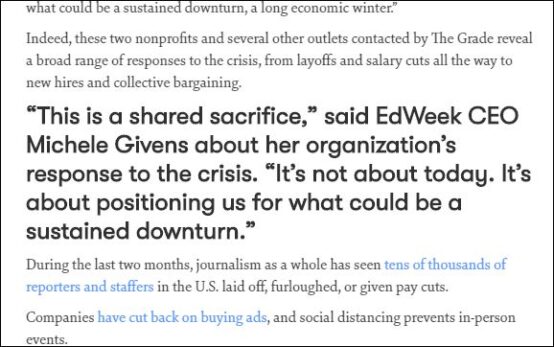
“This is a shared sacrifice,” said EdWeek CEO Michele Givens about her organization’s response to the crisis. “It’s not about today. It’s about positioning us for what could be a sustained downturn, a long economic winter.”
Indeed, these two nonprofits and several other outlets contacted by The Grade reveal a broad range of responses to the crisis, from layoffs and salary cuts all the way to new hires and collective bargaining.
“This is a shared sacrifice,” said EdWeek CEO Michele Givens about her organization’s response to the crisis. “It’s not about today. It’s about positioning us for what could be a sustained downturn.”
During the last two months, journalism as a whole has seen tens of thousands of reporters and staffers in the U.S. laid off, furloughed, or given pay cuts.
Companies have cut back on buying ads, and social distancing prevents in-person events.
And the reaction among philanthropic groups is mixed. Some have pledged to increase spending—others have declared no changes.
All this at a time when the demand for information has increased dramatically.
While there have been few education reporter layoffs thus far, specialty journalism outlets focused on education news appear no more immune than mainstream media counterparts to the economic pressures.
Asked about the business aspects of their work, EdWeek and Chalkbeat reported increased web traffic during this crisis. But more clicks haven’t necessarily translated into higher revenues.
Although both companies have avoided big changes so far, upcoming budget decisions could portend adjustments if and when COVID-19 anxieties subside.
“In every crisis, there is some kind of opportunity,” Givens said. “We’ve got to keep finding those, whether it’s new twists on existing products or even new initiatives that serve a need, like our newsletter for principals.”
Previous coverage: Limited layoffs, furloughs, & salary cuts for education reporters so far
“In every crisis, there is some kind of opportunity,” EdWeek’s Givens said. “We’ve got to keep finding those.”
According to Givens, EdWeek has still produced its print edition with a remote staff, avoided furloughs and layoffs, and broken records in March and April for website visitors, registrations, subscriptions, and engagement.
However, the organization has also decided to reduce some salaries temporarily to withstand the COVID-19 damage to revenues, she told The Grade.
The Bethesda, Md.-based organization of about 100 staffers — about 40 in editorial — hasn’t changed pay for employees who make less than $65,000 a year. However, employees who make between $65,000 and $100,000 received a 10 percent reduction. Employees who make more than $100,000 received a 15 percent reduction.
“It’s not all about cutting expenses,” said Givens, who has taken a 20 percent pay cut. “We’re thinking creatively and agilely to improve our revenue picture.”
Part of Givens’ strategy has included more virtual summits to increase ad and marketing revenue. Education Week’s last two virtual events each attracted about 4,000 registrants.
EdWeek is certainly not alone in making these difficult decisions. NPR staffers are taking compensation and benefit reductions for the rest of this fiscal year, according to a spokesperson.
Chicago-based WBEZ public radio hasn’t had layoffs or furloughs, either, education editor Kate Grossman said. But the station has frozen hiring, cut discretionary spending, frozen salaries and suspended retirement contribution matching. Station employees at the level of managing director, vice president, and above will take compensation reductions of up to 25 percent.
Grossman says she remains hopeful that the newsroom will be protected from future cuts. “We’re knocking on wood everything will be OK moving forward,” she said.
“It’s not all about cutting expenses,” said EdWeek’s Givens, who has taken a 20 percent pay cut. “We’re thinking creatively and agilely to improve our revenue picture.”
Several nonprofit journalism organizations have applied for and received federal Paycheck Protection Program (PPP) funding to help make up for the economic crisis.
EdWeek received about $1.5 million from the program, Givens said. Chalkbeat received $1.1 million from the PPP.
CalMatters, a California-based nonprofit news organization that features education, received more than $500,000 in PPP funding.
Chicago public radio has also received $2.8 million PPP funding, WBEZ senior director of communications Betsy Berger said in an email.
EdSource, EdScoop, the Hechinger Report and The 74 did not respond to email requests for comment. The Chronicle of Higher Education declined to comment.
Related coverage: Extras, specials, and other newsroom responses to the COVID-19 pandemic
“The response from readers has been amazing,” said Bene Cipolla, who has been with Chalkbeat since 2017. “Even if a reader gives us $10, that’s valuable.”
The New York City-based Chalkbeat network of education bureaus has hired its first higher education reporter, who started in April, Chalkbeat editor-in-chief Bene Cipolla said. But the organization has since initiated a hiring freeze. It’s seen no layoffs, furloughs, or pay cuts.
Chalkbeat operates seven bureaus nationwide and a national desk. It has 64 total employees, 41 of them in newsrooms.
The organization has seen success in gaining new paid members, offering three membership levels starting at $1 a year for a special newsletter. Since March 1, the total number of members has grown 79 percent to 889.
“The response from readers has been amazing,” said Cipolla, who has been with Chalkbeat since 2017. “Even if a reader gives us $10, that’s valuable.”
In March, the website received three times its traffic target for the month and more than three times the 2019 monthly average. April saw 2.5 times its traffic target and about three times the 2019 monthly average.
The coronavirus outbreak hasn’t changed Chalkbeat’s plan to reach 18 bureaus by 2025. “No matter how our plan evolves, the pandemic has illustrated a need for local news,” she said.
We look “forward to working with the guild to understand and try to resolve their concerns, while also ensuring the best interests of the company.” — Inside Higher Education CEO and publisher Mark Belles.
Responses to the COVID-19 crisis range widely.
Seattle Times Education Lab editor Joy Resmovits said in an email that the newspaper has not laid off any staff and plans to still hire a permanent replacement for education reporter Neal Morton.
The Richmond Times-Dispatch of Virginia gained a new education reporter in April.
The 74 just hired a handful of new journalists and launched a new vertical.
And, amid all the uncertainty of COVID-19 for the media business, journalists in at least one newsroom have formed a labor union.
A dozen staff members of for-profit Inside Higher Ed—including its eight reporters and some editors and web developers—have joined the Washington-Baltimore chapter of The NewsGuild-CWA.
In an email, Inside Higher Ed CEO and publisher Mark Belles said leadership looks “forward to working with the guild to understand and try to resolve their concerns, while also ensuring the best interests of the company, and the majority of its employees who are not part of the union, continue to be met.”
Related stories
Newsroom flexibility is key to COVID-19 education coverage
How to survive being laid off from your first newspaper job
How the Seattle Times education team covered the COVID-19 crisis
Furlough Journal, day 1 (Linda Borg)
A brain drain in education journalism
In Connecticut, fewer education reporters and more missed stories
ABOUT THE AUTHOR

Wade Tyler Millward
Wade Tyler Millward is a freelance journalist and editor based in Oakland, Calif. He has previously worked for EdSurge and The Las Vegas Review-Journal. Follow him at @wademillward and email him at wademillward@gmail.com.