An education reporter describes what it’s like being laid off from her first newspaper job — and how she’s managing to thrive despite the uncertainties of the current economic crisis.
By Aaricka Washington
It was strange enough when we got the order in March to start working from home, being so far away from the people I worked with and the community members I regularly talked to at meetings.
But then on April 24, I found out that I would soon become another statistic amid this once-in-a-lifetime pandemic: an unemployed journalist.
That Friday morning, I received a text and a Zoom invite from my boss that I never thought I would get, asking me to attend an “important” and “unfortunate” meeting in the afternoon.
I panicked.
That week, I had done my job diligently reporting about how school districts were grappling with COVID-19 nearly every day. But now I couldn’t even think about where to start with all the story ideas I had in mind.
Nothing mattered except the looming thought that I would be without a job nearly eight months after I started my first one. My work, and the future projects I dreamed to do with the organization, had been cut short.
I, a young, black woman reporter from a working-class family, would be laid off from my very first professional journalism job.
My last day was May 1.
On April 24, I found out that I would soon become another statistic amid this once-in-a-lifetime pandemic: an unemployed journalist.
As a freshman at Indiana University, I dreamed of becoming an education reporter.
While in school, I not only majored in journalism and minored in sociology and African American and African diaspora studies, I was also heavily involved in a student volunteer organization where college students wrote stories with middle and high school students. As part of that program, I taught in Rwanda one summer.
Through this experience, I gained an appreciation for educators and a passion for teaching kids, especially kids who came from historically under-resourced backgrounds.
So, I joined Teach For America in Houston, Texas. I loved teaching, and I wanted to experience what it was like to be a teacher so that one day I could better report on issues in the education field.
After teaching, and after a year working as an AmeriCorps VISTA member, I was ready to get back into journalism. I got into my first-choice program at Columbia Journalism School. After an internship at The Hechinger Report, I decided to try my hand at daily journalism back in a place I knew and loved: Texas.
I became an education reporter at the Austin American-Statesman.
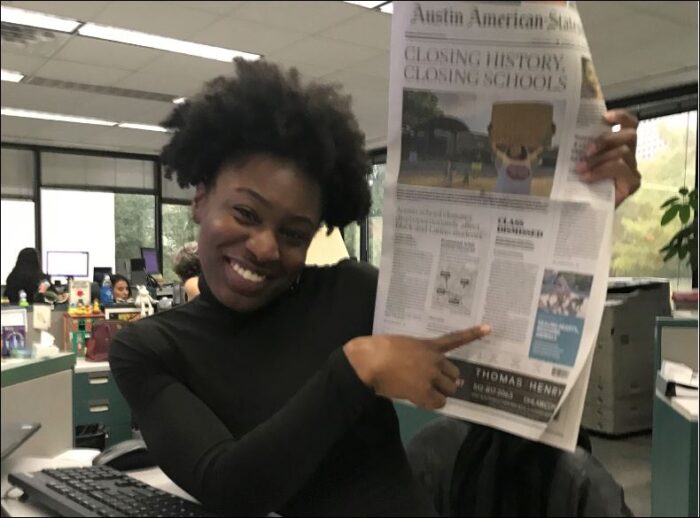
Above: Washington celebrates her first front-page story at the Statesman
I was excited to do local journalism for a major city in Texas. I would have the opportunity to get to build relationships with community members and stakeholders and get to know the important things that were facing education systems.
It was challenging coming from my Hechinger Report internship, where I had all the time in the world to craft my stories, to a job where I was tasked with writing a story quickly and accurately each day. And I happened to arrive at one of the most heated times in the Austin school district’s history, in the middle of debates about closing schools and a new sex education curriculum.
Sure, reporting daily was a challenging, but I really felt like I was learning the craft. This job meant so much to me as a beginning reporter. Sometimes, I was the only reporter in board meetings, working to figure out which issues community members deemed important. I loved that part.
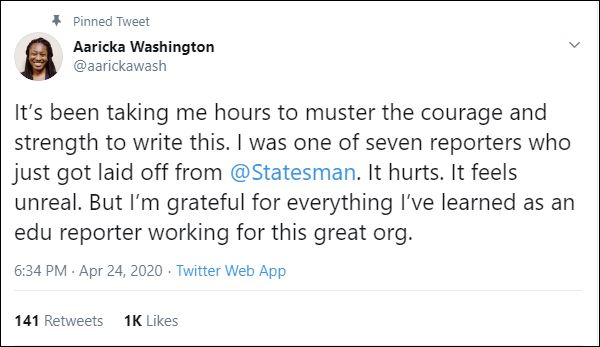
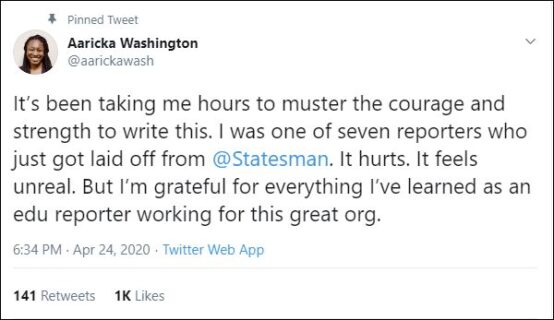
Above: Washington’s April 24 layoff announcement, which generated an enormous response.
In the past 20 or so days since I found out I would be without a job, I have been trying to get into a consistent routine. I pray. I meditate. I ask my professional network for advice. I search for jobs.
I’ve been trying to get back into writing every day. I’m telling you, getting laid off can be a hit to your self-esteem, even if it had nothing to do with your actual work.
And it’s been hard, especially after the killings of three twenty-something black people this year – Ahmaud Arbery (February 23), Breonna Taylor (March 13) and Dreasjon Reed (May 6).
I cannot believe it’s only May.
There is so much grief in being a young, black female journalist right now. I have to carry the weight of moving in a world that sees me and people who look like me as a threat – even when participating in an activity that is one of the only acceptable things to do outside amid a pandemic: exercise.
There is so much grief in being a young, black female journalist right now… There is grief all over the place.
I thank God every day that at the very least, all of my family members and friends are safe and have not been physically affected by the coronavirus, even though they still have to go to work because they are certified nursing assistants, doctor’s assistants, operating room technologists, social workers, caregivers, project coordinators, UPS package handlers, Los Angeles Department water and power employees, forklift drivers, electricians, and more.
But there is grief all over the place. I have to carry the weight that people who look like me are contracting and dying from COVID-19 at disproportionate rates all over this country just because they work in essential fields.
I have to carry the weight of trying to find a job as a newly laid-off young person who had a position for only eight months, with just my network and my talent as a writer and reporter guiding me through this.
According to a recent Bloomberg article, when we look back at history, minority workers – people of color and women – have been negatively affected by a “last hired, first fired” dynamic that “has limited their ability to notch wage gains.”
Related coverage: Newsroom diversity on the education beat
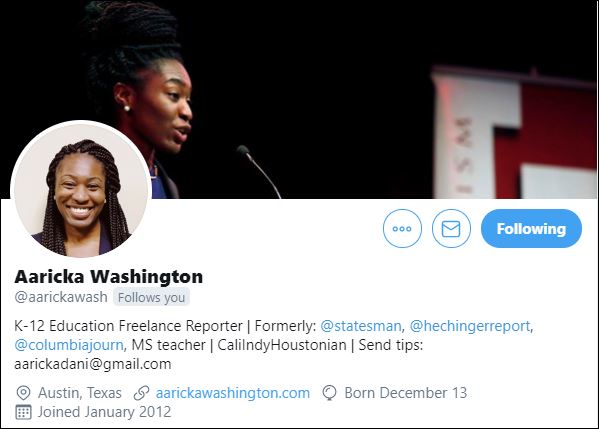
Above: Since May first, Washington has been praying, networking, and planning her next moves.
For me and for so many others like me, this has been a balancing act of handling multiple crises at the same time.
I’m grateful that I live by myself. I’m an introvert-extrovert anyway, but I do miss my family and friends. I’m grateful to be doing fine financially at least for the next two months.
I try my very best to take care of my mental health. I have a therapist who has helped me learn how to breathe deeply (yes, it takes a lot of practice especially for someone with anxiety) as well as how to reframe any negative thoughts I have about myself, others and this world. The world and the life we live are beautiful, if we really think about it.
I practice my faith. I meditate and stick Post-It notes all over my living space with quotes by black women who inspire me and mantras to encourage me.
One current favorite, which former Teen Vogue editor in chief Elaine Welteroth attributes to Eve Ewing: “There is no glory in a grind that grinds you all the way down.”
That’s now one of my many quotes on my desk that I live by to remind myself to always act with excellence and self-care in mind.
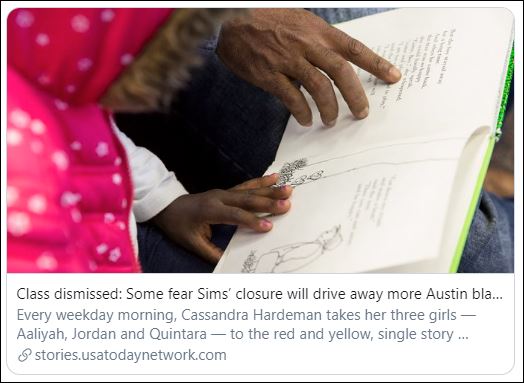
Above: One of Washington’s biggest stories for the Statesman focused on the closure of a historically black school might drive more black families out of Austin.
I get up as early as 5 a.m. to start my day. I keep a strict routine because it’s so easy to let time pass you by. I listen to The Daily and a few NPR podcasts after I spend quiet time and exercise in the morning. I make time to catch up on the news and brainstorm story ideas that I could write about. It keeps me actively thinking about my craft.
And I talk to people who invest in me and vice versa.
If there’s one thing I can say, I have the best “presidential cabinet” in the world. During these past few weeks, I have not only received encouragement and help from my journalism mentors, but from my friends as well. My mom and dad have been my biggest supporters and confidants. I have had the best conversations in the past few weeks simply because I made time to talk, cry, laugh and pray with the people in my life.
I’ll be honest and say that I don’t know what my future will look like. But if there is one thing I know from working at the Statesman, it’s that I have the ability to write stories and work on projects that impact communities. I have the talent to do amazing things.
I know that I will not only survive this pandemic, but I can also thrive through it.
ABOUT THE AUTHOR

Aaricka Washington
Aaricka Washington is a freelance national multimedia education reporter and former educator based in Texas. She has worked previously for the Austin American-Statesman and the Hechinger Report. You can follow her on Twitter at @aarickawash.