How journalists can make sure readers know that many of the problems arising with remote learning are variations on preexisting problems.
By Bekah McNeel
While it’s been popular among politicians to refer to COVID-19 as an “equal opportunity” virus or to say it “doesn’t discriminate,” recent data show the impact on black communities has been deadly and disproportionate.
The pandemic-created educational disruption is following a similarly clear and predictable trend: Where there were gaps, they are widening. Where there were shortages, they are deepening. Where there were struggles, they are intensifying.
Where there were gaps, they are widening. Where there were shortages, they are deepening. Where there were struggles, they are intensifying.
As newsrooms continue to prioritize coverage of the pandemic, reporters must keep this critical context in mind. Like the virus itself, the move to remote learning is most dangerous for those students and schools with preexisting conditions.
If your teacher was great before, they are probably still great now. Students who needed interventions had a hard time getting them before; now they are likely minimal at best. Schools that had to meet more of their students’ basic needs before have to meet even more needs now. If quality curriculum and instruction were not available to all students before the closures, they probably still aren’t.
Like the virus itself, the move to remote learning is most dangerous for those students and schools with preexisting conditions.
There are a handful of stories I’ve seen that attempt to address these preexisting conditions explicitly, giving readers important context on what’s happening.
In Politico’s The lost year, Nicole Gaudiano surveyed ways several state departments of education are confronting the impending learning losses. For each example, Gaudiano includes expert insight on how existing inequities will make the fallout worse for some students than for others, compared to the past. The traditional two- to three-month summer slide will become a five-month free fall. The digital divide was a huge problem for homework even before all work was homework.
Jenni Fink tackled the same topic for Newsweek relatively early in the school closure story cycle, in “School closures due to coronavirus could widen education inequality among students.”
This story, too, touches on summer slide and the digital divide and adds the challenges of delivering special education remotely. Fink spoke to academics and educators primarily, who were frank about the bleak outlook. She also interviewed American Federation of Teachers President Randi Weingarten, who kept the focus squarely on preexisting out-of-school disparities, and how they will grow.
Journalists just need to remember to remind readers of that context, even if they’ve written the story a hundred times before.
Journalists have plenty of expert sources who can explain how issues like the digital divide are not “new” news, they’re just getting worse since the schools shut down almost a month ago. They just need to remember to remind readers of that context, even if they’ve written the story a hundred times before.
This is especially true when wading into inequalities around instruction, which has always been a heated subject. Schools and teachers are being asked to solve problems well outside their current resources, and journalists will need to foreground that fact when pointing out the gaps in what various districts are able to provide by way of instruction.
Based on what I’ve seen, reporters are getting better at contextualizing novel and preexisting problems related to the pandemic. However, few have hit the trifecta as well as Ricardo Cano did in his April 10 story for CalMatters.
As one education reporter found out, failing to remind readers of the preexisting conditions in education can result in confusion or upset among readers.
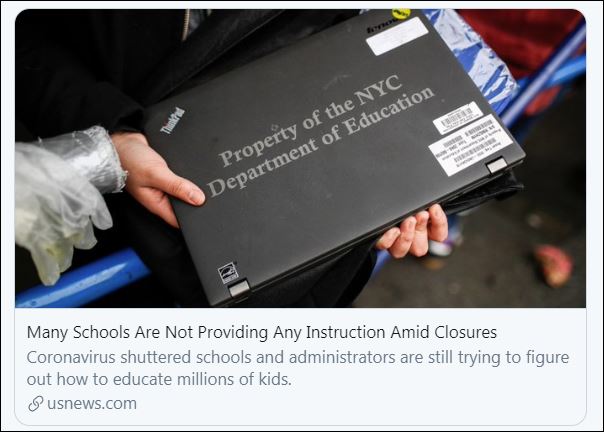
When U.S. News and World Report’s Lauren Camera wrote about data showing very few districts doing any sort of online instruction, critics Twitter-dinged her for not contextualizing the data in terms of the digital divide.
Camera responded that she has covered that issue in depth in the past, which indeed she has, and didn’t believe anyone in her story was ignoring it.
Based on what I’ve seen, reporters are getting better at contextualizing novel and preexisting problems related to the pandemic. However, few have hit the trifecta as well as Ricardo Cano did in his April 10 story for CalMatters.
Cano pointed out a widening instruction gap, linked it to the digital divide, and identified whether or not instruction itself was also preexisting condition for the students in the story. In this case, it wasn’t. Classroom instruction for the students in his story had been rigorous and engaging. That detail twists the knife and shows just how devastating the digital divide really is.
Our COVID-19 stories need to look at the virus as yet another example (though, yes, a novel one) of the danger inherent to inequity. We don’t need to put schools on blast, and we certainly don’t need to be shaming anyone. We just need to hold two truths at the same time: In the COVID-19 era, schools are being asked to fill gaps and inequalities that have been around for a long, long time…and how they respond will determine how much worse it gets.
Previous coverage:
Journalists push to report remote participation
Including English learners in COVID-19 coverage
ABOUT THE AUTHOR

Bekah McNeel
McNeel is a freelance journalist who has been covering education for eight years. Her education reporting has appeared in The Hechinger Report, The 74 Million, The Christian Science Monitor, The Texas Tribune, Edutopia, and Texas Public Radio. Based in San Antonio, she also covers immigration, currently for Christianity Today. You can follow her on Twitter at @BekahMcneel.