Teachers must be mindful of how they implement mindfulness practices.
Anyone who has been in education as long as I have knows that educational trends come and go. These days, one of the hottest trends in education happens to be mindfulness. The most common way to practice mindfulness is to have practitioners focus on their breathing and then notice distractions (sounds, thoughts, feelings, sensations) before turning their attention back to their breathing again and again. Several research programs are underway to determine whether mindfulness practices have clear benefits for students in school (Deruy, 2016). Other well-controlled studies have already concluded that mindfulness has significant positive outcomes for a range of highly valued school-related skills (Flook et al., 2010; Quach, Mano, & Alexander, 2016; Schonert-Reichl et al., 2015).
For those of us with sufficient historical perspective to have seen several education movements come and go, the question is: What could possibly cause the eventual demise of mindfulness in the schools? One possibility is that these studies will eventually come up empty-handed, and mindfulness will be regarded as lacking a strong research base. A much more likely scenario, in my opinion, has to do with religion. Because mindfulness originally emerged out of Buddhism, the argument goes that these practices constitute religious activities and thus violate the First Amendment. In fact, groups such as the American Center for Law and Justice and the National Center for Law and Policy have sought to curtail the use of mindfulness and yoga in school because of the connections to Buddhism and Hinduism (Manson, 2019; Perry, 2015).
In the midst of these challenges, educators need to mount a strong defense for the essentially secular nature of mindfulness practices. The fact that mindfulness emerged from Buddhism does not automatically make it a religious activity. After all, the Golden Rule (“Do unto others as you would have them do unto you’’) forms a central part of several religions, but few would object to teaching this idea in public schools. The key here is context and intention. For mindfulness, that means a context of scientifically based research and an intention of making students better able to concentrate, self-regulate, remember, attend, and achieve in school.
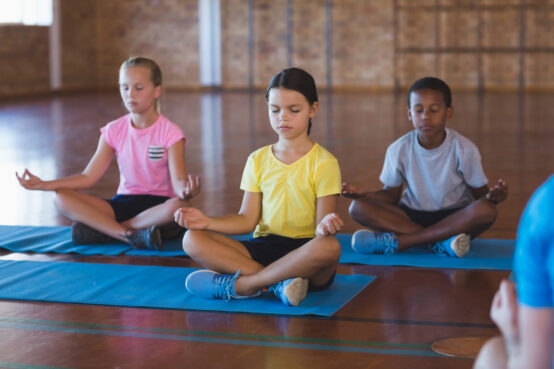
However, while doing research for a book on mindfulness in the classroom, I ran into numerous instances where, under the guise of mindfulness, children in public schools were engaging in practices that appeared to have religious or spiritual overtones. So when I see children in the lotus position with their eyes closed and their hands forming mudras (hand gestures that have religious significance), I see the First Amendment being violated. When I hear teachers say “now we’re going to do the Dhanurāsana pose’’ in a yoga class or read of an instructor ending a mindfulness session by having every student press their hands together at the level of their “heart chakra’’ and say the Sanskrit word “Namaste,’’ I’m witnessing still other violations of the First Amendment.
Educators, be mindful of how you use these practices. Don’t blow it for all the teachers and students who are doing mindfulness appropriately and benefiting from its effectiveness. Keep in mind that mindfulness may be just one Supreme Court decision away from joining “the new math’’ and “open education’’ on the slag heap of abandoned educational trends.
References
Deruy, E. (2016, May 20). Does mindfulness actually work in schools? The Atlantic.
Flook, L., Smalley, S.L., Kitil, M.J., Galla, B.M., Kaiser-Greenland, S., Locke, J., et al. (2010). Effects of mindfulness awareness practices on executive functions in elementary school children. Journal of Applied School Psychology, 26 (1), 70-95.
Manson, P. (2019, May 7). Conservative legal group challenges ‘mindfulness’ in schools. U.S. News.
Quach, D., Mano, K.E.J., & Alexander, K. (2016, May). A randomized controlled trial examining the effect of mindfulness meditation on working memory capacity in adolescents. Journal of Adolescent Health, 58 (5), 489-496.
Perry, T. (2015, June 12). Legal fight against yoga in Encinitas schools is finished. Los Angeles Times.
Schonert-Reichl, K.A., Oberle, E., Lawlor M.S., Abbott, D., Thomson, K., Oberlander, T.F., et al. (2015, January). Enhancing cognitive and social-emotional development through a simple-to-administer mindfulness-based school program for elementary school children: A randomized controlled trial. Developmental Psychology, 51 (1), 52-66.
ABOUT THE AUTHOR

Thomas Armstrong
THOMAS ARMSTRONG is the executive director of the American Institute for Learning and Human Development. He is the author of Mindfulness in the Classroom: Strategies for Promoting Concentration, Compassion, and Calm .