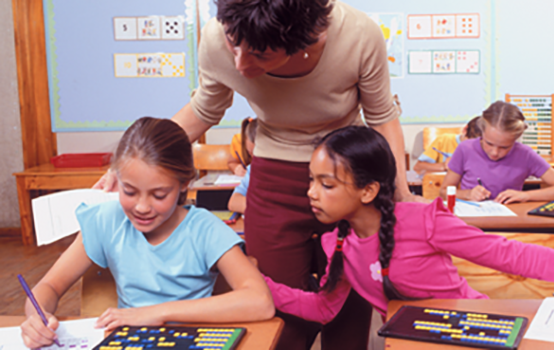
Careful, skilled observation of classroom instruction focuses not just on teachers’ goals and behaviors but, most important, on the specific learning opportunities provided to students.
To the untrained eye, classroom instruction often looks better than it really is. For example, if the teacher seems friendly, students seem engaged, and the activity proceeds smoothly, a novice observer might judge the lesson to be a success. But in fact, those may not be the best indicators of quality instruction. A more seasoned observer, turning a more practiced eye on the very same classroom, might find that while the teacher and the students seemed perfectly happy and got along with each other, the lesson was not well-designed and did little to teach the intended concepts.
The question is, what does it take to observe teaching in ways that yield truly valuable insights? We argue that one needs to bracket off the more superficial aspects of instruction, focus on the quality of the learning opportunities provided to students, and gauge the extent to which those opportunities are aligned to the lesson’s specific learning goals.
Looking for learning in a science lesson
In a high school science lesson that one of us (Ermeling) observed, the learning goal was to understand how dissolved oxygen levels affect biological activity in aquatic environments (Ermeling & Graff-Ermeling, 2016). Specifically, students needed to analyze how oxygen levels vary in different bodies of water (e.g., a tropical sea vs. a mountain lake) based on complex interactions of climate, salinity, water movement, and the surrounding ecosystem.
The lesson opened with a review of a lab worksheet describing variables (such as climate, salinity, water movement, and organic waste) that can influence dissolved oxygen levels and showing how changes in oxygen levels affect biological activity. Next, students worked in groups to sort photos of five differing bodies of water (arctic oceans, tropical seas, lakes, rivers, and swamps) and plot them on a grid according to their estimated oxygen content. Each student group then gave a presentation to explain its analysis, followed by teacher-led class discussion.
The teacher expected that, when it came time to sort the photos, the groups would make their decisions based on what they had learned about climate, salinity, and other variables. Instead, students simply glanced at the photos and turned back to the worksheet to find the right answers. One group of students even lined up the worksheet next to the grid to make it easier to copy the information from one to the other. Another group seemed puzzled for a few minutes until one student exclaimed, “I have my worksheet right here!” They, too, proceeded to find the information on the sheet and transpose it to the grid. When asked to present their grids to the class, most of the groups gave more or less identical presentations: They pointed (correctly) to where the photos were supposed to go on the grid, but they offered little or no explanation as to their reasoning.
What might a practiced, professional observer have commented after viewing this lesson? While students were collaborative, on task, and engaged, they did not arrive at a deeper understanding of complex material. The teacher aimed to get them to struggle productively with the content, using their background knowledge to solve problems. Instead, most did little more than copy and paste information.
Observing teaching with a practiced, professional eye reveals the true learning opportunities provided to students plus their misunderstandings and learning difficulties.
Rather than handing out a lab worksheet that divulges all the key variables and their specific effects on oxygen levels, presenting fresh information to the students would have been far better. For example, the teacher might have introduced new facts to consider — such as the time of day, amount of sunshine, average precipitation, or living organisms present — to go along with each photo. Then the students would have no option but to grapple with the material at hand and generate inferences about each variable’s effect on levels of dissolved oxygen. They might end up with less accurate graphs, and their presentations might include some “errors.” But the subsequent discussion would be much richer and more nuanced as a result, since they would have to articulate, defend, and revise their explanations of how these factors influence biological activity.
Key questions for lesson analysis
Detecting and analyzing learning opportunities (or missed opportunities, as in the example above) is a learned skill. It requires careful consideration of the given learning goals and lesson design, followed by close observation of the lesson in practice. Key questions include:
- How does the instruction facilitate or fail to facilitate productive learning opportunities?
- What evidence is there that students achieve the intended learning goals?
- How can instruction be revised to provide stronger opportunities for students to achieve the learning goals?
Looking for learning in a math lesson
To illustrate the use of these questions to analyze a lesson for learning opportunities, we present a second example, featuring a lesson in a 5th-grade mathematics class. The goal was for students to understand why common denominators are needed when adding fractions. Before this lesson, students had learned to add fractions with like denominators, but they had not yet learned what to do with unlike denominators.
After a brief review of adding fractions with like denominators, the teacher presented the following problem: 2/3 + 1/4 = ? Instead of showing students how to find the answer, she asked them to come up with their own method. The only rule was that the answer they got should make sense to them.
The teacher reminded students of the fraction pieces they had used in earlier lessons and that they had stored in their desks. The pieces were color-coded, with each fractional part of a circle represented by a different color. Students were asked to work for five minutes by themselves and then compare their ideas with their partners. Together, each pair of students was to find a method and prepare a description of it to share with the class (and if they found a method within five minutes, they were asked to find and share a second method).
The teacher noticed a variety of initial methods as she circulated around the room, taking notes on students’ progress. “Can you check to make sure your answer makes sense to you?” she asked them. “Is there another way you can think of to add these fractions?” Some students used the fraction pieces, putting out two one-third pieces and a one-fourth piece to see how they fit together. Others tried adding the top and bottom digits in 2/3 and 1/4. This resulted in the answer 3/7, a number smaller than one of the numbers they started with, 2/3. Some students realized this didn’t make sense, and they decided to look for other solutions.
After giving students five minutes to work alone and another several minutes to discuss, the teacher asked the pairs of students to share their methods (asking those who had come up with the most advanced solutions to go last). After each presentation, she asked the class to discuss why that method did, or did not, make sense to them.
An early presentation by one pair of students used the adding numerators and denominators method resulting in 3/7. During the discussion, other students explained why 3/7 could not be the answer. In another early presentation, students showed that they had placed the two one-third pieces together with the one-fourth pieces. Since they combined to make almost a complete circle, they concluded the answer was “a little less than one.” Then a pair shared a method that took this idea a bit further: After putting together the fraction pieces and seeing that they formed almost a complete circle, they looked for another piece that would fill in what remained. “We found that a one-twelfth piece made it into a full circle so, the answer must be eleven-twelfths.” Finally, the last pair of students showed that each of the one-third pieces was the same as a four-twelfths piece, and the one-fourth piece was the same as a three-twelfths piece. When they combined four-twelfths, four-twelfths, and three-twelfths, they got eleven-twelfths.
The class considered each of the methods in turn, discussing which ones made sense, and which ones produced exact answers. The teacher saved time to focus extra attention on the last method: Why did these students choose twelfths? Would sixths have worked? Would their method always work? Would it always be possible to find smaller fraction pieces that fit exactly over the pieces labeled with larger fractions? Finally, the teacher asked students to try this substitution method on another problem: 1/3 + 1/2 = ? The lesson ended with a brief discussion about why it is impossible to find an exact answer unless you add fractions with the same denominator.
What does it take to observe teaching in ways that yield truly valuable insights.
What were the learning opportunities for students in this fraction lesson? Which opportunities helped students move toward achieving the learning goal? Recall that the learning goal was for students to understand why they needed to find common denominators to add fractions. Asking students to work out their own methods for adding fractions encouraged them to notice that if pieces of different sizes are added, it can be difficult to determine the exact size of the total. This is the key concept needed to achieve the learning goal, and the teacher created opportunities for students to develop this concept by asking them first to grapple with this idea and then to participate in a class discussion about why some methods worked better than others. If the teacher had moved directly to showing students how to find common denominators and then asked them to practice this method, the opportunity to understand why such a method is needed would have been lost. The evidence that students were achieving the learning goal included their comments during the discussion about why it was difficult to determine the answer if pieces of different sizes were combined and why the substitution method would always work, along with their performance on the second task in which they were asked to try this method with their fraction pieces.
Using video for observations
The payoff for learning to observe teaching is that it makes teaching visible. Greater visibility enables better analyses of teaching which, in turn, enables deeper insights into teaching as well as ideas for improving it. The more careful and detailed the observation, the more instructional details and nuances become the object of study and the subject of discussion. Observing teaching with a practiced, professional eye reveals the true learning opportunities provided to students plus their misunderstandings and learning difficulties — information that can lead to better lesson plans and more effective learning opportunities, as well as attention to individual differences.
Video offers an increasingly popular but still under-used medium for observing teaching (and for learning how to observe teaching carefully). Better and cheaper video technologies have opened the doors of classrooms, putting an end to the old joke about how teaching is the second most private act. Ordinary classroom teaching can easily be recorded, observed, analyzed, and — thanks to the internet — shared and compiled into video libraries of instruction.
Using video does have some notable drawbacks. Single-camera recordings limit observation to a single viewing perspective (often the teacher or a few students interacting) making it difficult to follow and observe the learning pathway of multiple students or student groupings. Overlapping talk during student group work and pair conversations can reduce the quality of audio and hinder observational analysis.
But the advantages far outweigh the problems. Most important, video makes it much easier to arrange for an individual or group of teachers to analyze and discuss a lesson than it is to arrange live observation in a classroom. Group viewing of video ensures that all members are watching the same teaching, and pausing and rewinding video for review and analysis enables teachers to view and discuss in depth what they are observing and analyzing.
Further, video is especially useful for cultivating observation skills. For example, experts can select particular video clips and add reflective prompts to help teachers learn to focus on key details and to ignore less important ones, such as the clothing people are wearing, the colors of the walls, or the content of bookshelves. Over time, teachers tend to observe in more and more sophisticated ways, such as by analyzing student responses to particular teacher moves, identifying learning opportunities that were missed, or collecting evidence to formulate conclusions about the lesson’s impact.
Often, the most useful videos are captured from the student perspective, featuring interactions between student and teacher or among students who are working on assigned tasks. Even whole-class discussions or teacher-led segments of lessons can be filmed from the front or side of the room, rather than from a traditional position with the camera in the back of the room facing the teacher. And if the goal is to identify students’ learning opportunities, then such footage is best since it captures what students are actually doing (or do not have opportunities to do).
The videos themselves need not be perfect exemplars or captured by professionals. The most important thing is the quality of the audio, allowing viewers to hear student voices clearly. Having a cordless lavaliere microphone is useful for capturing less audible conversations from student-teacher interactions as the teacher circulates through the classroom or even positioning the microphone on a student desk during pair work or group discussions.
Whole lessons or special parts of lessons can be recorded. Recording an entire lesson has the advantage of seeing how all parts of a lesson work together to create particular learning opportunities. Teaching is ready to be observed as soon as it is captured; editing usually is not necessary.
Ordinary, everyday teaching offers as many opportunities as ideal teaching to practice seeing learning opportunities in the midst of the typical, unscripted, sometimes untidy nature of classrooms. Lessons need not to be taught by acknowledged teaching stars; lessons taught by colleagues provide as many opportunities to learn critical observation skills. Prior to studying the video, however, preparing to “see” deeply into a lesson, observers ought to review the lesson plan, including specific learning goals, instructional activities, planned explanations, and the rationale for the lesson design.
The payoff for learning to observe teaching is that it makes teaching visible.
Rethinking observations
Why focus an entire essay on observing teaching? Because educators need to rethink the purpose of observations. Currently, too many observations are conducted for the purpose of evaluating teachers — not learning to analyze and improve teaching. To ensure that such evaluations are reliable and fair, observations often focus on specific teacher behaviors, with raters looking to see how well those behaviors align with items on an observation checklist. However, this information rarely gives teachers information they can use to improve since it rarely captures the learning opportunities that existed (or did not) for students in the given lesson. Further, it rarely reveals the alignment between the learning opportunities and the learning goal(s) for the lesson.
In truth, there is no one-to-one correspondence between a particular teaching move and the type of learning opportunity it creates. Very different teaching behaviors can lead to equally powerful learning outcomes, and the same teaching behavior can be effective in one context but not in another. In the end, what matters most isn’t the specific set of moves a teacher employs but the learning that occurs among the given students. To “see” such opportunities requires careful analysis of lesson features that cannot be anticipated and reduced to a checklist. Meaningful data comes from looking at what unfolds in a lesson, not from counting the number of times a teacher makes one move or another.
Educators elevate the value of classroom observations when they develop a professional eye for picking out critical learning opportunities. Rather than investing large amounts of time, effort, and money in formulaic methods of evaluating teachers, school systems should invest in helping teachers learn to analyze learning opportunities carefully and integrate focused observation into their ongoing professional routines.
Reference
Ermeling, B.A. & Graff-Ermeling, G. (2016). Teaching better: Igniting and sustaining instructional improvement. Thousand Oaks, CA: Corwin.
Originally published in May 2017 Phi Delta Kappan 98 (8), 54-58. © 2017 Phi Delta Kappa International. All rights reserved.
ABOUT THE AUTHORS

Bradley A. Ermeling
BRADLEY A. ERMELING is an educational researcher and consultant based in Shanghai, China.
Ronald Gallimore
RONALD GALLIMORE is distinguished professor emeritus at the University of California, Los Angeles.
James Hiebert
JAMES HIEBERT is the Robert J. Barkley professor of education at the University of Delaware, Newark, Del.