By Alexander Russo
Reporter Greg Toppo’s controversial USA Today story about college persistence rates for charter schools is just the latest example of an unfortunate but popular trend lately: approaching an important and complicated education issue through the lens of the charter school sector without first carefully placing the issue in useful context.
The USA Today story revolves around low college-completion rates among students who have graduated from charter schools – leaving it unclear how charter schools fit into the troubling larger picture of college completion in the United States.
The gap between affluent and poor students in completing college has widened since 1970, rather than narrowing. Charter schools, which educate a fraction of students compared with traditional public schools, appear to be more successful at preparing graduates to complete college. Roughly 23 percent of charter graduates persist in college, compared to 15 percent of students most comparable to charter school demographics.
The USA Today story doesn’t make this clear in its beginning paragraphs, however, and reads – despite reporter Toppo’s intentions — more like an attack on charter schools than an exploration of an important challenge for both K-12 systems and colleges. In so doing, USA Today misses out on the chance to tell a more balanced, accurate, and interesting story.
”The [college completion] challenge is national,” says Alexandra Bernadotte, founder and CEO of Beyond 12, a college support organization that works with all the different kinds of organizations with a responsibility to help low-income kids graduate college: charter networks, school districts (including San Francisco, Oakland, and Atlanta), and postsecondary institutions including CUNY and the University of California.
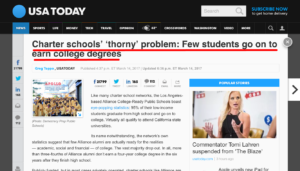
Headline and top paragraphs from USA Today college completion story.
The first and most obvious issue with the USA Today story is that it fails to give readers much context early on in the piece. The headline, graphics, and the opening of the story – all that most readers will register, unfortunately – focus narrowly on charter school networks’ struggles to help figure out how to get more of their graduates to complete college:
“Even as their popularity rises, charters face a harsh reality: Most of the [charter] schools boast promising, often jaw-dropping high school graduation rates,” the story says. But “their college success rates, on average, leave three of four students without a degree.”
Low college completion rates are indeed a problem – they’re just not particularly a charter school problem. But it’s only at the end of the fourth paragraph that Toppo notes that for low-income, high-minority urban traditional schools, most comparable to charters, the college persistence rate is eight percentage points lower.
Even later on in the story, Toppo acknowledges the broader reality. “In many ways, the college-persistence problem is not just a charter school problem, but one that afflicts low-income students more generally.”
Asked about criticisms of his story (most of them from charter school supporters), reporter Toppo defended his presentation of the facts. “I see their point but I think they’re missing the bigger picture. They seem to be saying if A is better than B, then A must be good. I think that’s a crazy way to look at things.”
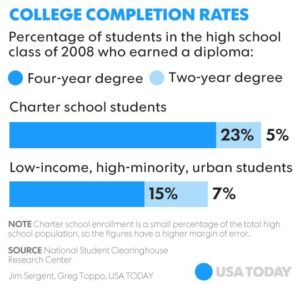
Main graphic from USA Today story.
To be fair, the USA Today piece does give some space to describing structural problems for low-income high school graduates such as challenging academics, lack of guidance or support, and struggles with fees and other expenses related to going to school.
But the piece also misses out on so many other opportunities to explore the broader issue.
Left out of the piece are questions about whether traditional college degree programs are a good match with students’ needs and the job market they will face when they finish. A 2016 Danielle Drelinger series called Higher Ground got at some of these issues.
The voices of urban school district leaders are also conspicuously absent. How many public-school systems express any real interest in ensuring that more of their students complete college? Most seem to think they’re doing a great job by getting somewhat larger numbers to graduate, and brilliantly if they get them to college.
A 2016 US News & World Report story found that only about half of big urban districts track students after graduating high school, or know which colleges and universities do best and provide that information to counselors and colleges.
For example:
*The NYC Department of Education has launched or expanded a variety of programs to help high school students and graduates complete their college degrees, including a website that provides school-level persistence data but no district-wide figures. They did not provide a college persistence rate for their graduates.
*The District of Columbia Public Schools provides institution-level college completion information to parents, principals, and guidance counselors to help graduates make informed decisions (and to help postsecondary institutions make improvements). They did not provide a college persistence rate for their graduates.
Missing also are the voices of college and university leaders whose institutions accept students who face particular challenges to graduating – the much-cited statistic for low-income students is 9 percent over six years. There is an argument to be made that this isn’t a K-12 issue, really – neither charters’ nor districts’ responsibility. The Atlantic’s Ann Hulbert wrote about innovative efforts to improve low completion rates for community colleges in 2014. “Once the student leaves your control, your ability to influence things is somewhat limited,” notes CAP postsecondary guru Ben Miller.
__
Ironically, Toppo’s stated goal in writing the story was to try and “get away from the either/or market share debate” about charter schools and the either/or discussion that inevitably follows.
“I was trying to write a different kind of charter school story,” he said – one that examined the challenges that choice does not seem to alleviate. “Choice is fine but what are the biggest issues necessary to think about?”
Traditional big-city school districts, charter school networks, and the colleges and universities who enroll low-income students have a long way to go when it comes to college completion rates.
However, between the headline, the graphics, and the garbled presentation of information at the top of the story, Toppo’s intentions got lost.
Related post: Rocky Start for ProPublica “Alternative Schools” Series
ABOUT THE AUTHOR

Alexander Russo
Alexander Russo is founder and editor of The Grade, an award-winning effort to help improve media coverage of education issues. He’s also a Spencer Education Journalism Fellowship winner and a book author. You can reach him at @alexanderrusso.
Visit their website at: https://the-grade.org/