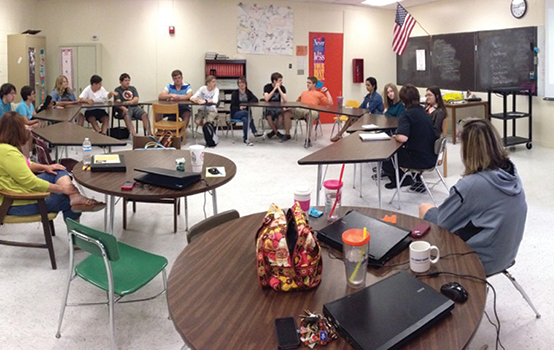
A Florida career academy produces measurable gains for students by creating a new synergy between career-technical education and the economic needs of a community.
When vocational and work-based learning is paired with rigorous academic learning, the results can be amazing, as in the case of students at Spruce Creek High School in Port Orange, Fla.
In just one year, students who had been among the lowest performing students at the high school showed significant academic gains compared to other students at their school and at other high schools in the county. Those previous low performers were enrolled in the Academy of Information Technology and Robotics (AITR), part of the Ford Next Generation Learning (NGL) network, an initiative of the Ford Motor Company Fund.
“My parents wished they had something like this when they were growing up. [If everyone attended a school like AITR,] I think there would be a lot of people who would be more successful than they are now. They would have better jobs, better education, and they would just be overall better,” said AITR student Alec Davis.
AITR, established in 2007, benefits from being in the Volusia County Schools — a district that has prioritized career and technical education. Since 1994, when the first academy opened, the district has developed 35 career academies across 10 comprehensive high schools, enrolling 22% of the county’s high school students. Students who enroll in one of the career academies have the benefit of being in a large comprehensive high school with all of its advantages, as well as being part of a smaller, career-focused school-within-a-school academy.
Career academies prepare students for the workplace by developing interesting and rigorous lessons and by developing close relationships with potential employers.
AITR currently enrolls 130 of the 2,800 students at Spruce Creek High School, which also houses an Academy of Finance. To enroll, students must express an interest in technology, maintain at least a C grade point average, have few absences, and few to no discipline referrals. In addition to four core academic courses and a foreign language, AITR students choose from one of four technology specialties: PC Support, Computer Programming, Game and Simulation Design, and Robotics. Students can earn industry certifications in one or more of these areas and also complete an internship during their junior or senior year.
The AITR model aligns with the Ford NGL framework, which includes three distinct but interconnected strands:
- Transforming teaching and learning. AITR creates meaningful learning experiences that enable students to learn and apply academic and technical knowledge and skills to real-world challenges. At AITR, these experiences take the shape of interdisciplinary team projects — called challenges — in which teachers serve as mentors and facilitators.
- Transforming the secondary school experience. AITR creates and maintains the collaborative structures, practices, and culture of a high-quality career academy. AITR teachers collaborate as a team to create the rigorous and relevant challenges that students complete.
- Transforming business and civic engagement. AITR engages employers, civic organizations, and postsecondary institutions in aligning community resources to enhance students’ learning and improve the workforce development system. AITR’s community and business partners play a key role by providing students with invaluable insights into the workplace, critiquing students’ products, offering internship opportunities, serving as mentors, and keeping teachers apprised of the skills and knowledge students will need to succeed in the workforce.
Research supports the idea that career academies can make a difference when they provide a college preparatory curriculum focused on a career theme that connects academic subjects to the real world of work, and offer work-based learning opportunities and connections to adult mentors (Brand, 2009). Studies also demonstrate career academies’ positive effects on academic outcomes — attendance, grade point averages, graduation rates, and college attendance and completion rates (Dayton, Hester, & Stern, 2011; Maxwell, 2001; Maxwell & Rubin, 2000) — and labor market outcomes (Kemple, 2008).
The results at AITR support this. At the start of the 2011-12 school year, 25% of AITR’s 9th graders tested in the lowest academic performance quartile of the school. By the end of that year, those 9th graders showed significant academic gains compared not just to their school but also to other high schools in Volusia County.
- 97% of AITR students scored in the midrange and above on the end-of-course, 9th-grade biology exam, compared to only 69% of 9th graders districtwide.
- 55% of AITR 9th graders scored in the midrange and above on the Algebra 1 end-of-course exam, compared to 35% districtwide.
Results from a broader measure of students enrolled in career academies in Volusia County also underscore the strength of participating in a career academy.
- Career academy students in Volusia County had a 3.31 grade point average compared with a districtwide GPA of 2.87.
- Career academy students performed better on Advanced Placement tests, posting an average score of 3.12, compared with 2.86 districtwide.
- More than 85% of career academy students have some kind of postsecondary education plans in place when they graduate, compared with 78% for other graduates (Ford NGL, 2013; Pierce, 2012).
Most notably, AITR’s graduation rate is 100%, compared with the districtwide rate of 78%.
A deeper look: Teaching and learning
With input from students (AITR’s students formed a student curriculum committee that meets with teachers to provide feedback on curriculum and academy operations), teacher teams develop interdisciplinary challenges that address essential practices and core knowledge and skills from several subjects. Every six weeks, students take on a new challenge. AITR courses that students take in English, math, science, social studies, and foreign language may be part of these challenges, along with technology courses.
For example, the CSI-AITR challenge integrates biology with concepts from physics, trigonometry, English, and history.
Biology and environmental science teacher Kate Freeland designed the CSI-AITR challenge as a way to teach genetics to 10th-grade biology students. “It would be the best time to teach genetics, DNA, and cells. I got to thinking what kind of cool thing could I teach this with and forensics was a natural,” she said.
That led Kate to fashion the course in the manner of a problem from the “CSI” television series. In the course, students explored core biology concepts — why everyone has DNA, what makes DNA, and the process for replicating DNA — which is usually reserved for senior biology students. In furtherance of the challenge, AITR teacher team member and math teacher Jamie Schultz introduced students to elements of trigonometry that would help with blood spatter analysis. He also veered into physics, which would help determine the trajectory of a bullet and is typically taught in 12th grade. For English, as part of the challenge, students conducted research, wrote reports, and completed real legal documents, including search warrants and witness statements obtained from law enforcement. History teacher Michelle Eaton adapted her American history segment to the challenge in the first year by teaching the history of the FBI. In the second year, she engaged the students in exploring world history.
“We looked at ancient civilizations and what they knew about crime and how they dealt with crime, and mummification and preservation,” Eaton said. The team also brought in outside experts (a state’s attorney, someone who was in an FBI cyber-crime unit, a school resource officer with a nine-year history in homicide) to work with students and talk about careers in forensics.
Students were deeply engaged in the CSI challenge, gained critical thinking skills, and learned subject-area content and skills, Freeland said. “They were living those roles; they took everything seriously. They learned the importance of documenting, taking pictures, taking notes, and recording as they’re interviewing witnesses. They also learned the importance of procedure in a way that when they got to the [mock]trial the defense attorneys found holes in documentation and were able to use it.” The students also worked on their collaboration and planning skills.
“It is amazing to see how well they all work together even with their differing ability levels,” said Michelle Kelley, a reading teacher for the team. “For students with learning differences, they are with a peer group who know them and who accept their [differences]. . . . We have so many students who have learning differences who have just excelled and, I am very proud of this, all of our juniors and seniors who had to pass the state reading test passed with the exception of one junior.”
Changing the school experience
When AITR students reflect on how the academy differs from their previous schools, they talk a lot about taking responsibility for their learning. “We’re kind of pushed out there on our own to learn, to immerse ourselves in this new technology,” said Gavin St. John, describing a programming challenge in which he and freshman classmates animated a Greek or Roman myth using 3D Studio software.
Another student, Jacques Thomas, said, “The work is a lot more hands-on, and you have to be more in control of the work you do. The work you turn in is your responsibility more than the teachers’. At first, it felt like a burden and it was too much. Eventually, you accept the fact that it’s your work, and the teachers are there to help but not do the work for you.”
Said student Alec Davis, “Teachers don’t necessarily give direct instruction. It’s more teaching the students how to teach themselves. And that’s a very big aspect of the academy.” Classmate Jena Morrisey said even when challenges turn out less successfully, they still are “a learning experience for us and for the teachers.”
Keith Nalbach, a teacher and Ford NGL professional development provider who has coached AITR’s interdisciplinary team, said, “It is the focus on the student as an individual and the relationships that are built between staff and students that allows for an incredibly safe, risk-taking environment. This culture promotes true learning, allowing students to make mistakes and collaborate with each other to find answers.” Nalbach attributes the team’s success to the teachers’ dedicated work and flexibility, as well as to Ford NGL’s focus on engaging teachers in learning communities and coaching. All Ford NGL professional development supports teachers in taking risks and collaborating — key ingredients of the learning environments they create for students.
Civic and business engagement
In each challenge, AITR students create end products that they often present to outside reviewers. These presentations expose students to the demands of the workplace and get them excited about their futures. Recently, representatives from companies in the Volusia Manufacturing Association interviewed students as the culmination of a mock job interview challenge. “It was really a good learning experience because we do have things that teach the regular subjects, but we also have things that prep us for our life in the future,” said student Christen Ryan.
Another student, Alec Davis, described a challenge in which company representatives assessed students’ redesign of a product. “They judged us, and, after they gave us our scores, we actually had a talk with them. And they were saying ‘well, this part of your project could be redesigned to be more efficient.’ They opened our minds.”
In Volusia County, the community and educators joined forces to transform secondary school experiences so their career pathways would align with regional economic development opportunities.
Integration of work-based learning experiences is characteristic of high-quality career academies, and AITR has been highly successful in drawing on volunteer mentors from the community. Local businessman Norman Lane, whose company makes rotary actuators, helps AITR students learn to design and build robots. He also judges AITR’s robotics competitions and takes students on tours of the Rotomation factory. Through such interactions, AITR students gain invaluable social capital and begin building networks of relationships that provide them with mentors, resources, and lifelong connections.
Another community volunteer, Matt Cawood, invited a busload of AITR students to visit his company to see how robots are welded and to tour the lab testing facility. “We’re hoping to build engineering talent in this area and help young people understand what great careers are available if they receive the right education. They don’t have to leave Volusia to get a good job, and it will help benefit our businesses as well,” Cawood said.
That level of local employer engagement is characteristic of Ford NGL communities, where a range of business and civic partners are committed to supporting and sustaining the school district’s transformed high schools.
Building capacity
AITR is not alone in seeing positive changes in students’ academic achievement. Data collected on students who participated in the Ford career academies point to key improvements in academic achievement and career preparation. In a 2012 survey, schools in Ford NGL communities reported increased graduation rates, decreased dropout rates, decreased suspensions, and higher GPAs for students in their academies (Leiterman, 2013).
Positive outcomes in AITR and the other Volusia County academies, in particular, demonstrate that there is a strong relationship between a high level of fidelity to the Ford NGL framework — including a sustained commitment from the school district and intensive engagement of civic and business leaders — and high levels of success. To sustain and scale these successes, Ford NGL communities learn how to tap into local and state resources. In preparing to join Ford NGL, Volusia County and other communities engaged in a process that involved employers, community leaders, and educators in developing and then implementing a master plan to build and sustain transformed secondary school experiences while aligning their career pathways with regional economic development opportunities. In Florida, this process enabled Ford NGL communities to secure essential support from Workforce Florida, Inc., the state workforce development board, to carry out the master planning process. To date, over $1 million in Workforce Investment Act funds have enabled Ford NGL to expand from four to seven Florida communities. The master planning process builds the capacity of the local partnership to become self-sustaining and integrates the community into the national Ford NGL network so it can continue to develop by becoming part of a national community of practice.
Improving high schools
The Obama Administration’s proposed education budget for 2014 included $300 million for an initiative to “redesign academic content and instructional practices to align with postsecondary education and careers” (U.S. Department of Education, 2013). Elements of the high school redesign proposal included career and college exploration and counseling, allowing students to earn postsecondary credit while in high school, and encouraging work-based learning experiences. The high school redesign effort, though not supported by congressional budget action, pointed the way for a $100-million Youth CareerConnect program initiated by the U.S. Department of Labor, which resulted in funding for 24 local partnerships of school districts, workforce investment boards, institutions of higher education, and employer partners to redesign the teaching and learning experience for youth to ensure they are prepared for college and careers. These efforts reflect a realization that our nation can no longer afford to perpetuate a divide between “academic” and “career” education but must ensure that secondary schools fully prepare all students for success in postsecondary education and careers. “Career academy . . . plus” models are not the only approach to high school redesign worth considering. However, as AITR illustrates, when career academies are embedded in community-supported structures and are part of national networks designed to promote and sustain excellence and continued innovation, they represent an especially promising approach.
References
Brand, B. (2009). High school career academies: A 40-year proven model for improving college and career readiness. Philadelphia, PA: National Career Academy Coalition.
Dayton, C., Hester, C.H., & Stern, D. (2011). Profile of the California Partnership Academies, 2009-10. Executive summary. Berkeley, CA: University of California, Berkeley, Career Academy Support Network.
Ford Next Generation Learning. (2013). Power of the network: Sharing, caring, and daring. Annual Report 2013. https://fordngl.com/ford-ngl-2013-annual-report
Kemple, J.J. (2008). Career academies: Long-term impacts on labor market outcomes, educational attainment, and transitions to adulthood. New York, NY: MDRC. www.mdrc.org/publications/482/full.pdf
Leiterman, C. (2013, January). Personal communication.
Maxwell, N. (2001). Step to college: Moving from the high school career academy through the four-year university. Evaluation Review, 25 (6), 619-654.
Maxwell, N. & Rubin, V. (2000). High school career academies: A pathway to educational reform in urban school districts? Kalamazoo, MI: W.E. Upjohn Institute for Employment Research.
Pierce, M. (2012, May). A career education program that gets results. T.H.E. Journal. http://thejournal.com/Articles/2012/05/10/Career-education-volusia.aspx
U.S. Department of Education. (2013). Fact sheet: Redesigning America’s high schools. www.ed.gov/news/press-releases/fact-sheet-redesigning-ameCurrricas-high-schools
CITATION: Kantrov, I. (2015). New CTE model is a plus for schools and students. Phi Delta Kappan, 96 (6), 27-32.
ABOUT THE AUTHOR

Ilene Kantrov
ILENE KANTROV is director of Pathways to College and Careers programs at Education Development Center, Inc., a partner in the Ford Next Generation Learning initiative.