The best way to help teachers learn about and adapt technology in their classrooms is by immersing them in hands-on work in the same way their students use social networks and other technology applications.
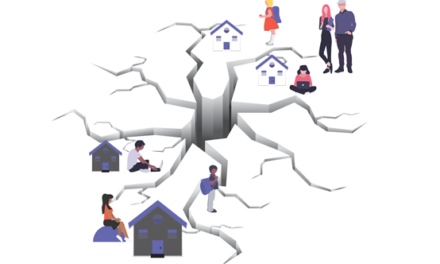
Some see a revolution afoot, and not the quiet kind. Almost everyone at the current moment is affected by vast shifts — economic, social, and cultural — set in motion and then propelled by new and evolving digital technologies and related infrastructures. Consider the ubiquity of social media platforms like Facebook, Twitter, and YouTube. These did not exist just a few years ago, but they quickly spawned practices that now organize the social aspect of our everyday lives. Our historical moment, with its exponential rate of far-reaching change, its compression of time and space, and a connectivity that juxtaposes diverse geographies, ideologies, and languages, is a radically different one, demanding a reimagining of how we live, work, learn, and play.
In virtually every rethinking about education, digital technologies take center stage.
Learning scientists Hagel, Brown, and Davison call this moment the “big shift” and predict that the changes we’re experiencing are “redefining what success means in a wide range of endeavors for both individuals and society” (2012, p.31). They also try to predict the skills, strategies, and dispositions that our new world seems to demand and, along with a host of other educational visionaries, call for what amounts to a revolution in how we imagine learning, education, and schooling. Even during the current climate of accountability, high-stakes testing, and demands for higher academic standards, there are persuasive voices that urge a paradigm shift in how we think about the contents, processes of and purposes for learning. And in virtually every reconceptualization, digital technologies take center stage.
We ask Kappan readers to join that conversation by considering some of the pedagogical implications of this new digital world that are important for classroom teachers and for those who prepare teachers-to-be.
Institutional barriers
We have high hopes for certain types and uses of digital technologies and believe that such new tools — along with the innovative social practices that can develop around them for creation, communication, and problem solving — have great potential to energize and inspire teachers and students. However, we also acknowledge that schools change at a glacial pace and that teachers experience myriad pressures not only to innovate but to hew to customary and sometimes anachronistic ways of doing school. Educational historian Larry Cuban (1986) has startlingly revealed that across time and each new technology teachers’ initial optimism gradually devolved into frustration and limited uptake.
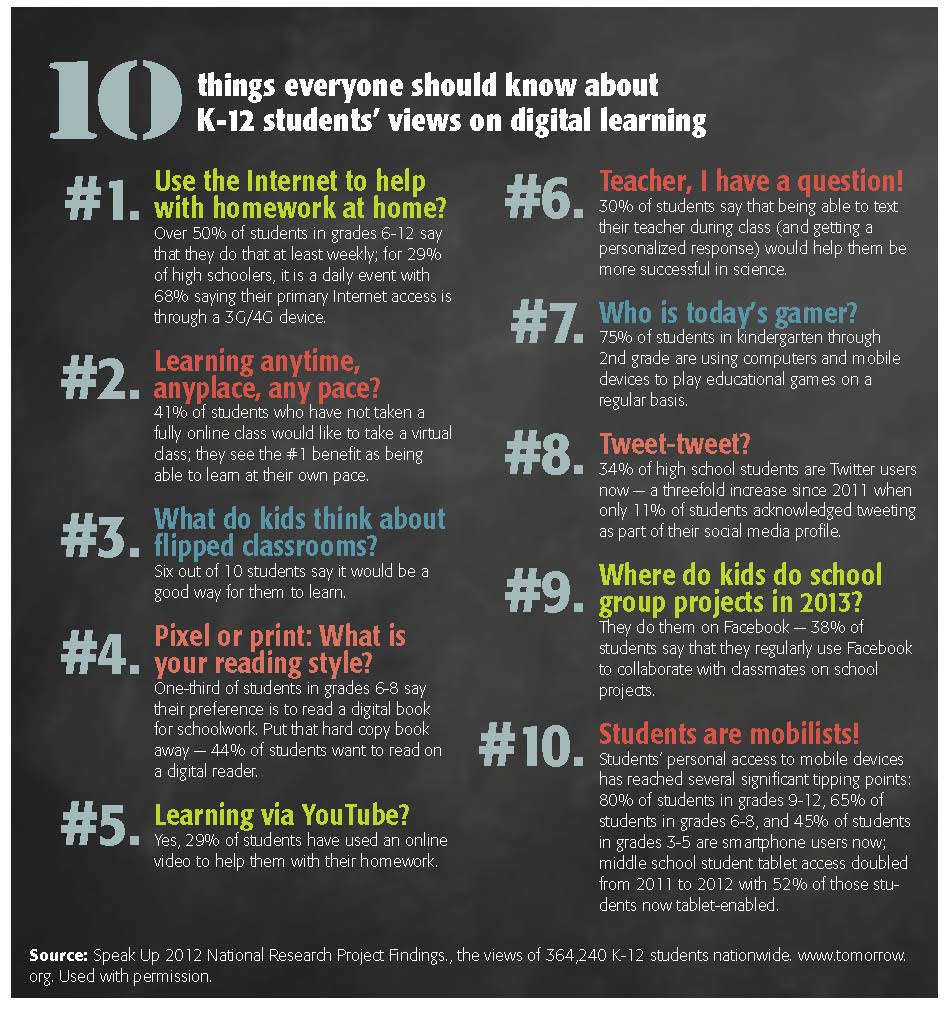
When we examine the most recent research, we find that the center still doesn’t hold in terms of technology’s power to transform education. For example, a recent national survey of 1,441 literacy teachers showed an increase in teachers’ confidence around using information and communication technologies during instruction, but it also revealed that they did not use these tools in service of 21st-century literacies (Hutchison & Reinking, 2011). Similarly, a Pew survey of 2,400 Advanced Placement and National Writing Project teachers found that while a variety of digital tools were available in classrooms — laptops, tablets, mobile phones — there was little innovation in how they were being used (Purcell, Heaps, Buchanan, & Friedrich, 2013). Finally, a survey of more than 300,000 K-12 students showed that students want to use the same mobile devices and social media tools during the school day that they use outside of school and that they are frustrated by school policies and other institutional barriers that thwart them (Project Tomorrow, 2013). (See sidebar, 10 things everyone should know about K-12 students’ view on digital learning.)
Such findings are consistent with Cuban’s earlier research.
Digital Age pedagogy
In the remainder of this article, we focus on one essential part of the solution: positioning teachers to develop the competencies, habits of mind, pedagogical relationships, and dispositions needed to deploy new technologies — pedagogical identities, if you will, for a digital age. Most teachers-to-be are introduced to educational technologies during their teacher education programs for initial licensure (Kleiner, Thomas, Lewis, & Greene, 2007). This is done through stand-alone courses that feature widely used tools — spreadsheets, PowerPoint™, digital portfolios — or through integrating such tools into courses on theories, methods, and subjects of teaching.
There is much interest in improving such courses and in figuring out how teachers might best develop “technological pedagogical content knowledge” (Angeli & Valanides, 2013). We are interested in this, too, but via a different path than is customarily taken. Rather than ask teachers and teachers-to-be to learn about digital tools in a mostly decontextualized way — as discrete skills to acquire and then use at a later time — we advocate immersing them in tool use and artifact generation in much the same way that kids acquire expertise in using digital technologies out of school to socialize, solve problems, explore interests, and make things. We refer to such immersion as “creative action spaces,” and, as we will illustrate, such spaces can be virtual as well as brick and mortar. Their most important feature is organizing participation so students can acquire technical skills in tandem with developing dispositions toward digital tools and learning.
To illustrate, we draw upon two related examples from our research around online social networks and multimodal designing. Each involves teachers’ uses of our custom-built, online social networking platform, Space2cre8.com, a private site created especially for youth and their teachers in extra-school and school-based sites around the world (Hull, Stornaiuolo, & Sahni, 2010; Hull & Stornaiuolo, 2014). The examples we offer here are from our work with preservice teachers in a university preparation program and with teachers of after-school digital media programs. We highlight some of the ways in which the after-school teachers engaged digital tools to create multimedia projects and used Space2cre8 as a way to share their work and to connect as members of an artistic community. We also illustrate the importance of offering educators opportunities to collaborate with peers in supportive design and learning communities.
In each context, we sought to position participants as artists and designers of multimodal digital artifacts and to enable them as a community of tinkerers and experimenters with creative habits of mind and a problem-solving approach to changing times and challenging problems. We asked participants to learn from one another as they developed competencies in using digital tools and to experience firsthand pedagogical strategies that they could deploy or adapt for students. Each project was organized around principles for fostering creative action spaces.
Principle #1: Teachers and new media tools
Relatively little attention has been paid to articulating the kinds of professional development experiences that educators require in order to support students’ expressive and intellectual engagement with new media. Professional learning around digital media often focuses on tool use and neglects consideration of teachers as interested, creative producers of digital media artifacts. In our work with preservice and after-school teachers, we aimed to approach digital media education differently, providing teachers opportunities to work as artistic communities in designing and producing multimedia artifacts and digital videos.
Professional learning around digital media often focuses on tool use and neglects consideration of teachers as interested, creative producers of digital media artifacts.
Our approach included organizing learning activities into team-based “missions,” where instructors worked with one another alongside researchers and media specialists to complete a series of digital art challenges. In the case of the after-school instructors, while they arrived at the first workshop with varying levels of experience using video-editing software, video cameras, and social media platforms, the team structure and missions helped scaffold tool learning within the context of doing and making while also modeling an effective pedagogical strategy to use with students. One such mission asked participants to explore the collaborating university’s campus through a video scavenger hunt that required them to find and record a number of university buildings, landscapes, and happenings. While completing the mission, they were shooting, editing, and sharing a digital video on the Space2cre8 network, developing relationships with one another, and receiving support from more knowledgeable team members.
One participant, in fact, found the scavenger hunt mission to be so engaging and the product that he made so compelling that he began making videos of his weekend nature hikes, putting to personal use the editing skills he had developed during the workshop and sharing the results on YouTube. He then used these videos as models for his students, focusing his early classroom efforts around having students produce similar videos of natural wonders around their own school.
Principle #2: Working across multiple modes of meaning through creative media production
Although print-based reading and writing are and have always been multimodal in that they require interpreting and designing visual marks, space, color, and, increasingly, image (Jewitt, 2005; Kress, 2003), the proliferation of digital media tools has widened the lens of multimodal composing to include genres such as digital stories, computer programming, and podcasts (Hull & Katz, 2006; Peppler & Kafai, 2007; Soep & Chávez, 2010). Engagement with a wider range of modalities has enabled us to produce new texts for new audiences, transcend local and global boundaries, and develop and express identities across the production of multiple forms of texts. For an increasing number of educational researchers and practitioners, young people’s “do it yourself” production of media across modes (Kafai & Peppler, 2011; Lankshear & Knobel, 2010) holds promise as a method for positively developing their identities as writers (Lam, 2000), boosting their “creative confidence” (Carroll et al., 2010), and fostering problem-solving skills (Barseghian, 2009). Keeping in mind the affordances of multimodal composition in a digital age, we wondered what our after-school instructors and preservice teachers might gain from expanding their creative capacities and exploring new ways of communicating ideas. Accordingly, we designed workshops and graduate courses to help them experiment with multiple modes and develop their technical and aesthetic abilities.
Principle #3: Providing a welcoming community for creative design
Teachers, like students, need access to contexts in which they can develop as creators of media. This development doesn’t happen in isolation; being situated in and supported by a community of practice that links to other people, forms of participation, and collaborative opportunities (Brown, Collins, & Duguid, 1989) is key to moving beyond interaction with media and into creation (Brennan, Monroy-Hernandez, & Resnick, 2010). Participating and collaborating in a community also can help teachers develop as creators of media.
Building community starts with establishing a common purpose among members and includes opportunities to build relationships when members share responsibility for one another’s learning. Digital tools can provide these opportunities. In our preservice English education courses, students reflected on their participation on the Space2cre8 network as vital to their coming together as a class and juxtaposed this experience with more traditional online learning management systems, such as Blackboard, which they criticized as aesthetically bland and not conducive to sharing multimedia artifacts and building an online identity. Unlike their previous experiences on Blackboard, which one student described as making her feel like “a number on an assembly line” or “just a faceless person commenting on a discussion thread,” students felt motivated and purposeful when sharing and participating on Space2cre8 because of the enhanced capacity to craft a multimodal digital body and share multimodal texts. Important choices about tool design can powerfully affect participation and learning.
For after-school teachers, a sense of community was fostered in multiple ways and spaces. Professional workshops in the state-of-the-art media lab at a collaborating university gave teachers access to an abundance of tools, resources, and shared space for creative action. Along with working on the various project missions, instructors had multiple opportunities to share student work, reflect on pedagogical strategies they used in their respective after-school contexts, and devise improvements and adaptations suited to their needs and abilities. Seeing the work shared by another teacher (e.g., a digital movie project) or hearing a teacher articulate a successful strategy (e.g., helping students stay on task during projects) inspired another teacher to take similar actions in her own practice. To promote a community of reciprocity, researchers and media specialists also visited teachers at their respective schools as helpers and to problem-solve various issues. These multiple spaces and pathways for community building promoted an atmosphere of collegiality and support that was vital to the teachers’ growth and the community’s successful production of rich artistic works.
Conclusion
There is no doubt that the world has changed and continues to shift, requiring intellectually fresh and ethically tuned responses to economic, social, health, and environmental challenges. Nor is there debate that digital technologies and related infrastructures have been prime movers in this big shift. But how can we marshal digital tools to prepare young people to participate effectively, for themselves and their communities, in new times? Can transformative uses of new technologies help foment a revolution of sorts to speed a shift in how we imagine doing school by extending the rejuvenated benefits of the reach of education? Some scholars over the years have answered a resounding “no,” but optimists, their visions and their examples remain. We wish to emphasize the power of teachers to innovate as well and to call for conceptions of teacher education that integrate digital technologies in ways that enable creativity, agency, and community. If this call is answered, a revolution in education driven by a changing world and digital technologies may indeed be afoot.
References
Angeli, C. & Valanides, N. (2013). Introduction to special issue: Technological pedagogical content knowledge. Journal of Educational Computing Research, 28 (2), 123-26.
Barseghian, T. (2009). Design thinking: Creative ways to solve problems. San Rafael, CA: Edutopia. www.edutopia.org/design-challenge
Brennan, K., Monroy-Hernandez, A., & Resnick, M. (2010). Making projects, making friends: Online community as catalyst for interactive media creation. New Directions for Youth Development, 128, 75-83.
Brown, J.S., Collins, A., & Duguid, P. (1989). Situated cognition and the culture of learning. Educational Researcher, 18 (1), 32-42.
Carroll, M., Goldman, S., Britos, L., Koh, J., Royalty, A., & Hornstein, M. (2010). Destination, imagination, and the fires within: Design thinking in a middle school classroom. International Journal of Art & Design Education, 29 (1), 37-53.
Cuban, L. (1986). Teachers and machines: The classroom use of technology since 1920. New York, NY: Teachers College Press.
Hagel, J., Brown, J.S., & Davison, L. (2012). The power of pull: How small moves, smartly made, can set big things in motion. New York, NY: Basic Books.
Hull, G. & Katz, M. (2006). Crafting an agentive self: Case studies of digital storytelling. Research in the Teaching of English, 41 (1), 43-81.
Hull, G. & Stornaiuolo, A. (2014). Cosmopolitan literacies, social networks, and “proper distance”: Striving to understand in a global world. Curriculum Inquiry, 44 (1), 15-44.
Hull, G.A., Stornaiuolo, A., & Sahni, U. (2010). Cultural citizenship and cosmopolitan practice: Global youth communicate online. English Education, 42 (4), 331-367.
Hutchison, A. & Reinking, D. (2011). Teachers’ perceptions of integrating information and communication technologies into literacy instruction: A national survey in the United States. Reading Research Quarterly, 46 (4), 312-333.
Jewitt, C. (2005). Multimodality, “reading,” and “writing” for the 21st century. Discourse: Studies in the Cultural Politics of Education, 26 (3), 315-331.
Kafai, Y. & Peppler, K. (2011). Beyond small groups: New opportunities for research in computer-supported collective learning. Paper presented at proceedings of the Computer-Supported Collaborative Learning Conference, Hong Kong.
Kleiner, B., Thomas, N., Lewis, L., & Greene, B. (2007). Educational technology in teacher education programs for initial licensure: Statistical analysis report. Washington, DC: U.S. Department of Education, National Center for Education Statistics.
Kress, G. (2003). Literacy in the new media age. London, UK: Routledge.
Lam, W.S.E. (2000). L2 literacy and the design of the self: A case study of a teenager writing on the Internet. TESOL Quarterly, 34 (3), 457-482.
Lankshear, C. & Knobel, M. (2010). DIY media: Creating, sharing, and learning with new technologies. New York, NY: Peter Lang.
Peppler, K.A. & Kafai, Y.B. (2007). From SuperGoo to Scratch: Exploring creative digital media production in informal learning. Learning, Media, and Technology, 32 (2), 149-166.
Project Tomorrow. (2013). From chalkboards to tablets: The emergence of the K-12 digital learner: Speak Up 2012 national findings. Irvine, CA: Author.
Purcell, K., Heaps, A., Buchanan, L., & Friedrich, L. (2013). How teachers are using technology at home and in their classrooms. Washington, DC: Pew Research Center.
http://pewinternet.org/Reports/2013/Teachers-and-technology.aspx
Soep, E. & Chávez, V. (2010). Drop that knowledge: Youth radio stories. Berkeley, CA: University of California Press.
R&D appears in each issue of Kappan with the assistance of the Deans Alliance, which is composed of the deans of the education schools/colleges at the following universities: George Washington University, Harvard University, Michigan State University, Northwestern University, Stanford University, Teachers College Columbia University, University of California, Berkeley, University of California, Los Angeles, University of Colorado, University of Michigan, University of Pennsylvania, and University of Wisconsin.
Citation: Hull, G., Scott, J., & Higgs, J. (2014). The nerdy teacher: Pedagogical identities for a digital age. Phi Delta Kappan, 95 (7), 55-60.
ABOUT THE AUTHORS

Glynda Hull
GLYNDA HULL is a professor at the Graduate School of Education, University of California, Berkeley.
Jennifer Higgs
JENNIFER HIGGS is a graduate student at the Graduate School of Education, University of California, Berkeley.
John Scott
JOHN SCOTT is a graduate student at the Graduate School of Education, University of California, Berkeley.