Schools must take deliberate actions to teach students how to become responsible for their own learning.
The capacity for self-direction is the foundation for learning. Students who develop a sense of responsibility for their own learning are prepared to master rigorous academic content, think critically and analytically, communicate effectively, and collaborate productively.
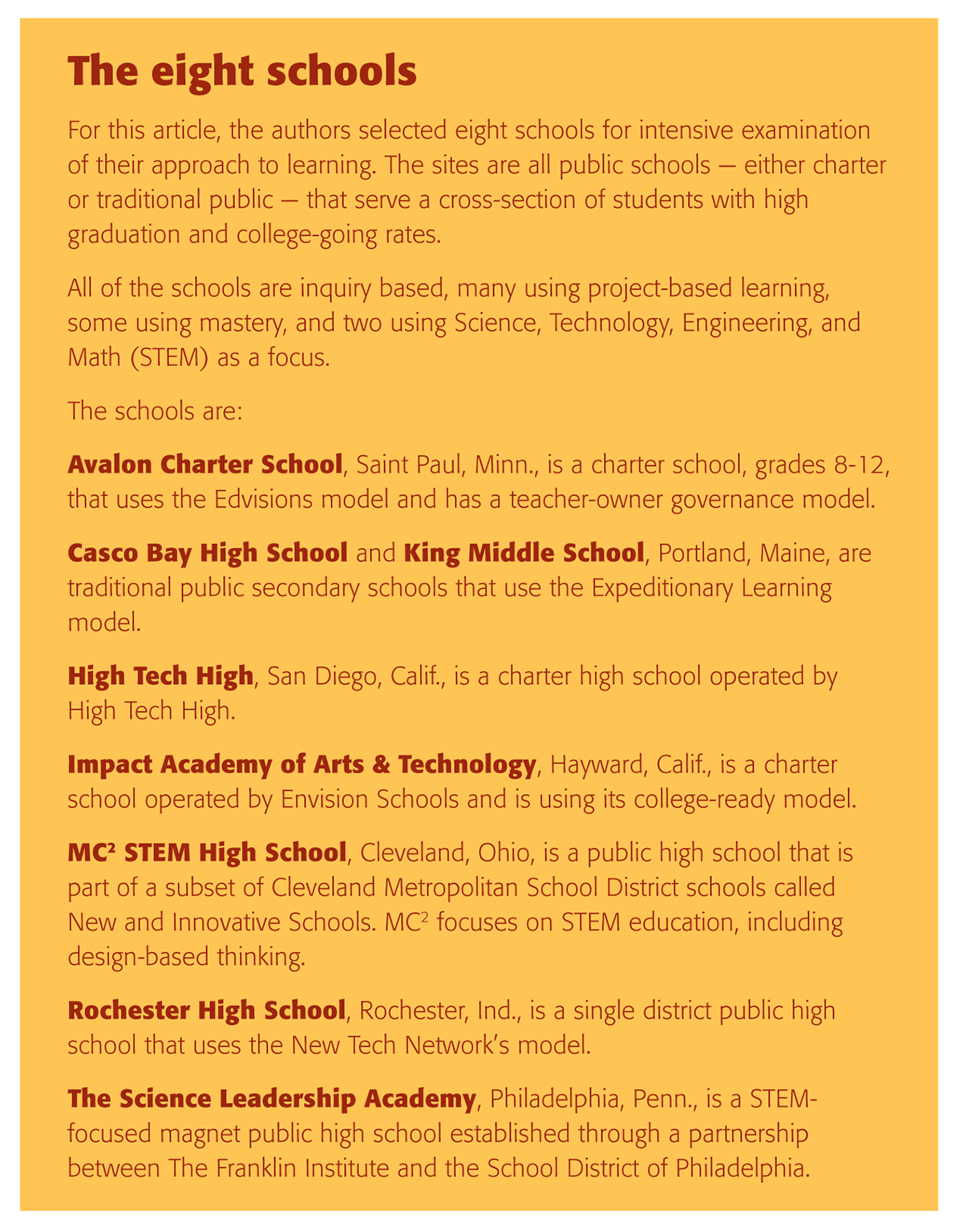
That is the view of teachers and principals we interviewed and observed in action for our forthcoming book, Deeper Learning: A Blueprint for Schools in the 21st Century (New Press, 2014). Supported by the William and Flora Hewlett Foundation as part of its Deeper Learning Initiative, we developed case studies of eight schools committed to deeper learning. The schools we examined (see p. 26 for a list of schools) develop students as self-directed learners through three common practices: experiences that disrupt traditional expectations of teaching and learning; socializing students into a school culture rich with messages and rituals signaling the expectations for learners; and using a consistent pedagogical approach in which students manage complex projects and assignments, seek feedback, revise work, and reflect on what they’ve learned.
Education leaders and educators can benefit from examining how the schools we visited have enabled students to assume responsibility for their own learning.
PRACTICE #1. Disrupting student expectations
Because incoming students have been shaped by passive rote learning, the principals and teachers at the schools we visited have developed disruptive socializing experiences to teach the attitudes and behavior required for self-directed learning. As a teacher from Science Leadership Academy (SLA) in Philadelphia, Penn., said, “New students need to understand that this school is not about where learning just happens . . . but where responsibility for learning is expected from everyone.”
Orientation at SLA, Avalon Charter School in Saint Paul, Minn., and MC2 STEM High School in Cleveland, Ohio, socializes students into the respective school’s expectations through similar activities. Incoming students are immediately immersed in a learning experience that reflects what learning will be like at the school, including working in groups to conduct research or develop a product and ending with a presentation. SLA introduces incoming students to project-based learning and scientific inquiry as a foundation for learning. MC2 introduces project-based learning and design thinking, and Avalon helps students understand how to connect their interests to academics through group or independent projects.
Incoming SLA students form small groups led by a teacher and an upperclassman and then fan out across the city to develop questions, observe how people use urban space, and record their observations. The upperclassmen and teachers then help each team analyze their findings and develop a presentation to the entire freshman class.
At MC2, seniors use orientation to introduce freshmen to the school’s language and core elements. The seniors explain project-based learning and design thinking, share examples of their products, and describe Capstones (cross-subject projects) and mastery learning. On the second day of orientation, 10th and 11th graders immerse freshmen in the design process with a Penny Launcher Competition. The seniors give each freshmen team broad directions and common materials to design a penny launcher. By the time the teams compete, incoming students have a significant experience of what the prototyping and design processes entail.
Because Avalon’s curriculum is built around individualized learning plans, student-initiated projects, and a multidisciplinary senior thesis project, orientation helps students understand their interests and strengths. Teachers lead exercises where students identify what they want to learn and what they wish they were better at and then what they’re already good at and what they already know. Upperclassmen help by sharing how they turned their own interests into independent projects such as writing a play, developing a community service project, or writing a paper based on a family vacation. As explained by Avalon teacher Nora Whalen, “The point of both exercises is for students to understand that everyone has something to offer to their own and others’ learning.”
Immersing students in the school’s culture and learning approach and using upperclassmen as models provide a powerful experience to incoming students. As Jeremy Spy, an SLA staff member said, “The older kids are really important in socializing the new students. They [the upperclassmen] tell their story to the newer kids that this is a great school and that the work they do here is meaningful to them.” Everything the student sees says to them that this is like no other school they have attended before and signals the expectations that will direct them as they become responsible for their own learning.
PRACTICE #2. Using school culture to promote self-direction
After disrupting initial expectations, the schools use their strong cultures to socialize students into a new approach to learning. Allison Rowland, former principal of City Arts & Technology High School of the Bay Area Envisions Charter School Network, said, “We’ve had to develop a culture that not only holds high expectations, but consciously works to develop learners.” The schools are distinctive in that everyone — the principal, teachers, staff, and current students — harness the power of the school’s culture to help new students become self-directed and responsible learners.
Upperclassmen walk the talk. Tyler Fister, a teacher at Impact Academy in Hayward, Calif., said, “This is the first school most kids have ever attended where they know they are here to study and to be successful and not fool around. They get that message from the older students much more than teachers.” Some schools rely on formal programs. Avalon has peer-to-peer mentorship, and SLA uses upperclassmen as teaching assistants. At Casco Bay High School in Portland, Maine, seniors offer freshmen formal advice in the form of a letter and an interview following their orientation week. Many schools have mixed-grade advisories to ensure that younger students continually learn from upper-grade students.
The schools further socialize students through a common language and consistent messages about the importance of becoming self-directed and responsible learners. At Impact, each student, along with teachers and parents, signs a Community Agreement that includes four tenets: “We are respectful, we are safe, we work hard, we support one another.” The four agreements are a constant presence at the school, posted in the hallways, on the walls in each classroom, and are part of the school’s classroom management system.
The value placed on self-direction is also integrated into assessment tools such as rubrics. Rochester High School in Rochester, Ind., has a set of schoolwide learning outcomes that include work ethic and collaboration. When Rochester students work in groups, they are assessed on their individual work including leadership and initiative, collaboration, facilitation and support, and contributions and work ethic. Casco Bay teachers communicate the value placed on student responsibility through a schoolwide rubric, “Classroom Habits of Work” (HOW), to assess student behavior aligned to school values: accountability, work ethic, community, collaboration, perseverance, and pursuit. The schools have a systematic approach to inculcating the value placed on self-direction.
If students are going to become self-directed, a teacher cannot be “the sage on the stage.”
PRACTICE #3. Using the learning loop to teach self-direction
The development of self-direction is reinforced by a pedagogical approach the teachers use across the schools, referred to as “the learning loop.” Because the learning loop is used in all classes, students have a consistent model of what learning is like. Students continually cycle through a process where they are given a complex task or assignment along with the criteria and a model for quality work. They are provided with extensive feedback and opportunity to revise their work, and they are given time to reflect on what they have accomplished and how they might improve with their next project or assignment.
Projects with clear standards and expectations
If students are going to become self-directed, a teacher cannot be “the sage on the stage” but has to back away so students can take responsibility for their learning. As an Avalon teacher said, “My job is to fade into the background in a classroom. If I have planned well, the set-up is good, and the directions are clear . . . the students can do it.”
Teachers make the standards of quality work transparent when they launch a unit by showing students exemplar products such as designs, essays, or art work produced in prior classes and provide rubrics that will be used to assess student work. This degree of transparency enables students to make decisions about what they will do and the degree of effort they will invest in their work while developing a shared understanding of what high-quality products are like.
Every school used a rubric that reflected the school’s overall learning approach. Avalon’s rubric is a particularly powerful tool to guide students through their independent projects. The rubric assesses goals, research, and quality of product, process, and project management. For SLA, common rubrics are used quarterly to assess benchmark projects across all subjects. The rubrics include the same criteria for design, knowledge, application, process, and presentation. Principal Chris Lehman explained how rubrics contribute to a common language. “When everyone uses the same language of assessment, students don’t have to spend time figuring out the adults to guess what makes for a good paper, and even before they begin working, they have a well-developed sense of the elements of a quality product.”
Feedback and revision
The centerpiece of the learning loop at these schools is the emphasis placed on students revising their work in response to feedback. In going through a continual cycle of feedback and revision, students discover that learning requires consistent effort and self-direction. As David Grant of King Middle School says, “the point is learning and understanding. School is revision.”
In classes across the schools we visited, students review one another’s projects and offer feedback on papers, poems, and other assignments; present multiple drafts of their work to a teacher, or solicit feedback from an expert on a project. As a Casco Bay student said, “We feel like we get feedback from our peers and teachers on every essay, if not every paragraph, we write.”
The learning loop teaches students that learning requires long-term effort where they must persevere until they have done high-quality work and can reflect on their growth as well as their challenges.
Teachers often use collaborative processes in pairs and small groups to facilitate peer feedback and revision. Eighth-grade students at King swap their papers with a partner and talk about whether they met the expectations of the assignment so they can move on to the next phase of the project. A set of Rochester team teachers, Ryan Helt and Valerie Hoover have upperclassmen and freshmen in their integrated digital arts and English class provide peer critiques of papers written to demonstrate quality work and show how feedback is a natural part of learning. Similarly, Dan Wise, the humanities teacher at High Tech High, uses extensive peer editing for a major project in which students turn their family’s life stories into a book on the immigration experience. By using peer editing, the teacher noted that student groups had so improved each other’s work that he was able to include every student’s story in the published book.
Teachers believe that offering individual feedback and encouraging students to write multiple drafts of papers before turning in the final product are essential in helping students reach professional standards of performance. As a teacher at Impact said, “We want students to learn a process and understand that a project won’t be done the first time.” A Casco Bay senior said, “Before I was a minimalist in school. I did just enough to get my passing grade and quit. Here it [feedback and revision] makes you want to do your best the first time, and if it isn’t enough, the revision system helps you improve.”
The teachers equally value the contribution of their community partners as experts who provide professional feedback to students. Avalon requires that students have an outside expert on a review panel for their senior project who provides guidance, feedback, and access to unique resources or networks. Seniors at Casco Bay receive feedback from a local nonprofit writing program on their major writing assignments in humanities as well as their college application essays. Juniors in humanties receive feedback from The Salt Institute for Documentary Studies when they practice their interviewing skills in preparation for a multimedia storytelling project. When 9th graders from MC2 complete their design and construct a model bridge, engineers at the NASA Glenn Research Center test the model bridges on “shaker tables” for structural integrity. The engineers videotape the testing and review the video with students and help them identify structural defects and revise the design if necessary.
The role of reflection
Just as students discover that their work is not finished after one draft, they also learn that they don’t complete a product without reflecting on what they have done, including the choices and decisions they made throughout the project. As an Avalon teacher said, “It starts with putting the questions out there. Even simple things are useful. What did you do? How did it go? If given the chance, what would you change?”
Students have extensive and varied opportunities to reflect on their work through oral and written reflective exercises and major culminating events and rituals. Teachers facilitate whole-class conversations and writing where each student is given prompts for reflection, such as being asked to identify, “What did you do well, what can you improve on, and what do you still struggle with?” Advisory classes at Avalon often begin with reflective questions, such as, “What is going well with you this week?” Additionally, students typically have a reflective writing assignment as the final step of their project, most often in the form of journal writing with guiding questions. Many teachers use electronic journals stored in the school’s learning management system, and some use blogs as the modern day journal. For instance, at SLA, instead of students writing their reflection pieces in a private journal, students make their reflections public to the larger community and where others can respond to students’ thoughts.
Reflection is also practiced throughout the year in major events. One of the most powerful events to promote self-direction is the student-led conference many of the schools use. At the conference, with a parent or guardian present, the student is responsible for leading the discussion by talking about examples of their work and discussing their strengths and weaknesses as well as plans for improvement. The teachers’ role comes beforehand, helping students’ review, select, and present representative samples of their work and lead the conference. In describing her role, Pia Martin, an SLA teacher, said, “I want students to be able to talk about why they are getting the grades they are getting but also to be able to identify the issues that keep them from getting good grades.”
Helping students develop a sense of responsibility for their own learning is invaluable because it allows students to successfully master rigorous academic content, think critically and analytically, communicate effectively, and collaborate productively.
End-of-the-school-year rituals are designed to help students reflect upon their overall development and on their goals for the following year. Casco Bay has Freshman Finales and Sophomore Passage where students reflect on a product or project that exemplifies their best work and shows their growth over the year or demonstrates their ability to persevere in the face of difficulties. In High Tech High’s transitional presentations of learning, students formally present their work at the end of every academic year and talk about projects that they’re particularly proud of or that have some special significance to them. Students continually review and reflect on their growth by maintaining a digital portfolio of the work that they’re required to update regularly.
The learning loop teaches students that learning requires long-term effort where they must manage their work, stay on task, solicit and integrate feedback, and persevere until they have done high-quality work and can reflect on their growth as well as their challenges.
Conclusion
Helping students become responsible for their own learning is an incredibly challenging task since it requires transforming their previous, passive “sit-and-get” learning style into a “go-and-get” orientation. The schools we have discussed offer valuable examples of how to develop students as self-directed learners. The principals and teachers purposefully disrupt students’ expectations of passive, rote learning and immerse them in active and self-directed learning that is buttressed by the school culture. The pedagogical approach of the learning loop reinforces the value of self-direction and helps students internalize an understanding that the ability to produce professional quality work requires sustained effort, incorporating feedback from others, and reflection on the choices and decisions made during the learning process. Helping students develop a sense of responsibility for their own learning is invaluable because it allows students to successfully master rigorous academic content, think critically and analytically, communicate effectively, and collaborate productively.
Citation: Martinez, M.R. & McGrath, D. (2013). How can schools develop self-directed learners? Phi Delta Kappan, 95 (2), 23-27.
ABOUT THE AUTHORS

Dennis McGrath
DENNIS McGRATH is a professor of sociology at Community College of Philadelphia, Philadelphia, Pa. He and Monica Martinez are coauthors of Deeper Learning: How Eight Innovative Public Schools Are Transforming Education in the 21st Century .
Monica Martinez
MONICA MARTINEZ is an educational consultant. She and Dennis McGrath are coauthors of Deeper Learning: How Eight Innovative Public Schools Are Transforming Education in the 21st Century .