Questions to ask about the Biden administration’s latest efforts.
By Alexander Russo
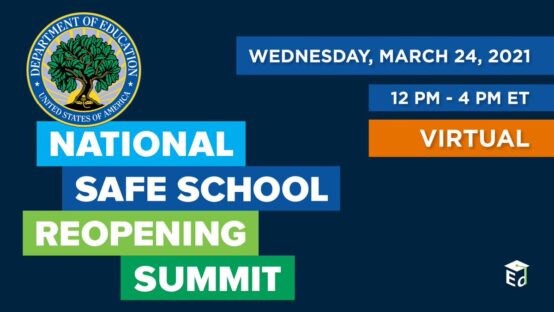
Today at noon Eastern, the Biden administration is hosting National Safe School Reopening Summit, “one of a series of steps the Department is taking to provide support and resources to schools as they work to reopen quickly and safely and equitably address the academic, social, and emotional needs of students most impacted by the pandemic.”
School reopening has remained a hot a topic during the first couple of months of the new administration, which has committed to helping states and districts reopen the majority of elementary schools to full-time in-person learning by the 100th day, roughly five weeks from now. Parent advocates in favor of reopening have complained about being excluded from the event. The American Federation of Teachers has raised concerns about the new Centers for Disease Control and Prevention (CDC) recommendations. There will likely be lots of social media commentary and a fair amount of reported coverage.
I hope the event includes opportunities for the press to ask questions, though it’s not clear at present. If allowed, here are some topics to consider. In any case, journalists and observers should think about how the event was shaped and what messages are being emphasized.
The program is provided here. A write-up of the administration’s efforts is here. It’s a public event, open to all. Register here if you haven’t already. You can watch it here.
How hard does the administration push for widespread reopening?
On paper, at least, the administration’s 100-day goal seems already close to being met. The first wave of results coming in from the new U.S. Department of Education (USDE) survey tells us that 47% of schools enrolling 4th graders offered full-time classroom learning in February, about the same as for schools enrolling 8th graders, according to an AP write-up of the results. However, for reasons including lack of opportunity and parent preference, nearly 60 percent of Black and Hispanic students are still learning entirely remotely. And there are still millions of elementary schools that don’t offer full-time classroom learning. So it will be interesting to see whether administration officials consider the 100-day goal something to celebrate or merely a starting point.
Do officials stick to their definition of “reopened”?
After some initial confusion, the Biden White House clarified that its goal was the safe reopening of the majority of K-8 schools in the U.S., full-time, five days a week. But many school districts are offering something partial, part-time, or not even really in person (i.e., the kids come to school and sit in classrooms, but the teachers remain remote). In its metrics and its messaging, will the White House consider districts like New York City offering much less than five days of full-time in-person classroom instruction to be fully reopened, or not really?
These variations make a difference, especially given that the new USDE results reported in the Washington Post tell us that about a third of hybrid and all-remote schools offer two hours or less of live instruction. Another third are offered just three to four hours of instruction, still far short of a traditional six-hour school day.
Which districts are given the reopening spotlight — and why?
According to the official program, Cleveland, Ohio; New York City; Tulsa, Okla., and Cajon Valley (California) school districts will be featured for their efforts. Why these four, and not, say Providence, Dallas, Miami, and Chicago? NYC’s rollout has been a major roller coaster, and Tulsa and Cleveland reopenings have both been delayed and controversial.
Read about Tulsa here and here. Read about Cajon here and here. Read about Cleveland here. It’s not too hard to figure out how the administration came up with its list.
Do officials stick to the new 3-foot CDC guidance?
The new guidance featuring distances of three feet rather than six came out last week. It was the Biden administration’s second such effort. But at least one of the teachers unions has expresses doubts, and some districts like Los Angeles say that they are sticking with six feet. It’s only guidance, but the unanimity or lack thereof from Biden officials at the event will send a clear message and could influence some districts’ decisions. It will also indicate whether U.S. National Institute of Allergy and Infectious Diseases leader Anthony Fauci, Education Secretary Miguel Cardona, CDC Director Rochelle Walensky, and press secretary Jen Psaki can get on the same page.
What role is given to the national teachers unions?
The two main national teachers unions and their locals have played a major role in supporting the Biden campaign and in shaping the reopening process. They’ve also met with White House officials several times since the transition began. At least one of them has publicly questioned the new CDC guidance. So it will be interesting to see what role teachers unions are given, formally or behind the scenes. Were they involved in selecting or approving the featured districts? Are their concerns and needs highlighted above and beyond those of other school staff, parents, or students?
How does the administration handle equity arguments?
In a debate often characterized by one side accusing the other of racism, reopening opponents have frequently noted lower participation rates of Black parents in sending their kids back into schools, along with lower interest expressed in surveys. Reopening proponents have noted the importance of giving parents choices, and the downsides of remote learning for most kids. The new USDE data find big racial gaps in student participation, reflecting differences in what’s offered and family decisions. “Officials said they had not yet analyzed how much offerings vs. family preferences influenced the results,” according to the Post. Given the heated debate and the delicacy of the issues, how the administration addresses equity arguments could shift the tone.
ABOUT THE AUTHOR
Alexander Russo
Alexander Russo is founder and editor of The Grade, an award-winning effort to help improve media coverage of education issues. He’s also a Spencer Education Journalism Fellowship winner and a book author. You can reach him at @alexanderrusso.
Visit their website at: https://the-grade.org/