A homeless student. A struggling parent. An overwhelmed high school junior. Experts and journalists describe how to bring life to your stories despite access limitations.
Great profiles usually require extensive in-person reporting and meticulous detail to bring subjects and their environments to life.
But journalists are operating under new rules during the coronavirus pandemic. To protect themselves and their sources, they must practice social distancing, keeping at least six feet away from others, or staying at home altogether.
So how can education journalists still write vivid profiles?
Narrative writing experts as well as education reporters who wrote recent profiles say journalists can try a variety of techniques, including conducting multiple interviews; spending more time to build a rapport, and using technology such as video chats to try to simulate being with the subject as much as possible.
As you will see, the results are often impressive.
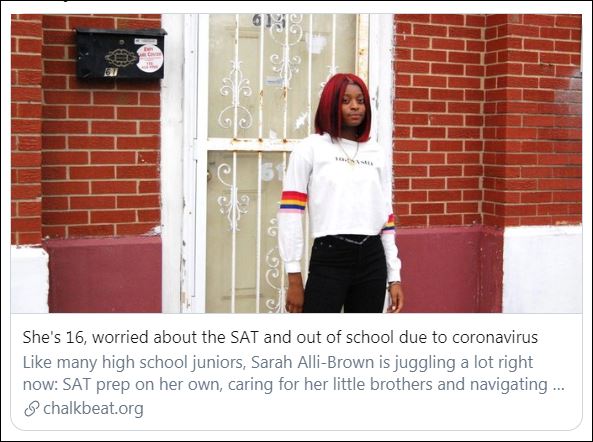
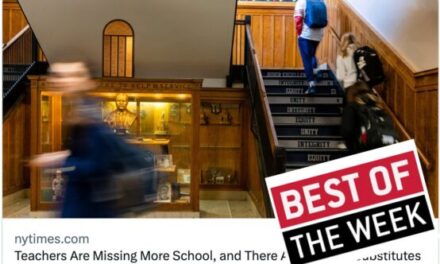
Above: Kalyn Belsha’s profile of a high school student in Chicago (for Chalkbeat) is an example of high-quality work that’s being done despite lack of access.
Do multiple interviews
Mitchell Zuckoff, a Boston University professor of narrative studies and New York Times bestselling author, said that doing multiple interviews is an important component of profile writing — especially when you cannot be there in person.
“Usually when people tell you a story, they’re telling you the plot. The clinical details…It’s only by repetition and drawing out more details that you could possibly get the kind of ‘you are there’ experience,” Zuckoff said in an interview with The Grade.
Chalkbeat’s Kalyn Belsha recently profiled Sarah Alli-Brown, a high school junior in Chicago:
Sometimes she feels scared for her mom, who can’t stop working. Sometimes she misses those long Sunday services at church followed by a potluck meal, where her mom’s jollof rice is a standout dish. Sometimes she gets so bored she just goes to sleep.
Belsha found that checking in with her subject several times helped her better understand how the student’s life and emotions evolved from day to day.
“I was able to get a sense of if the emotions she was feeling were lasting or a response to something that specifically happened that day,” Belsha said in an interview with The Grade.
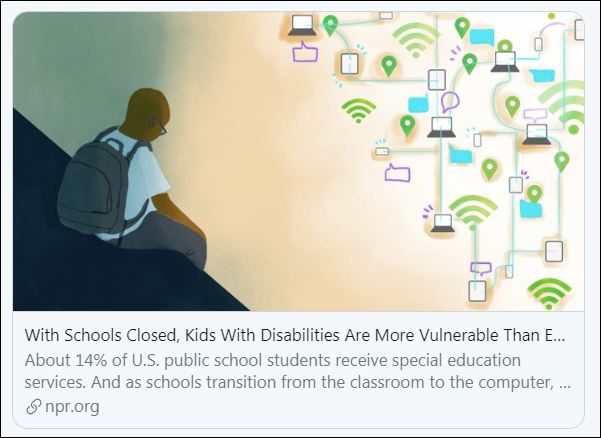
Above: Elissa Nadworny’s NPR story about students with disabilities during the remote learning era benefitted from the reporter’s candor with her subjects.
Set the subject at ease
During this difficult time, journalists also may have to give a bit more of themselves to help interviewees open up.
“When you’re writing a profile, it’s important for you to quickly set the person at ease; share something about yourself and about how your day is going,” said Tom Huang, assistant managing editor for journalism initiatives at the Dallas Morning News, in an email to The Grade. “This is especially important if you’re interviewing the person remotely.”
This aligns with the experience of NPR’s Elissa Nadworny, who said that being straightforward with subjects about the reporting process is helping her connect with them.
“Part of this is transparency…if you bring them into what you’re doing, I find the buy-in is much higher,” she said.
Nadworny recently published an NPR piece about parent Marla Murasko and her son, Jacob. Despite never meeting her subjects in person, the NPR journalist gave her audience a bit of the family’s new morning routine:
Marla Murasko begins her morning getting her 14-year-old son, Jacob, dressed and ready for the day. They have a daily check-in: How are you doing? How are you feeling? Next, they consult the colorful, hourly schedule she has pinned on the fridge. Jacob, who has Down syndrome, loves routine.
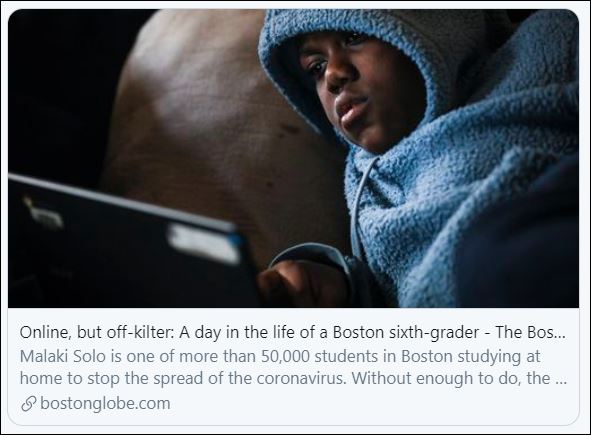
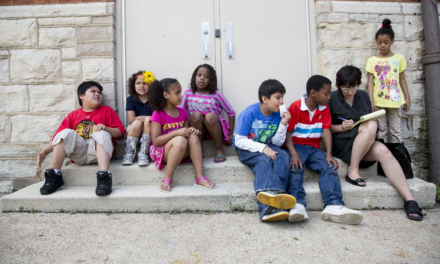
Above: For this recent story by Bianca Toness, “The Globe spent a school day following Malaki — virtually, via Zoom — to glimpse how one city middle-schooler was faring.”
Technology is your friend
Technology, too, can help reporters get to know subjects better. In addition to interviews, Nadworny used primary source digital documentation, like her subject’s social media posts, vlogs, text messages, emails from schools, and Zoom classroom sessions, to understand how COVID-19 changed their day-to-day lives.
“That is kind of a positive in this world of sharing so much. I’ve found many of the people I’ve been talking to have some sort of documentation of their lives over the past couple of weeks,” Nadworny said.
Huang said that reporters should try to interview their sources via video chat, if possible, to pick up on nonverbal cues that they cannot see in phone conversations. The medium can also help build rapport.
“Seeing a person, and letting them see you, is important. You’ll catch facial expressions and body language. There’s also something about our faces that help engender trust, too,” he wrote via email.
Put on your writing hat
Even if you can’t hang out with your subjects, you can still write vividly about them, depicting details through phone interviews and meticulous reporting.
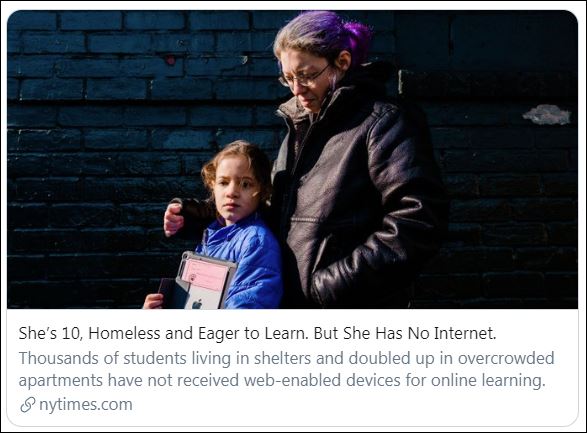
For example, in her recent piece about a homeless student named Allia Phillips, the New York Times’ Nikita Stewart led off with emotion and detail:
On Monday, the first day that New York City public schools began remote learning, the 10-year-old placed her iPad on a tray she set up over her pillow on a twin bed in a studio that she shares with her mother and grandmother inside a homeless shelter on the Upper West Side. And then, Allia saw nothing.
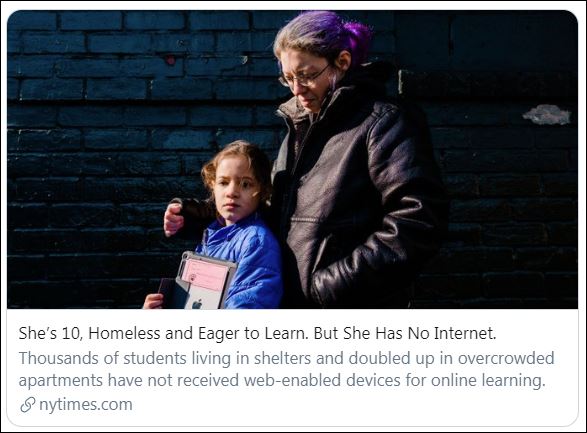
Above: Nikita Stewart’s NYT profile of a homeless student is a strong example of the kinds of reporting and writing that are still possible to do.
As these examples show, reporters can still write great profiles, even without in-person access to their subjects with a little extra time, effort and — as Belsha suggests — grace.
“Be flexible and try to make yourself available whenever the student has time,” Belsha said. “People are going to have access issues, things will come up…Be gentle with yourself.”
ABOUT THE AUTHOR

Amber C. Walker
In addition to being a consulting editor and columnist for The Grade, Walker is a multimedia journalist and digital content strategist. You can find her @acwalker620 across platforms.