In this week’s newsletter: The SATs are making a comeback — sort of. An Oklahoma district revamps its advanced math program without the usual controversy. The Newton teachers strike reminds us how difficult it is to cover strikes well. State- and district- level learning recovery results are out — though few local stories have yet appeared. The sweetest education journalist picture I’ve ever seen. And Chalkbeat gets a shoutout on many educators’ favorite TV show.
RETURN OF THE SAT
The big story of the week
The big education story of the week is the return of the SAT as part of the college admissions process at some elite colleges and universities — and, by implication, the reconsideration of standardized testing as a tool for evaluating student learning and promoting equitable access.
As has been widely reported, Dartmouth announced that it would go back to using the SAT as part of its admissions process in order to help support and improve student diversity (New York Times, USA Today, Wall Street Journal, Washington Post, Inside Higher Ed, ABC News).
Dartmouth is just the latest in a series of schools that have gone through a similar debate, though not all have come to the same decision (Marketplace, NPR). At the same time, the SAT test itself is going through a series of major changes, which could further confuse the current situation (USA Today). And the College Board, which administers the test, has been the focus of enormous scrutiny in recent years.
Other big stories of the week:
📰 SHOOTER’S MOM: The mother of Oxford, Michigan, school shooter Ethan Crumbley was found guilty of involuntary manslaughter for buying her son a gun four days before the shooting despite being aware he was struggling with mental health (Washington Post, New York Time The Daily, NPR, Detroit News, NBC News). She and her husband — whose trial is scheduled to begin in March — are the first parents of a mass shooter to face such serious charges for their child’s crime. Could more parents face charges for school gun incidents? Could the school be next? Some parents hope so (NPR).
📰 FLOODING DISRUPTION: Most K-12 schools in Southern California remained open during this week’s torrential rains and flooding, but in LAUSD, the bad weather still kept 4 out of 10 students out of school anyway (New York Times, LA Times, EdSource). Up north in the Bay Area, multiple schools closed (CBS News). Given the prevalence of extreme weather these days, it’s a good reminder to read this piece in The Grade from Anya Kamenetz on why climate change is the biggest under-reported education story. For a recent admirable example, see this piece from City Limits on New York City schools at risk of extreme flooding.

EQUITY WITHOUT DETRACKING
The best education journalism of the week
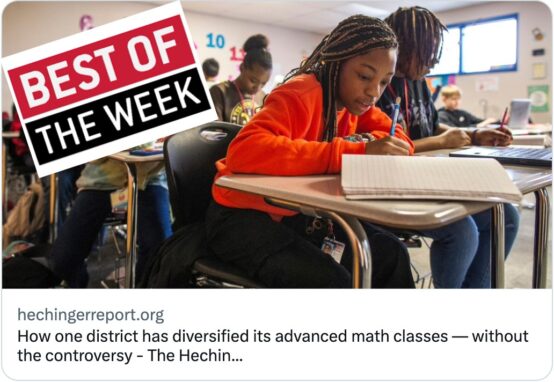
The best education story of the week is How one district has diversified its advanced math classes — without the controversy, by the Hechinger Report’s Neal Morton. (The story also appeared in Tulsa World.)
Morton reports on the math sequence at Union Public Schools, a suburban Tulsa district whose advanced math classes once skewed disproportionately white, but now, thanks to a decade-long effort, better reflect the racial makeup of the community.
Rather than place students in the advanced track based on a single high-stakes test they take as fifth graders, the district gives kids multiple opportunities to qualify — in the form of more assessments and tutoring support in early grades. As a former math teacher told Morton, “We hunt them down from every corner of the school district.”
Morton’s story charts less-covered territory in the detracking debate by focusing on a school system that has made advanced mathematics a key part of its equity strategy rather than eliminating courses. Classroom scenes including a hands-on sixth-grade class on ratios and a “pin-drop quiet” calculus session make the story more vivid and urgent.
See also Jill Tucker’s latest on SFUSD’s detracking saga and a similar story in the Wall Street Journal from Sara Randazzo looking at both San Francisco and Cambridge.
Other great education stories this week — and why we liked them:
👏 Zaidee Stavely adds another dimension to the migrant student story by taking readers to Tijuana, Mexico, where bilingual teachers in training at San Diego State spend four days as they prepare to serve Spanish-speaking newcomers (EdSource).
👏 This solid piece of local watchdog reporting from Andrea Eger cleanly reconstructs an aspiring superintendent’s complicated scheme to defraud the Tulsa school district and its students out of hundreds of thousands of dollars (Tulsa World, 1/28). Featured in Local Matters.
👏 Elaine S. Povich balances a national perspective with local detail in this anecdote-rich story about several states’ successes with outreach workers who build relationships with students who’ve been missing school by knocking on doors and walking them to the bus stop (Stateline, 2/2).
👏 Scrutinizing one education company’s offerings and a Bay Area school’s decision to adopt them, this Jill Tucker piece about an elementary school that spent $250,000 on a program literally called Woke Kindergarten is both an entertaining read and a thorough piece of reporting (San Francisco Chronicle).
STRIKE SKEPTICISM
Our latest columns and commentary
On Monday, we published Oregon Public Radio editor Rob Manning’s piece about how to prepare for — and survive — covering a prolonged teachers strike.
Among several pieces of advice, Manning’s first recommendation was to be skeptical about what sources are telling you during a strike.
“There was a remarkable lack of candor and clarity during the Portland teachers strike from both district officials and union leadership,” Manning wrote. “Be skeptical of ALL of it from the start,” he advised, “or be prepared to have to correct your coverage at some point down the line.”
This would turn out to be an eerily prescient piece of advice when, just two days later, the Boston Globe was forced to correct a story describing how the mayor of Newton had been absent from the bargaining process — “due to incorrect information provided by sources.”
This isn’t the only recent indication that covering teachers strikes is a challenge. When we asked Boston-area education journalists to share insights and experiences covering the Newton strike, which ended Monday, journalists from two major outlets did not respond or declined to participate.
Those who did described an exhausting process, a complex set of stakeholder perspectives, and a reluctance to report backstage political dynamics.

Above: The sweetest image of an education reporter at work I’ve ever seen.
PEOPLE, JOBS
Who’s going where and doing what
🔥 New endeavors: Education journalist Holly Korbey is starting her own new publication called The Bell Ringer. “While there are a lot of blogs and newsletters for teachers, there isn’t currently a whole publication focused on the science of learning for a general audience,” Korbey tells us. Meghan Mangrum has a new education newsletter, Deep South Education, focusing on school choice among other things. Make sure to subscribe! Started last summer, the Seattle Hall Pass podcast just got a big shout-out from the Seattle Times editorial page. And check out the new landing page for the Boston Globe’s big series on literacy, “Lost in a World of Words.”
🔥 Sound off: “When the news outlet in your town stops covering the school committee or school board, there’s an information vacuum,” Ellen Clegg, co-author of the newly published book “What Works in Community News,” tells us. The situation gets worse when local news outlets start focusing on national stories rather than “whether the new elementary school will go over budget or why reading scores are down.” However, Clegg praises models like Chalkbeat and the various foundation-funded Ed Labs embedded in newsrooms. “I’m optimistic that the local news crisis will be solved one community at a time.”
🔥 Job openings & opportunities: The Boston Globe is hiring a higher education reporter. NOLA.com is hiring a reporter to cover K-12 schools and higher ed in New Orleans. Chalkbeat Detroit is looking for a reporter to cover district and charter schools. The Florida Phoenix is hiring an education reporter. MLK50 is hiring a juvenile justice and youth reporter. Apply by Feb. 15 for the Institute for Citizens and Scholars Higher Ed Media Fellowship, which offers $10,000 to report a long-form story or series on post-secondary career and technical education.
🔥 Downsizing: Is there an exodus at the Boston Globe’s Great Divide? The once mighty team of eight is down to five, with reporter Naomi Martin the latest to leave to become an editor for the Globe’s business section, we hear. Last week, we reported that Niki Griswold moved to the politics beat, and digital producer Adria Watson is now a general audience editor. No word yet on whether any of them will be replaced.

Above: This week, I learned that Stanford’s Education Recovery Scorecard gives data down to the district level. I’ve spotted local stories featuring Birmingham, Philadelphia, and Berkeley, but I’d love to see more.
APPEARANCES, EVENTS, & NEW RESOURCES
What’s happening and new research
⏰ Podcasts, segments, & films: The 74’s Linda Jacobson spoke with KJZZ Phoenix about her reporting on schools at risk of closure due to enrollment loss. WBUR On Point had a segment last week on how to fix chronic absenteeism. Two new episodes of “Sold a Story” and a Spanish translation are coming soon, according to Emily Hanford. WBUR education reporter Carrie Jung was on “The Common” talking about the Newton teachers strike — the longest in recent memory in Massachusetts. And don’t miss the Oscars next month, where the German film “The Teachers’ Lounge” is up for the best foreign feature award. “Such a taut, intense depiction of what it’s like to be an educator in the post-pandemic era of high stress, low trust, and rampant social media,” tweeted ProPublica’s Alec MacGillis.
⏰ Research: New federal data shows that public school enrollment across the country has finally ticked up slightly but is still below pre-pandemic levels (K-12 Dive, EdWeek, The 74). The rebound was mostly reserved for students in upper grades. Census data also notes that private school enrollment has increased in almost every state and Washington, D.C., since the pandemic (Axios Portland).
⏰ Resources: Houston Landing shares helpful information for parents and journalists about what happens during “closed” school board sessions. Denise-Marie Ordway of the Journalist’s Resource has seven tips for improving coverage of private school choice. Check out ProPublica’s maps showing which states have active shooter training requirements for schools — and which for law enforcement (hint: far fewer). Remember Burbio? This week, they’re tracking deadlines and unspent ESSER III funds.
THE KICKER

It’s not often that education journalism outlets make their way into pop culture. But this week, Chalkbeat did — and the Nieman Lab was there to celebrate.
That’s all, folks. Thanks for reading!
Reply to this email to send us questions, comments or tips. Know someone else who should be reading Best of the Week? Send them this link to sign up.
Using Feedly or FlipBoard or any other kind of news reader? You can subscribe to The Grade’s “feed” by plugging in this web address: http://www.kappanonline.org/category/the-grade/feed/.
Read more about The Grade here. You can read all the back issues of The Grade’s newsletter, Best of the Week, here.
By Alexander Russo with additional writing from Colleen Connolly and Will Callan.
ABOUT THE AUTHOR

Alexander Russo
Alexander Russo is founder and editor of The Grade, an award-winning effort to help improve media coverage of education issues. He’s also a Spencer Education Journalism Fellowship winner and a book author. You can reach him at @alexanderrusso.
Visit their website at: https://the-grade.org/