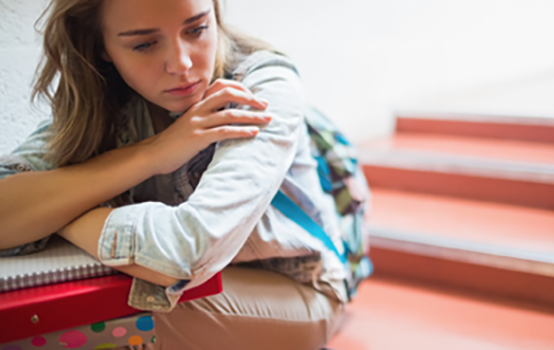
About 10% of the school population — 9 to 13 million children — struggle with mental health challenges, some of the most challenging students that educators face. In our inclusive classrooms, teachers are becoming skilled at working with children who exhibit learning, physical, and cognitive disabilities, as well as those on the autism spectrum while students with mental health challenges continue to mystify and frustrate.
Many students with mental health challenges have difficulty regulating their emotions and behaviors, often becoming inflexible and oppositional, disengaged or disruptive. Classroom culture is often not supportive of these students, who have difficulty with expectations that are reasonable for most of the class. Traditionally in classrooms, we’ve emphasized and rewarded consistent and regulated behavior and performance — the exact skills lacked by many with mental health challenges.
Students with anxiety or other mental health challenges may demonstrate inconsistent performance and behavior, which may fluctuate with their emotional state. As the student’s anxiety and mood fluctuates, so does his ability to attend, behave appropriately, and do schoolwork. This potentially causes them to go from writing a two-page essay in the morning to struggling with a coherent sentence in the afternoon, from being appropriate during a spelling quiz one moment to crying over an easier assignment the next. Teachers are left not knowing what to expect. Typical classroom expectations are inflexible and don’t account for a student’s varying ability to achieve them at any given moment. Inflexible cultures can produce anxiety in those unable to meet expectations.
How can we change classrooms to better accommodate students with mental health challenges? How can we change classroom culture to better accommodate these students? By making the classroom more flexible: “reading” the student and reacting accordingly while emphasizing skill building. Although this flexible classroom model has mainly been used in self-contained special education, it’s a universal design that benefits all students, not just those with mental health challenges.
- Also by Jessica Minahan: Building positive relationships with students struggling with mental health
Most students with mental health challenges exhibit small behavior changes (wiggling in their seats, speaking loudly, or putting their heads down) before they become overwhelmed, act inappropriately, or stop working. Responding at the first sign of dysregulation “catches” them while they’re still rational and accessible to intervention. This response doesn’t need to be more than a check-in, asking how the student is doing or suggesting that he use a calming strategy. Because regulation in a more flexible classroom culture can be as important as work production, expectations may need to be adjusted accordingly. For example, in math, the expectation may change from producing a fact sheet to remaining seated and calm.
In his book How Children Succeed, Paul Tough describes learning regulation skills as essential for all students. This can be achieved by taking brief moments throughout the day to teach and review techniques for staying calm, persisting with a difficult task, and identifying emotions and stressors. In the flexible classroom, demonstration and practice of self-regulation skills, instead of perfect behavior and production, can become the emphasis and expectation. It gives those students with mental health challenges essential strategies to cope with difficult situations they’ll face in the future.
Students with mental health challenges are increasingly present in our classrooms. A flexible classroom culture that’s proactive and supportive can prevent them from becoming disruptive, disengaged, and work avoidant, while leaving the teacher more available for teaching. A more flexible classroom culture is universally beneficial, teaching every student skills for success.
ABOUT THE AUTHOR

Jessica Minahan
Jessica Minahan is a licensed and board-certified behavior analyst, special educator, as well as a consultant to schools internationally. She is the co-author of The Behavior Code: A Practical Guide to Understanding and Teaching the Most Challenging Students (Harvard Education Press, 2012) and author of The Behavior Code Companion: Strategies, Tools, and Interventions for Supporting Students with Anxiety-Related or Oppositional Behaviors (Harvard Education Press, 2014).
Visit their website at: www.jessicaminahan.com