|
Echoing the debate that’s roiled progressive private schools for at least the past year, efforts to address racial inequality in schools are now raising concerns for parents (and, as the Post notes, opportunities for politicians).
🔊 As schools expand racial equity work, conservatives see a new threat in critical race theory (Washington Post)
🔊 A Split Rockwood: School Community In War Of Words Over How To Teach Diversity (St. Louis Public Radio)
🔊 Texas lawmakers see civics bills as a rejection of ‘woke’ philosophies. Educators say they would have a chilling effect (Dallas Morning News)
🔊 GOP Lawmakers Look to Ban ‘Woke Philosophies’ Like Critical Race Theory in Texas Schools (Texas Tribune/The 74)
🔊 In bitterly divided election, opponents of anti-racism education win big in affluent Texas town (NBC News)
🔊 Tennessee legislature approves ban on teaching critical race theory in schools (Chalkbeat)
🔊 “It’s Blatant Invisibility”: Students And Parents Call For Asian American Studies At NYC Schools (Gothamist)
CORRECTION: Last week’s review of the 100-day reopening coverage linked to the wrong story from The 74. This is the story I meant to link: As Biden’s 100-Day Mark Approaches, 97% of Youngsters Have Access To In-Person Classes. Apologies to all.
For other big stories this week, see Media Tidbits two sections below.
|
HELPING DYSLEXIC KIDS IN TEXAS
The best education journalism of the week, plus a runner-up or two.
|
|
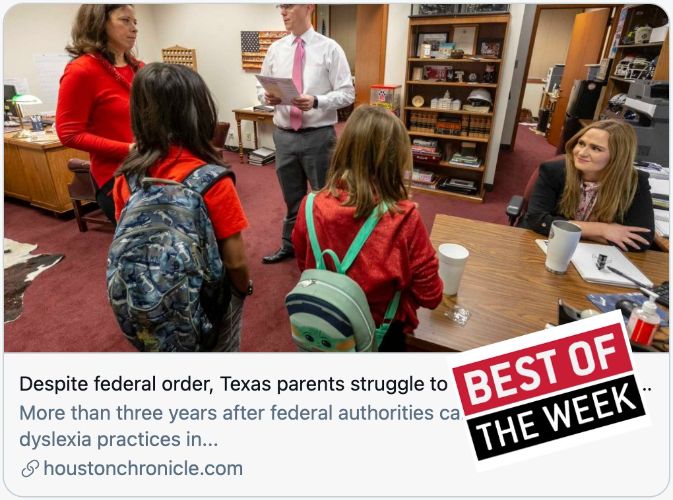
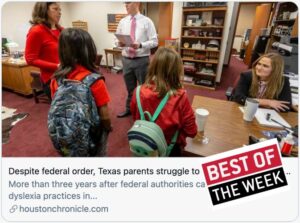
| 🏆 BEST: The best education story of the week is Despite federal order, Texas parents struggle to win services for dyslexic students by Shelby Webb in the Houston Chronicle. Webb speaks to parents whose kids have struggled to get the services they need to succeed in school more than three years after federal officials called out Texas’ dyslexia practices following a Chronicle investigation. “Investigators found about 20 percent of dyslexic students received special education services, while many more were given reading interventions or offered minor accommodations,” Webb writes. “Little has changed.” In a recent story we published on how to cover literacy, reporters recommended interrogating state policies. Webb does exactly that in this piece and holds officials accountable.
🏆 RUNNER-UP: This week’s runner-up is Dueling rallies in Harlem about reopening NYC schools by Ellen Moynihan and Larry McShane in the New York Daily News. This story is not a deep dive, but it is parent-centered and it focuses on the fact that “parents” aren’t a monolithic group in the school reopening debate. Moynihan and McShane covered two rallies happening simultaneously just a few hundred feet apart in Harlem and found opposing views among rally attendees, which included some politicians, too. In an election year for New York City mayor, these voices are important and could have a big influence on the race. (For another view of the protests, check out today’s NYT story, Restaurants and Broadway Are Coming Back. What About Our Schools?)
To get daily education headlines and education news events, follow @thegrade_.
 Getty Images
|
COVERING SEL THE SMART WAY
New from The Grade |
|
|
Social and emotional learning is all the rage in education, but some recent media coverage has been missing the mark.
“As attention to SEL continues to grow this spring and beyond, educators need to know what ‘good’ SEL implementation looks like, and journalists need to avoid misrepresentations of SEL and young people,” writes CASEL’s Justina Schlund in a new column copublished with SmartBrief Education.
Remember not to focus on perceived deficits, according to Schlund’s recommended strategies for covering SEL effectively. And whatever you do, don’t conflate SEL with mental health.
Hard to believe it, but The Grade launched six years ago as a part-time side project with the Washington Monthly. Thanks to everyone — readers, contributors, colleagues, and critics — for helping us get to where we are today.
|
|
|
MEDIA TIDBITS
Thought-provoking commentary on the latest coverage.
|
|
|
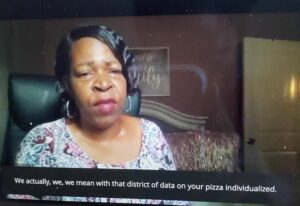
Above: “Don’t write about us until you’ve talked to us,” wrote Memphis Lift’s Sarah Carpenter (above) in an open letter from the Powerful Parents Network to education writers that was posted at the conclusion of this year’s EWA conference. “We actually know what’s going on with our kids and in our schools.”
📰 REOPENING IS BROKEN: While the Biden administration made its 100-day reopening goal — sort of — data and reporting keep reminding us that the challenge remains unmet. “Almost 4 in 10 students continued to take all their classes remotely, the survey found,” according to AP, “and an additional 2 in 10 were split between classroom and remote learning.” (See also US News.) The situation is even more dramatic in California, where 55% of all public school students, including those in charter schools, were at home in distance learning mode, according to EdSource. (EdSource also has a new tracker for learning modes across California you should check out.) In some places like LA and San Francisco, “Zoom in a room” has been the dominant model, per reporting from the WSJ. Lots of NYC kids are ostensibly back in school, but the NYT reminds us that what’s being offered is pretty skimpy.
📰 MISSING REPORTING ON THAT CDC GUIDANCE: This easily could have been a story broken and fully reported by education reporters. But instead, precious few mainstream news outlets or education journalists have touched it. On Saturday, the NY Post broke the news about extensive communication between the Biden CDC and the national teachers union (among others) in advance of the initial school reopening guidance. But EdWeek’s Evie Blad is the only education reporter I’ve seen sharing information about the issue so far. How are readers supposed to take mainstream news outlets (and education journalism) seriously if they won’t report (or debunk) such a hotly debated topic? There are so many unanswered questions, including the extent of the AFT’s influence, whether the CDC consulted with parents (or with districts and schools that had already reopened safely), and whether the CDC recommendations had any real impact on districts reopening or staying shut.
📰 STANDING UP FOR THE EDUCATION BEAT: Several education reporters stood up for the beat after someone on Twitter denigrated it as a “lesser” beat. The debate began when Arizona Republic state politics reporter Maria Polletta announced her move to the Arizona Center for Investigative Reporting to cover inequities in education. (Add Maria to the list of reporters you follow.) In her announcement on Twitter, she wrote, “Over the years, I’ve seen education reporting get pigeonholed as ‘women’s work,’ or work that only matters to readers with children. But the way Arizona educates or fails to educate its children has the potential to affect the state’s future on virtually every front.” When the move was criticized, current and former education reporters like Bethany Barnes, Lily Altavena, and Rebecca Klein all stepped in to defend her move. See the thread (also hear from Sonali Kohli).
Did someone forward you this newsletter? You can sign up here.

|
PEOPLE, JOBS
Who’s going where & doing what?
|
|
| Above: The Boston Globe’s Bianca Vázquez Toness won EWA’s Ronald Moskowitz Prize for Outstanding Beat Reporting and was praised for “highlighting systemic failures and abuses during the pandemic.” And The Washington Post’s Ian Shapira took home the Fred M. Hechinger Grand Prize for Distinguished Education Reporting for his story on racism at the Virginia Military Institute, which led to the resignation of the institute’s superintendent and an investigation ordered by the governor. For a roundup of all the winners, click here.
🔥 Job moves: Melissa B. Taboada, former education reporter at the Austin American-Statesman, will be the Boston Globe’s new Great Divide editor. Former Chalkbeat reporter Grace Tatter is leaving WBUR’s On Point to freelance. And Chalkbeat Chicago’s Yana Kunichoff is moving to Arizona to report on K-12 education for the Arizona Republic. Congrats to everyone.
🔥 Welcome to the beat! Ileana Najarro started at Education Week as a race and opportunity reporter. Chalkbeat Newark’s new bureau chief Catherine Carrera had her first byline this week: How should Newark schools spend $84 million in COVID relief money?. The New York Times’ Rukmini Callimachi published her second education piece. You can follow her here.
🔥 Congrats to the new Spencer fellows: freelancers Kavitha Cardoza and Sara Ganim, Patrick O’Donnell, and Politico Senior Deputy Editor Nirvi Shah. They were announced on Friday. I’m especially excited about Shah’s project about the role of teachers unions during the pandemic.
🔥 More awards: Freelancer Casey Parks, whose work in education journalism we profiled in 2018, won a Lukas Work-in-Progress Award for her book “Diary of a Misfit.” Two of this year’s Livingston Award Finalists — the Tampa Bay Times’ Bethany Barnes and the Washington Post’s Hannah Dreier — have been featured in The Grade for their admirable education reporting and writing. And Nashville Public News is a Peabody nominee for its investigative series “The Promise.” |
|
|
EVENTS
What just happened & what’s coming next?
|
|
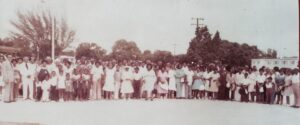
| Above: Railroad Shop Colored Addition was an all-Black community destroyed in 1947 by the City of Miami and the county school board to build a school for whites only. Read Nadege Green’s thread about what happened and then check out her award-winning WLRN public radio story.
⏰ Yes, that was education’s own Danielle Dreilinger on NPR’s Marketplace yesterday, touting her new book about the history of home economics.
⏰ WBUR is hosting an event May 20 called “Education Now And Then: Projections On Post-COVID Learning,” featuring reporter Carrie Jung in conversation with students and educators.
⏰ ICYMI: The LA Times had an event on how parents can navigate school reopenings with reporters Howard Blume, Paloma Esquivel, and Sonja Sharp and columnist Sandy Banks. You can watch a video of the event here. And The 74 hosted a debate-style event asking a panel of experts who should be holding schools accountable — parents or policymakers? Watch it here.
⏰ Between now and August, NPR’s Anya Kamenetz is going to be writing her book about the pandemic’s effects on children, titled “The Stolen Year: Children And COVID.” “That time and focus is such a luxury and I’m so grateful for it.” Want more Kamenetz? She’s still on Twitter. Last Friday, she wrote about the downsides of using “special needs” to describe a child’s educational journey, taking on the NYT’s use of the term.
THE KICKER

|
The Onion nailed it with this one.
|
|
|
That’s all, folks. Thanks for reading!
Reply to this email to send us questions, comments or tips. Know someone else who should be reading Best of the Week? Send them this link to sign up.
Using Feedly or FlipBoard or any other kind of news reader? You can subscribe to The Grade’s “feed” by plugging in this web address: http://www.kappanonline.org/category/the-grade/feed/.
Read more about The Grade here. You can read all the back issues of The Grade’s newsletter, Best of the Week, here.
By Alexander Russo with additional writing from Michele Jacques and Colleen Connolly. |
|
|
|
|
|
|
|
|