Advocates of public school choice have endorsed various models for providing choices, and with each new model, scholars have sought to determine whether those options have made a difference.
School choice has been a near-constant topic of conversation in the pages of this magazine since as far back as the 1960s, when Kappan authors considered whether parents should be given government funds that they could use to send their children to their preferred private school. The debate continued into the 1970s, as articles about tuition tax credits, specific choice programs, and proposed legislation proliferated.
Some of the most heated debate across the decades has centered on the use of vouchers to pay private school tuition; however, many authors who opposed vouchers actually expressed support for choice, as long as the choices were among public schools. In June 1987, for example, Mary Anne Raywid (“Public choice, yes; vouchers, no!”) noted:
Although I have been an advocate of public choice for more than a decade, I remain an opponent of vouchers. My opposition springs from my conviction that most youngsters in the U.S. will continue to rely on the public schools. Thus we need to improve these schools and to insure their continued good health. There is reason to believe that choice among public schools would be an excellent way to accomplish such purposes. Vouchers, by contrast, might well undermine education and leave public schools less capable of effective performance than they are now. (p. 763)
Two years later, in December 1989, Evans Clinchy (“Public school choice: Absolutely necessary but not wholly sufficient”) argued that public school choice initiatives must offer real choices among educational approaches (e.g., back-to-basics, individualized, Montessori) and areas of curricular emphasis (e.g., fine arts, science and technology, humanities). The idea should not be to allow some parents to put their children in superior schools but to enable all children to find an appropriate educational experience.
Clinchy further explained that if a large number of students did not get into their first choice school, the district should revisit its offerings to ensure they align with public demand. In the same issue, Charles Gleen (“Putting school choice in place”) pointed out that “Parents have a right to be confident that there are no bad choices among public schools — no choices that will shortchange their children” (p. 296). Thus, he declared, districts have a responsibility to hold all schools accountable for achieving certain results, even if they employ different means to do so.
Advocates of public school choice have endorsed various models for providing choices, and with each new model, scholars have sought to determine whether those options have made a difference — and Kappan has provided space for those assessments.
Alternative schools
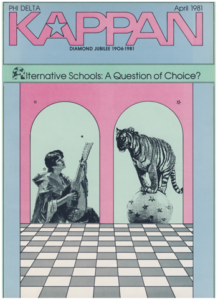
The April 1981 issue, titled “Alternative schools: A question of choice?,” devoted multiple articles to the alternative schools movement, which had emerged in the 1960s. In her retrospective (“The first decade of public school alternatives”), Mary Anne Raywid noted that these schools first took root outside public education but eventually inspired schools within public school districts to try out more humanistic and countercultural approaches to meet students’ needs. Raywid explained that the 1974 publication of David Tyack’s The One Best System lent support to the idea that, given the diversity of student needs, more options should be available:
Many came to see alternatives as a means of tailoring educational programs — content, approach, structure, climate — to the specific needs of different groups. Particularly in school districts with heterogeneous populations, teachers and administrators have looked to alternatives as a means of fitting education to particular sets of needs. (p. 553)
And so, according to Raywid, the movement grew to encompass more than 10,000 schools educating roughly 3 million students. Of course, not all of these schools were successful, and another April 1981 article (“Lasting alternatives: A lesson in survival” by Barbara Case) noted that the schools that survived tended to have appealing programs, a clear focus, a perception of legitimacy from the education community, reliable funding, and a positive climate. In the same issue, however, Robert Barr (“Alternatives for the Eighties: A second decade of development”) observed that although alternative schools showed great promise, their numbers were still small, and too many had become “dumping grounds for students labeled as disadvantaged, deprived, disruptive, or dull” (p. 572).
Magnet schools
In the 1980s, magnet schools, typically urban schools organized around a specific area of interest and designed to draw students from outside the school’s geographic boundaries, took the spotlight, and a pair of articles in the December 1984 Kappan explored the phenomenon.
Citing examples such as the Boston Latin School and the Bronx High School of Science, Denis Doyle and Marsha Levine (“Magnet schools: Choice and quality in public education”) said that although neighborhood schools were the norm in U.S. education, schools that served as magnets (without bearing the name) had a long history. These schools had been frequently characterized as elitist, the assumption being that they drew the brightest young people away from their neighborhood schools. Doyle and Levine suggested, however, that magnet schools should not be about appealing to the “best” students but about appealing to students with specific interests:
There is no one best school for everyone. As a people, Americans need some common core of cultural literacy, but this core can be achieved in different settings and by differing methods. There are many ways of approaching and appropriating the common culture. Indeed, the reality of the modern American city is different people with differing interests and differing learning styles. And differing teaching styles, we might add. (p. 268)
In the same issue, Rolf Blank (“Effects of magnet schools on the quality of education in urban districts”) described his study of 45 magnet schools in 15 districts. Although questions had risen about the effectiveness of magnets, Blank concluded that magnet schools with open admittance policies could provide a high-quality education.
Charter schools
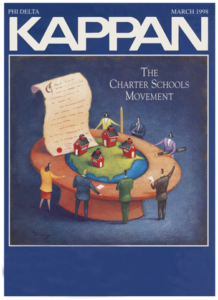
Starting in the 1990s, charter schools began to receive the bulk of the attention in Kappan’s coverage of public school choice. The March 1998 issue on “The charter schools movement” included an overview by Bruno Manno, Chester Finn Jr., Louann Bierlein, and Gregg Vanourek (“How charter schools are different: Lessons and implications from a national study”) that presented charter schools as centers for research and development, where new kinds of schooling could be tried out and then shared with the wider public school ecosystem. Because these schools are experimental by nature, the authors pointed out, “They won’t all succeed, and some that do succeed might appeal only to ‘niche’ markets. However, others are likely to be so good as to warrant wide dissemination” (p. 490).
Similarly, in the same issue, Joe Nathan (“Heat and light in the charter school movement”) noted that some charter schools would not be a success, but the same is true of traditional public schools. That does not mean the movement as a whole should be written off. In fact, Nathan suggested, the widespread interest in the movement from those across the political spectrum, including voucher opponents, was sending an important message about the need for alternatives to traditional models.
The debate rolls on
In Kappan’s June 1993 issue, Sen. Lamar Alexander (“School choice in the year 2000”), who had recently left his position as U.S. Secretary of Education, made a prediction about the school choice conversation:
By the time our fifth-graders, the class of 2000, are seniors, school choice will not be an issue. About the only people discussing it will be a few Ph.D. candidates who will have chosen to investigate that strange era when local government monopolies had control of the most valuable and important enterprises in America — our schools — and fought furiously to keep the doors to many of the best schools closed to middle- and low-income children. (p. 762)
Whatever one might think of Alexander’s characterization of choice and its opponents, it’s clear that the controversy related to school choice has lasted far longer than he anticipated — and it shows no sign of waning anytime soon.
ABOUT THE AUTHOR

Teresa Preston
Teresa Preston is an editorial consultant and the former editor-in-chief of Phi Delta Kappan and director of publications for PDK International, Arlington, VA.
Visit their website at: https://prestoneditorial.com/