|
|
SCHOOLS ARE OPEN, BUT KIDS ARE HOME
The big education story of the week |
|
50 HOURS VS. 200: SHORT SHRIFT IN PORTLAND
The best education journalism of the week |
|
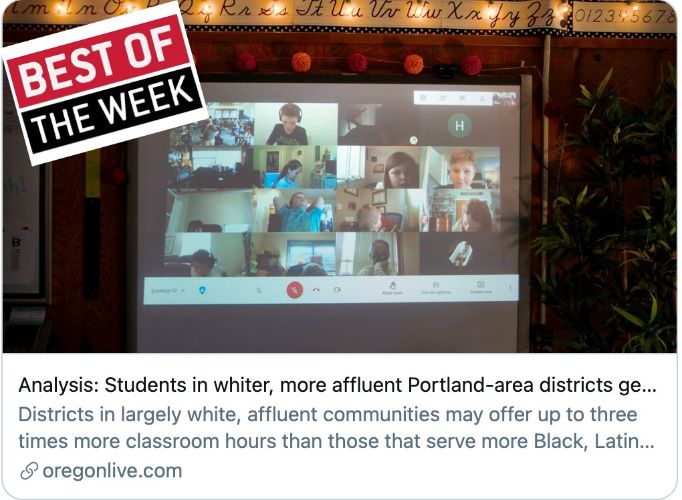
| 🏆 BEST: The best story of the week is Students of Color Get Short Shrift, the first in a two-part series by Eder Campuzano in The Oregonian. Campuzano reports that students in the whiter and more affluent Portland-area schools are more likely to be back in the classroom than those in other districts with more students of color — a trend in much of the country. “By the end of the academic year … elementary students in one of the state’s most diverse school districts in a high-poverty section of Northeast Portland are scheduled to see the inside of a classroom for fewer than 50 hours,” Campuzano writes. “By contrast, an elementary student in well-off West Linn will receive nearly 200.”
🏆 RUNNER-UP: This week’s runner-up is ‘No One Was Asking What We Thought’: San Francisco Students Weigh in on School District Controversies by KQED’s Holly McDede (whom you should follow). This story puts student voices front and center in a debate they have often been left out of. “A lot of you are nasty, very nasty in how you engage in this conversation,” said one high school senior. Another senior accused city leaders of using students as fodder to push partisan issues while leaving students struggling to learn.
To get daily education headlines and education news events, follow @thegrade_. |
|
THE RISE OF CONFLICT JOURNALISM
New from The Grade |
|
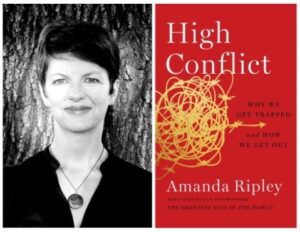
| I talked to Atlantic contributor and frequent education writer Amanda Ripley about her new book “High Conflict” and its implications for journalism.
“One of the side effects of journalism in high conflict is that it starts to become relentlessly and inaccurately negative, even when things get better,” she says.
In addition to being overly negative, conflict journalism tends to adopt the good/bad polarization of the environment in which it operates, taking on the righteousness of the debate. That serves the needs of online advocates, but not real readers, according to Ripley.
Always a straight shooter, Ripley characterized education coverage in the last year as “extremely unhelpful,” prompting her to cancel her New York Times print subscription. “There has not been the kind of soul-searching or reflection that I would have expected.” |
|
| THREE STRATEGIES FOR BETTER INTERVIEWS |
|
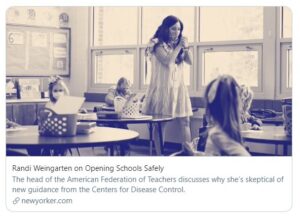
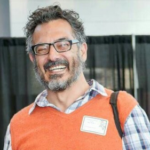
| While the New Yorker’s recent interview with American Federation of Teachers president Randi Weingarten (above) could have been more direct in a couple of places, it illustrated several useful interview strategies that any reporter could use with any interview subject: inserting contextual information, using past quotes, and repeating variations on a central question.
The result is much deeper and more informative for readers than the usual practice of quoting subjects and moving on to the next question, or letting subjects ramble on with long, uninterrupted, and often unhelpful responses. |
|
| MEDIA TIDBITS
Thought-provoking commentary on the latest coverage. |
|
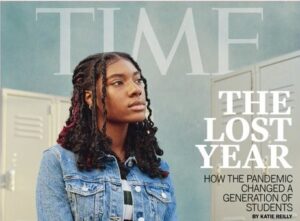
| ABOVE: In case you missed it last week, Katie Reilly’s TIME cover story was about the heightened challenge of applying to college in a pandemic.
📰 RETRACTION REQUESTS, CORRECTIONS, AND CREDITS: Featured in the New York Times’ story headlined Why Virus Tests at One Elite School Ran Afoul of Regulators, Chicago-area New Trier High School identified a series of alleged inaccuracies and demanded a retraction. As of last night, no major corrections have been made. Chalkbeat “updated” its recent story about teacher vaccination rates in New York City: “Editor’s note: This story has been updated to clarify that at least 44% of education department staff have been vaccinated, but the figure is likely an undercount.” Roanoke Times education reporter Claire Mitzel called out the New York Times for not linking to the articles they’re aggregating from. “It would be nice if the NYT gave local news credit, or even just a link, to the original reporting that occurred yesterday and over the weekend,” she tweeted.
📰 WHY YOU NEED A PUBLIC EDITOR: Public editors aren’t common these days — NPR is the only major outlet I know of that still has one, and EWA’s public editor position does not play the traditional ombudsman role. But the need for someone in that role is becoming clearer since last summer’s Black Lives Matter protests, according to a recent Nieman Lab piece from former education reporter Joshua Benton, which describes how public editors can push for more diverse representation in newsrooms and in news coverage. Read more about it in Reuters’ How a revitalised Public Editor role could solve two of journalism’s biggest crises.
📰 AN UNCHALLENGED CLAIM: I’ve mentioned several times that journalists would do well to challenge misleading claims directly, or at least give readers context about them. Simply quoting them and leaving it at that — as several outlets have done with AFT head Randi Weingarten’s claim that the union has pushed for reopening since last April — isn’t helpful to readers. But a new Politico story apparently goes in the opposite direction, making the union’s statement on its own: “AFT, which represents teachers in one of the first metropolitan school districts to reopen — New York City — has been pushing to get students back in chairs for nearly a year.” That’s a shame, whether or not you’re a fan of Weingarten or the union’s role in the reopening debate. I’ve reached out to Politico for a response.
📰 WHEN BEAT REPORTERS MOVE OVER TO OPINION: It can be exciting when education reporters move over to writing opinion. One recent example is former Seattle Times education reporter Claudia Rowe, who’s now writing columns for Crosscut, a local nonprofit outlet. “After three decades of writing about public schools and juvenile justice, how could I not have opinions about what I was seeing?” writes Rowe in a recent column. “And how did it benefit anyone for me to feign that old fig leaf of objectivity?” Another example is Boston Globe reporter Dan McGowan, who wrote a column about the Providence schools takeover debate. The downside is that neither Rowe nor McGowan are covering education full time any longer. Nobody allows that — except the Washington Post, of course. |
|
 |
PEOPLE, JOBS
Who’s going where & doing what? |
|
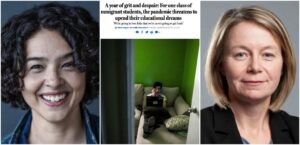
| ABOVE: The Boston Globe’s Bianca Vázquez Toness and Jenna Russell
🔥 The Boston Globe’s Bianca Vázquez Toness and Jenna Russell spent a year reporting on a class of immigrant English learners trying to stay on track during the pandemic, resulting in a deeply reported portrait of their lives and their struggles with the school system. In a recent phone call about their work, they told us how they kept in touch with students regularly — talking to some as often as twice a week, and how hard they worked to make sure that the students weren’t depicted stereotypically. “It’s easy to generalize, particularly about a group of students that come from afar and speak another language and this was such a rare opportunity to really make them specific people,” Russell said. “It just really helped us understand what his life is like,” Vázquez Toness said about walking home with one of the students from his job at 3 a.m. “Here’s this slight — he probably weighs like 140 pounds — 16-year-old walking home, working more hours than his father does now to support them.”
🔥 Job moves: Houston Chronicle editorial board member Mónica Rohr is joining Chalkbeat as a story editor. She’s amazing. What a good hire. Florida-based journalist Ileana Najarro is Education Week’s latest hire. The Objective’s Gabe Schneider is going to be Assistant Editor at CalMatters, working on college coverage. The NYT’s Jim Dao, who’s been overseeing its education team, has been promoted to metro editor. I wrote about his role editing national education coverage a few weeks ago. Congrats to all!
🔥 A handful of Texas-based education reporters are leaving the beat and going freelance. The Houston Chronicle’s Shelby Webb is leaving the beat to report on energy tech and renewable energy. This follows Aliyya Swaby’s recent exit from the Texas Tribune to report on children and families for ProPublica. Houston Public Media’s Laura Isensee is also leaving her job to go freelance. She tells us HPM will hire another reporter, but it’s not yet clear whether they will be an education beat reporter. Bekah McNeel’s contract reporting on COVID and schools for The 74 has also ended, but fortunately she says she plans to stay on as a freelancer for them and the Texas Tribune.
🔥 Jobs: Hechinger is hiring a Southern education reporter, a reporting intern, and a digital news/photo producer. And WNYC’s United States of Anxiety is hiring a senior digital producer.
🔥 Books: The 74’s Zoë Kirsch is leaving her job to work full-time on a book. And longtime education writer Karin Chenoweth has a new book out called Districts That Succeed: Breaking the Correlation Between Race, Poverty, and Achievement.
Did someone forward you this newsletter? You can sign up here. |
|
EVENTS
What just happened & what’s coming next? |
|
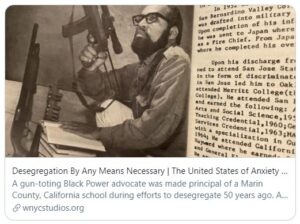
| Above: The United States of Anxiety’s latest episode, Desegregation By Any Means Necessary, came out on Sunday.
⏰ If you haven’t already done so, you should listen to the United States of Anxiety’s latest episode, Desegregation By Any Means Necessary. It’s the long-awaited sequel to Marianne McCune‘s 2020 episode, Two Schools In Marin County, one of the best examples of education journalism last year. “Me, myself, I don’t care about integration,” says longtime Marin activist Royce McLemore in the piece. “All I care about is equal education.” The episode received praise from Gulf States Newsroom managing editor Priska Neely: “Totally worked! Amazing episode.” In other podcast news, Part 3 of the New York Times’ Odessa series is out.
⏰ Newsletters & podcasts: Olivia Krauth of the Louisville Courier Journal is starting an education newsletter for the paper called The Hall Pass. Sign up here. Former New York Times education reporter Jenny Anderson has launched The Learnit Podcast, which features interviews with interesting folks who want to talk about curriculum, creativity, pedagogy, and policy. The first LAT 8 to 3 newsletter came out this week. In it, we got to meet the writer, Sonja Sharp, who says she spent most of her journalism career reporting on murder before joining the education team a year ago.
⏰ EWA’s Caroline Hendrie, freelance ed reporter (and The Grade contributor) Wayne D’Orio, and Industry Dive’s Kara Arundel talked about the state of the education beat on Wednesday. The EWA national seminar is coming in May.
⏰ Money on the table: Just two weeks left to apply for an #IRE21 fellowship! Ida B. Wells has some summer reporting internships to offer at the NYT, Miami Herald, and USA Today. And applications are open until April 16 for the latest round of EWA reporting fellows. Details here. Want $5K for one feature story? You’ve got two days left to apply to partner with The Hechinger Report to report an enterprise story. Details here.
⏰ Awards: Congratulations to the team at High Country News who won an IRE award for their piece examining land grant universities through maps, interactives, and analysis of archival materials that were almost lost to time. USA Today also took home an award for documenting how a university worked to protect its prized football program at the expense of sexual assault victims. |
|
THE KICKER |
|
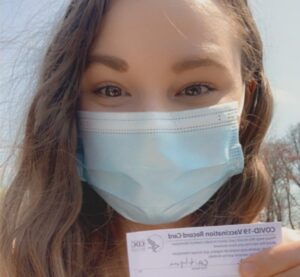
| “One year ago today, my first COVID symptoms hit and within days I was knocked flat,” tweeted Caitlynn Peetz. “Today, I got my J&J vaccine. What a difference a year makes. (Can you see my big, goofy grin behind the mask??)” |
|
| By Alexander Russo with additional writing from Michele Jacques and Colleen Connolly. |
|
|
|
|
|