It’s time to ask harder questions of public officials, press sources for inside information, and produce stronger, more demanding stories.
By Alexander Russo
The Biden White House has struggled mightily to get its education messaging straight, especially on its pledge to reopen schools within 100 days.
Over the past month, questions about reopening schools have become common at the daily press briefings. The reopening goals seemed to keep changing, at one point lowered to just one day a week. Biden press secretary Jen Psaki and CDC head Rochelle Walensky disagreed over the necessity of vaccinating teachers. Psaki and chief of staff Ron Klain fielded questions from TV reporters about the role of teachers unions. Meanwhile, many suburban schools and urban districts were already opened – without generating COVID outbreaks.
Just last night on CNN, President Biden appeared to change course yet again on the 100-day reopening pledge.
It’s been messy, to say the least. And yet, when the CDC released much-awaited guidance on school reopening last Friday, the initial coverage was generally superficial, describing the guidance contents and preliminary reactions while providing little in-depth examination or additional reporting.
“The guidelines for K-12 schools are not significantly different from those issued last summer by the Trump administration,” noted the Washington Post’s Friday write-up, headlined CDC offers road map for safely reopening schools. “But the Biden administration hopes a retooled, more clearly written version will be seen as more credible by concerned teachers and parents.”
There was precious little insight into the messy development of the report and little scrutiny into the provisions that would generate so much controversy over the next few days. Unfortunately, this isn’t the first time in recent weeks that education coverage has fallen short on examining critical questions.
Far too often, recent national education coverage has been superficial and credulous, eclipsed by the cacophonous debate on social media or politically focused TV news shows.
Related coverage: Biden transition coverage: not too hostile, not too credulous
Far too often, recent national education coverage has been superficial and credulous, eclipsed by the cacophonous debate on social media or politically focused TV news shows.
My examples are mostly taken from the New York Times, but much the same could be said about coverage from the Washington Post, NPR, and other national outlets.
During the first week of February, Psaki said that the administration would meet its school reopening goal if more than half of the schools were in-person at least one day a week.
This was a major change from the initial pledge, which had said nothing about a partial, part-time reopening. However, coverage of the about-face described the change without delving very far below the surface.
Stories like the NYT’s Biden Trims Ambitions on School Reopening Pledge gave reactions to the change and referenced tensions over the reopening rollout, but there was little reporting from inside the Biden administration or from advocacy groups on when or how the change had come about, what information or input had made it necessary, or whether it was always the plan.
What data or input caused the White House to water down its commitment so dramatically? How was the decision made? We still don’t really know many of the relevant details.
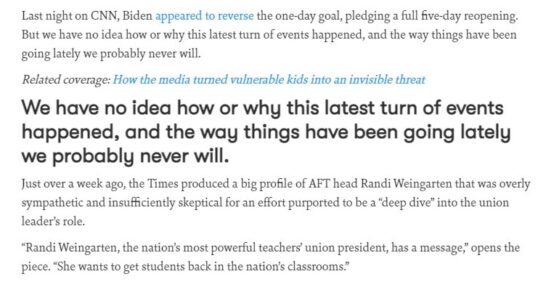
Last night on CNN, Biden appeared to reverse the one-day goal, pledging a full five-day reopening. But we have no idea how or why this latest turn of events happened, and the way things have been going lately we probably never will.
Related coverage: How the media turned vulnerable kids into an invisible threat
We have no idea how or why this latest turn of events happened, and the way things have been going lately we probably never will.
Just over a week ago, the Times produced a big profile of AFT head Randi Weingarten that was overly sympathetic and insufficiently skeptical for an effort purported to be a “deep dive” into the union leader’s role.
“Randi Weingarten, the nation’s most powerful teachers’ union president, has a message,” opens the piece. “She wants to get students back in the nation’s classrooms.”
Headlined, The Union Leader Who Says She Can Get Teachers Back in Schools, the story isn’t entirely complimentary, featuring an oblivious quote from Weingarten about friends and family sending their kids to private schools. But it emphasizes the important and difficult role Weingarten is playing. And it fails to flesh out Weingarten’s role in fanning teachers’ fears about reopening.
“I’m confident that we will overcome the fear,” Weingarten is quoted as saying in the piece. “But it’s not going to happen in two-and-a-half nanoseconds.”
Alas, the public record shows that Weingarten has been a major part in amplifying teacher fears and union activism that have prevented or delayed school reopening. And she’s never really held to account for this in the profile.
Since the story came out, Weingarten has participated in protests against reopening and signed grievance letters against districts trying to reopen.
Disclosure: The AFT was one of the original funders of The Grade during its first year.
Alas, the public record shows that Weingarten has been a major part in amplifying teacher fears and union activism that have prevented or delayed school reopening. And she’s never really held to account for this in the profile.
Another area where there hasn’t been enough aggressive coverage for my taste is reporting on schools and districts that have reopened.
There are exceptions, including from the Boston Globe and the Wall Street Journal. A recent Times magazine feature story on Rhode Island schools showed that, while extremely challenging, reopening in-person can be done without vaccines, strict social distancing, or hybrid learning or any of the other measures.
But far more often, coverage has focused on the obstacles to reopening – staffing, logistics, parent uncertainty, etc. There’s lots of talk about what a tough spot administrators and parents are in.
The tendency has been to accept narratives about logistics, costs, and risks. As a result, lawmakers, parents, and teachers aren’t sufficiently aware (or reminded) of the feasibility of reopening safely, without expensive measures or additional delays.
Related coverage: Negative COVID coverage and prolonged school shutdowns
The tendency has been to accept narratives about logistics, costs, and risks. As a result, lawmakers, parents, and teachers aren’t sufficiently aware (or reminded) of the feasibility of reopening safely, without expensive measures or additional delays.
I’m not recommending an ideological approach to reporting education news. We need timely and reliable new information not available without professional reporting, not more opinion writers like me.
And I’m not proposing anything that I think is unrealistic. Education journalists are more than capable of scrutinizing public officials when they choose. Remember DeVos?
But we need much more critical questioning and hard-nosed reporting during this critical early period of the new Congress and new administration.
Whether it’s the reopening debate, profiles of key education leaders, or Biden’s COVID relief package, it’s time to ask harder questions of public officials, press sources for inside information, and produce stronger, more demanding stories.
I know that everyone’s tired and that beat reporters feel the need to be especially careful about their coverage. But nobody knows this topic better than you. And there’s no good reason you should be taking a backseat to anyone else at such a critical time.
Related stories from The Grade:
The case for writing angry (Bekah McNeel)
ABOUT THE AUTHOR
Alexander Russo
Alexander Russo is founder and editor of The Grade, an award-winning effort to help improve media coverage of education issues. He’s also a Spencer Education Journalism Fellowship winner and a book author. You can reach him at @alexanderrusso.
Visit their website at: https://the-grade.org/