In this week’s newsletter: Increasing numbers of immigrant kids missing school. Where’s the Democratic education agenda — and why isn’t anyone covering its absence? A friendly interview with the New York Times’ Dana Goldstein. More Sold a Story coming soon. Also: Two new education books!
SCHOOLS WITHOUT IMMIGRANTS
The big education story of the week
The big education story of the week is the growing number of immigrant students who are scared of ICE raids and simply not showing up at school.
Several savvy news organizations turned their gaze to this phenomenon (NPR, LAist, Denver Post, Louisville Courier Journal, KSL, Boyle Heights Beat, WPBF, NY1, Fox 5). Some were on the story as early as Inauguration Week (Chalkbeat NY, The 74). And several covered this week’s “A Day Without Immigrants” student walkouts (USAT, KQED, WBAL, Lompoc Record).
But others seemed to spend most of their time producing hair-on-fire coverage of Trump’s long-anticipated attempts to strip DEI out of schools (Chalkbeat, Business Insider), reduce U.S. Department of Education staff (NYT, Politico, NBC News), and shutter the agency (Wall Street Journal, Washington Post, USAT). All this coverage without in-depth reporting on deputy secretary of education nominee Penny Schwinn, whose focus on student learning is a stark contrast to the administration’s circus politics.
To be fair, a few outlets stepped back from the noise to probe what the actions really mean (AP, Boston Globe. NYT, The 74, Globe). However, an unknown number of real students in real schools aren’t going to school — temporarily or for much longer, we don’t yet know. The Democratic party doesn’t seem to have an education agenda beyond opposing Trump. Not enough outlets seem to be paying attention.
Other big education stories of the week include parental rights in Washington State, publishers suing Idaho over kids’ access to books, and a grim audit of Houston’s special education department. Check out @thegrade_ for each day’s most important education news.
THREAT ASSESSMENT RUN AMOK
The best education journalism of the week
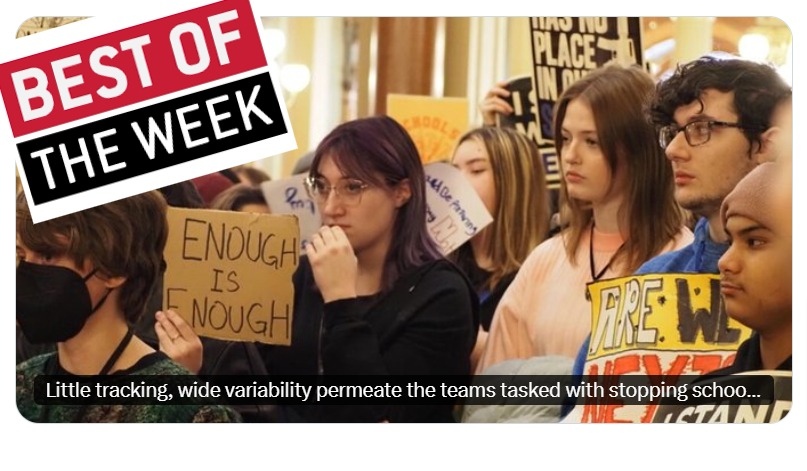
The best education journalism of the week is Little tracking, wide variability permeate the teams tasked with stopping school shootings by Cheryl Platzman Weinstock for the Indiana Capital Chronicle (above).
A KFF Health News reporter, Weinstock reports on the ubiquity of “threat assessment teams,” typically groups of law enforcement and school officials who try to identify potentially dangerous or distressed kids. But as they’ve become more common, there’s little data that they work. They’ve developed widely varying operations requirements, and a few advocates say children with disabilities “can easily get swept into a threat assessment” with little evidence they’re dangerous.
Weinstock’s piece works best when she’s zeroing in on specifics about details, like how in Dallas many students receiving special education services are scrutinized — without any special ed staff on the team.
It’s an incisive look at a seldom scrutinized slice of our school safety apparatus — one that other journalists could emulate. And it describes the situation economically.
Other education stories we liked include a new online literacy tool that leaves out key information (Oregonian), how play is helping LA kids process the wildfires (LAist), and “CPR for mental health” in aftermath of LA fires and NC floods (NPR).
SCHOOL ICE RAIDS? NO.
Our latest columns and commentary
It doesn’t take much to keep parents from sending kids to school — and the kids don’t always come back right away. This we already know.
That’s why it’s so frustrating to have seen the past two weeks of often reckless coverage suggesting that ICE agents were targeting schools for deportation.
It’s true, mainstream English-language outlets are no longer the primary information source for many people, notes one reporter. “What’s Telemundo reporting? Univision? Communities on Tiktok and Whatsapp? That’s where these parents are getting their information.”
But traditional journalism still sets the tone. So resist passing along rumors. Press officials for clarification. Document instances — or note their absence. Include “most likely” scenarios along with worst-case outcomes.

Above: Coming in August, Ranita Ray’s SLOW VIOLENCE lays bare the “routine indifference, racism, and verbal and emotional abuse and harassment that teachers and administrators perpetrate” on vulnerable students.
PEOPLE, JOBS, & EVENTS
Who’s going where and what’s happening
📰 Books: There are at least two exciting education books coming out soon, including David Zweig’s AN ABUNDANCE OF CAUTION (April 22) and Ranita Ray’s SLOW VIOLENCE (August). As contributors to The Grade, Zweig wrote about coverage of New York City’s arbitrary threshold for returning to in-person learning and Ray wrote about the inadequate coverage of everyday classroom racism by teachers.
📰 NAEP coverage commentary: “I really appreciate the reporting and analysis that others have been doing on NAEP,” says Daly, who name-checks journalists Chalkbeat’s Kalyn Belsha and Erica Meltzer, EdWeek’s Sarah Schwartz, and the Wall Street Journal’s Matt Barnum and Sara Randazzo. “In my opinion, America’s achievement score declines are an urgent problem, and they are particularly bad news with the end of the federal ESSER funds. But apparently the editors at our largest national newspapers don’t agree with me,” says Aldeman. Alderman says he thought that editors might have thought of the latest scores as “just another round of test score news” without seeing how post-ESSER budget cuts were going to create a larger problem.
📰 Interviews and podcast segments: Check out this totally worthwhile interview of Dana Goldstein by Ravi Gupta for the Lost Debate podcast in which the New York Times education reporter talks about Trump’s conflicting goals, charters’ durability, TFA’s humbling, & teachers’ dislike for ideological pressures (both left and right). The Lost Debate also interviewed the Washington Post’s Laura Meckler about homeschooling last year. Also: APM Reports’ Emily Hanford tells us about literacy researchers Mark Seidenberg and Maryellen MacDonald (in person March 1) and language researcher Julie Washington’s presentation on reading development in African American children is available for replay. New stuff from Sold a Story is coming later this month.
📰 Substackers: While most of the education media moved on from the NAEP results and literacy implications, helpful content and commentary continued from the likes of Tim Daly, Marc Porter Magee, Karen Vaites (new!), and Chad Aldeman. Any other information- focused newsletters or information sources out there that you like? Let us know.
THE KICKER
We saved the best for last.

It’s only cute when the cat does it.