In this week’s newsletter: Schools are closing in Salt Lake City and will likely close in Boston — with many other districts across the country hinting about the same fate. Reporters look into failures in literacy instruction at elite schools. A former industry insider-turned-journalist laments the lack of reporting on districts’ procurement processes. A new ed team is launching in Louisiana. And The Oregonian finds the education angle to the Alaska Airlines story.
SCHOOL CLOSURES LOOM LARGE
The big story of the week
The big education story of the week is the slimming down of America’s school facilities as districts nationwide face declining enrollments — a trend likely to continue throughout the decade (The 74). Several media outlets reported on the heartburn that current and anticipated closures are causing (KUER, CT Mirror, New Haven Independent, WBUR, Boston Globe).
In Salt Lake City, four elementary schools are slated to close this summer (KUER). In Connecticut the closure of five schools last year brought the decade’s total to more than 75 as schools there have lost more than 36,000 students (CT Mirror). In New Haven, a new planning study recommends that the district consider closing aging and under-utilized buildings.
And in Boston, the district released a long-awaited facilities master plan, with Superintendent Mary Skipper assuring principals last week that the “most extreme” scenario — closing as many as half of buildings — won’t happen (Boston Globe). Local outlets, including The Boston Globe, reported earlier that this was a possibility, as the district doesn’t need 119 buildings for a student body that has been shrinking since 2006. According to the plan, the district could get by with as few as 59 schools.
Other big education stories of the week:
ABSENTEEISM STRUGGLES: We’re now a long ways away from the perpetual distance learning days, but chronic absenteeism continues to be a big issue in schools, nearly doubling in the past few years (New Yorker, WBUR). Many districts — from rural areas to cities — can’t figure out how to bring kids back (Vox). New programs meant to reach disconnected kids are finding limited success (Chalkbeat Chicago). Meanwhile, some districts are slowly improving by doing things like sending postcards to families’ homes or going on experiential learning field trips (Ideastream Public Media, Colorado Sun).
SUMMER FOOD PROGRAM: More than 20 million school-aged children stand to benefit from a newly permanent federal program for summertime meals (Chalkbeat). Low-income families that qualify will get $120 per child to spend on groceries while school is out of session. But so far, Republican governors in 15 states — affecting 8 million kids — have opted out, citing reasons that include a childhood obesity epidemic and a general stance against welfare (Washington Post). On a related note, the long-running WIC nutrition program for new mothers and kids is growing — but needs $1 billion more to keep going as is (Stateline).
LITERACY FAILURES AT ELITE SCHOOLS
The best education journalism of the week
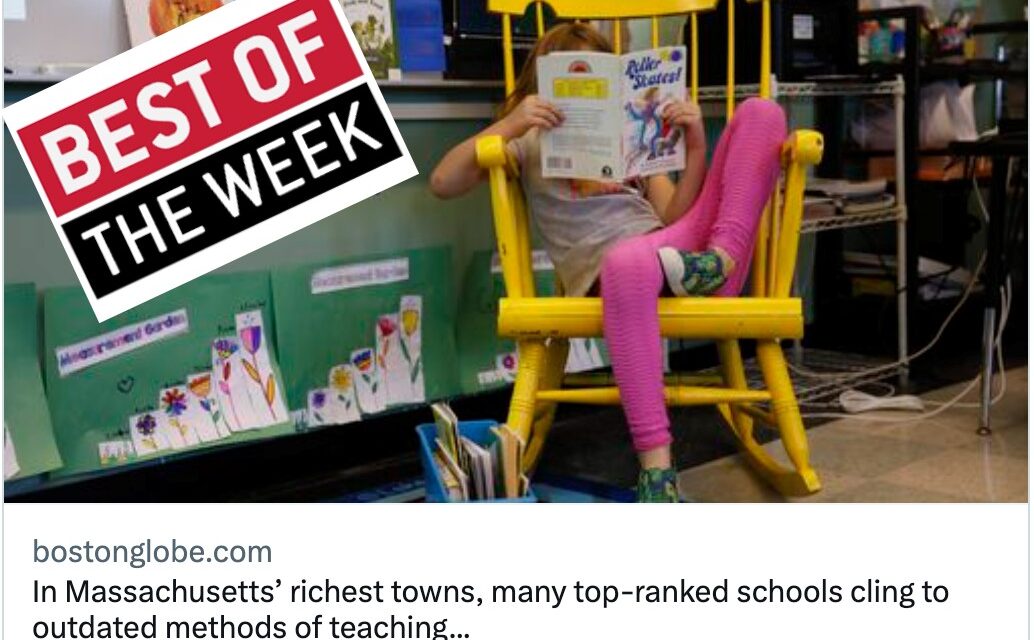
The best education story of the week is In Massachusetts’ richest towns, many top-ranked schools cling to outdated methods of teaching reading, the latest from the Boston Globe’s literacy duo Naomi Martin and Mandy McLaren.
The two reporters investigated a somewhat curious phenomenon in the Boston suburbs: wealthy districts are more likely than others across Massachusetts to use expensive reading programs considered “low-quality” by the state Department of Elementary and Secondary Education. That’s setting up vulnerable students to fail.
The reporting excels on multiple fronts, including original data analysis, vivid anecdotes, and a focus on equity. Those who struggle most in these reputationally sterling districts are Black, Latino, and low-income students and students with disabilities.
But the story doesn’t merely stand on the importance of the topic; it’s also dynamic and full of memorable characters, including a 16-year-old who still labors through pronunciation and the repentant literacy specialist who exposed her to flawed instruction eight years ago.
At one point, Martin and McLaren raise a question that all journalists covering high-performing districts should be asking: “How can a town take pride in its schools when so many of the most vulnerable are left behind?”
Other great education stories this week — and why we liked them:
👏 Asher Lehrer-Small distills a complex issue — the extreme need for mental health services in Houston schools, and their potential disappearance as ESSER funds dwindle — into a detailed and moving profile about a brother and sister who lost their dad to COVID-19 (Houston Landing).
👏 Reporters interested in ed tech and AI should take cues from this engaging Tara García Mathewson piece, which explains how a popular but unreliable plagiarism detection product has derailed students. She also looks closely at how the software works (The Markup).
👏 In a report that could guide future work by local journalists, Linda Jacobson digs into the national trend of falling enrollment (see The Big Story of the Week above), making the case that school closures could be imminent across the country. The most at-risk schools include those in Albuquerque, Philadelphia, and Utah’s Granite School District (The 74).
👏 This breaking news piece about recent storm closures at D.C. area schools may seem run-of-the-mill, but with a breadth of parent voices and analysis of district policies, Nicole Asbury shows just how badly poor communication can screw up a family’s week (Washington Post).
👏 Kelly Field traces the concept of the “gifted” student from its Cold War origins to present-day debates about access, producing an encouraging story that highlights a successful model for expanding gifted programs to low-income students and students of color in New York City (Christian Science Monitor).
FIXING SCHOOL PROCUREMENT
Our latest columns and commentary
In this week’s column, Colette Coleman, a former ed tech executive-turned-journalist, discusses the broken state of school procurement, pointing out that, as in many things school-related, relationships often trump quality. Coleman finds a dearth of coverage on how learning products are chosen and calls for journalists to take a closer look at procurement processes.
“I watched relationships drive districts to renew products that no teachers use, take chances on new offerings that end up not working, and put out requests for proposals that fit only one pre-selected product,” she writes.
Coleman offers kudos to select coverage, including that of Chalkbeat’s Kalyn Belsha, who in 2023 blew the whistle on Paper, the online tutoring company that has tapped into millions in federal COVID relief funding for one-on-one tutoring, but often fails to deliver basic services.
For the bravest of us, Coleman suggests attending K-12 sales conferences by outfits such as the Education Research and Development Institute (ERDI). “You may not get into the small sessions,” she writes, “but you may be able to find your way to the larger-group, informal, alcohol-lubricated events.” Sounds like a fun reporting trip!
ICYMI: Business Insider reporter Matt Drange was kind enough to acknowledge my small bit of help with his big new investigation into states’ failure to take action on serial sexual predators. I had FOIA’d the U.S. Department of Education for the underlying information on this topic but had stalled out when they sent me redacted info. I handed it off to Drange, who hired some researchers to unmask the data and turned the result into a damning map of state inaction.

Above: “As I tried to navigate my way through my first full year after college and the COVID-19 pandemic, the needs of Black students I witnessed would become the foundation for the reporting I’d do,” writes World In Black education reporter Aziah Siid, who started her career as a direct support professional in NYC schools.
PEOPLE, JOBS
Who’s going where and doing what
🔥 Career moves: Former Chalkbeat reporter Patrick Wall will lead a new Louisiana-wide education reporting team at NOLA.com and The Advocate. At least two other reporters will be hired, and the team will cover K-12 and higher ed in a mix of daily news, enterprise, and investigations, he tells us. Miami Herald education reporter Sommer Brugal is leaving for Axios Miami. Elissa Miolene is leaving her post at the Mercury News and East Bay Times. (Check out some of her favorite stories here.) And the Washington Post’s Donna St. George published her final story at the paper after more than 25 years working there. She is one of many on the ed team who recently accepted a voluntary buyout. Another one, higher ed writer Nick Anderson, announced he’s joining the American Council on Education as vice president for Higher Education Partnerships and Improvement.
🔥 Reflection: While reporting his story on chronic absenteeism for ProPublica and the New Yorker, Alec MacGillis tells us it was eye-opening to see “how much the norm of school attendance had eroded and how widespread the sense of entropy now is in so many households.” While not news to many, “the scale and degree of the condition matters,” he said. For more from MacGillis, see the rest of our brief Q&A with him here.
🔥 Sound off:
- The issue of chronic absenteeism has “attracted surprisingly little attention from leaders, elected or otherwise, and education coverage in the national media has focused heavily on culture-war fights,” MacGillis wrote in his piece.
- “I think you could argue that school shootings, relative to other types of gun violence, are overplayed in the media. … More run of the mill gun violence, and the extent to which children fall victim to it in the U.S., is underplayed,” Atlantic contributor Stephanie Murray posted on X in response to her essay Why Parents Struggle So Much in the World’s Richest Country.
- “Murrowites have been incensed that the news has downplayed the impact the stabbing had on the school day,” write a group of students from Edward R. Murrow High School in NYC about media coverage of a violent incident at their school.
- “All universities, not just Harvard, are reflections of the state of our society,” says the NYT’s Anemona Hartocollis in a recent interview about the resignation of Harvard’s president. The story also “engaged with a lot of contemporary issues, like the Israel-Hamas war, the influence of big money on universities and race, and its impact on our lives. I think people entered from a number of doors.”
- Retired journo Jim Schutze has some specific critiques for Houston news outlets in their coverage of the HISD takeover: “I keep waiting for the big Sunday take-out in The Houston Chronicle where a reporter or team of them have gone to diverse credible sources – by which I do not mean ed school faculty hacks — to find out what is really known about school reform. What works? What doesn’t?”
- “Some academics have publicly announced resignations, but evidence of a mass faculty exodus from states like Florida is thin, at least so far. Media hyped a brain drain regardless,” writes Inside Higher Ed’s Ryan Quinn.
🔥 Job openings: The new Louisiana education reporting team at NOLA.com and The Advocate is hiring a New Orleans higher ed and K-12 reporter and a statewide reporter. The 74 is still looking for a new editor-in-chief. And New York Focus is hiring an education reporter.
APPEARANCES, EVENTS, & NEW RESOURCES
What’s happening and new research
⏰ Podcasts, segments, & appearances: The Atlantic’s Adam Harris was on Vox’s podcast “The Weeds” answering the question, Why can’t we stop talking about Harvard? PBS News had a segment on the spike in childhood speech development delays. ProPublica’s Alec MacGillis was on WBUR’s “Here & Now” talking about chronic absenteeism and how to bring kids back to school. Rhode Island PBS Weekly ran a lengthy segment on multilingual learners in the state. WBUR’s Max Larkin was on “The Common” to discuss the future of Boston Public School buildings after a report hinted that up to half could close. Northern Public Radio, west of Chicago, has a new (to me) podcast called “Teachers’ Lounge,” with the latest episode about the role of paraprofessionals. And the CT Mirror’s Jessika Harkay was on the podcast “Long Story Short” explaining declining enrollment and school consolidation.
⏰ Deadlines: The James Madison Freedom of Information Awards are accepting entries for 2023 work until Feb. 2. Don’t miss out! And speaking of FOIAs, you can still sign up to be part of an info sharing group organized by Business Insider’s Matt Drange to access public documents on teacher abuse.
⏰ Books: In just a few weeks, Ben Herold’s new book on American suburbs will be out. Read the latest reviews here, and don’t miss his pub day launch event in Philadelphia with the Inquirer’s Kristen Graham. In more book news, NYU professor of social science Eric Klinenberg has a new book coming out in February called “2020.” One of the seven people he profiles is a public school principal, and another works at a charter school.
⏰ Movies & documentaries: WBUR education editor Suevon Lee reviewed a new documentary called “The Highest Standard” about a school that offers an extra year of classes to help students from underprivileged backgrounds gain access to New England’s elite high schools. And adding to the pile of reviews already out there, the Washington Post examined the German Oscar contender “The Teachers’ Lounge.”
⏰ Impact: During his State of the State address, Idaho Gov. Brad Little cited reporting from the Statesman and ProPublica about the need to invest in public school infrastructure. In case you missed it last month, a Texas state representative issued a call for campaign finance reform in response to a Texas Observer investigation into school board elections.
⏰ Research: The four-day school week had “minimal if any” impact on students’ academics, according to a new study out of Missouri. New research from Massachusetts and New Jersey shows that teachers who were granted emergency licenses in the pandemic were just as effective as teachers who go through the normal required training. According to Stephanie Murray’s Atlantic piece on U.S. parents’ struggles, “Kids who grow up in poverty in the U.S. are four times more likely to be poor as adults than those in Denmark or Germany, and twice as likely as those in the U.K. or Australia.”
THE KICKER
There’s always an education angle.
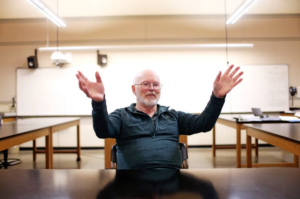
“Due to his unexpected moment in the spotlight, he lamented Monday afternoon that he’s getting behind on grading and getting reports in on his student’s grades before the end of the semester,” reports Maxine Bernstein in Portland teacher ‘Bob’ recounts finding Alaska Airlines door in yard in The Oregonian.
That’s all, folks. Thanks for reading!
Reply to this email to send us questions, comments or tips. Know someone else who should be reading Best of the Week? Send them this link to sign up.
Using Feedly or FlipBoard or any other kind of news reader? You can subscribe to The Grade’s “feed” by plugging in this web address: http://www.kappanonline.org/category/the-grade/feed/.
Read more about The Grade here. You can read all the back issues of The Grade’s newsletter, Best of the Week, here.
By Alexander Russo with additional writing from Colleen Connolly and Will Callan.
ABOUT THE AUTHOR

The Grade
Launched in 2015, The Grade is a journalist-run effort to encourage high-quality coverage of K-12 education issues.