In this week’s newsletter: Schools are beginning to feel the heat of the end of ESSER funds. A reporter goes inside schools before the first week to discover decay, mold, and broken floor tiles. A New Orleans reporter urges journalists to be “translators” when it comes to school closings. Past research and reports give insight on how to better cover school shootings. And an education reporter in New York goes back to school with an adorable throwback.
THE EDGE OF THE FUNDING CLIFF
The big story of the week
The big education story of the week is the soon-to-be end of federal pandemic funding for education — and the consequences for schools.
The last of the ESSER funds expire at the end of this month, and while their impact so far has been uneven and insufficient (EdWeek), their disappearance is likely to have a big negative impact on many districts.
Across Massachusetts, districts are experiencing shrinking budgets, resulting in layoffs in some schools and even cuts to AP classes and art and music programs (WBUR). In nearby Connecticut, parents and school board members protested to demand increased and equitable funding (CT Examiner).
Across the country, educators of color are bearing the brunt of funding cliff layoffs (USA Today). The crisis is exacerbated by ever-decreasing enrollment in some districts, leading to school closures (Chalkbeat CO, Boston Globe, Chalkbeat NY).
Look out for other impacts in the coming weeks and months. As Conor P. Williams, senior fellow at the Century Foundation, writes, “ESSER’s end will put K–12 schools squarely into an era of trade-offs” (Slate).
Other big education stories of the week include the mass shooting at Apalachee High School in Georgia, pro-Palestine protests returning to college campuses, and a report on the sad state of COVID student recovery report cards. Check out @thegrade_ for daily headlines!
BACK TO SCHOOL IN A DECAYING BUILDING
The best education journalism of the week
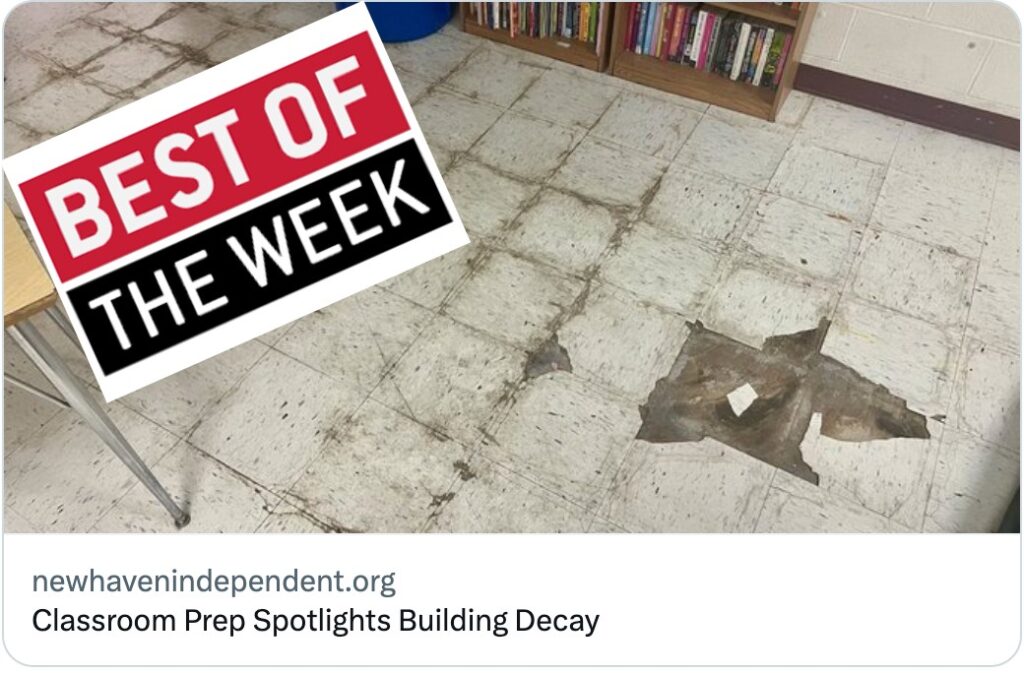
The best education journalism of the week is Classroom Prep Spotlights Building Decay by Maya McFadden of the New Haven Independent.
In a piece that basically doubles as a photo essay, McFadden lays out a different kind of back-to-school story. Educators at Wilbur Cross High School, the district’s largest, rushed last week to prepare classrooms for the first day of classes in a school with mounting classroom disrepair: chipping stairwell treads, damaged ceiling tiles, and mold on ceiling ventilation systems. One teacher took to cleaning a nearby bathroom and purchased $200 worth of bathroom supplies and menstrual products to stock up the women’s bathroom.
Though it isn’t flashy, McFadden’s report offers an important look inside a school whose condition, according to one teacher, is the worst she’s seen in 25 years. “This is not dignifying,” she said. “We all should be able to come here and feel clean and comfortable.”
We’ve reported on the Independent’s work in the past, and this piece is a great example of the kind of scrappy, watchdog-focused accountability journalism we should see other local outlets doing more of — and which, if the reader comments are any indication, will surely lead to more engagement and impact.
Other education stories we liked this week: David Hogg’s political movement (The 74 and The Trace), a one-on-one with NYC Chancellor David Banks (New York Times) before the police seizure of his cell phone (Chalkbeat), a school cop’s sexual misconduct (Washington Post), and seclusion in Massachusetts schools (Boston Globe).
HEARTBREAKING BUT NECESSARY: COVERING SCHOOL CLOSURES
Our latest columns and commentary
In this week’s new column, Marta Jewson of the nonprofit New Orleans Lens looks at school closures, urging journalists and parent activists to be “translators” for their communities when districts choose to move, consolidate, or close neighborhood schools.
To give readers a sense of how tricky this can be, she asks: If you saw this item on the school board agenda, what would you think? “Approval of Action(s) Designed to Drive Efficiencies in the Network and fully utilize the Avery Alexander site.”
Spoiler alert: It’s a 2106 item that signified a school being closed and its students moved to another building. It’s that sort of “innocuous” notice that could signify a huge change, Jewson writes. Don’t ignore them, especially in cities like New Orleans, where schools are decentralized and the system has a history of parental disenfranchisement.
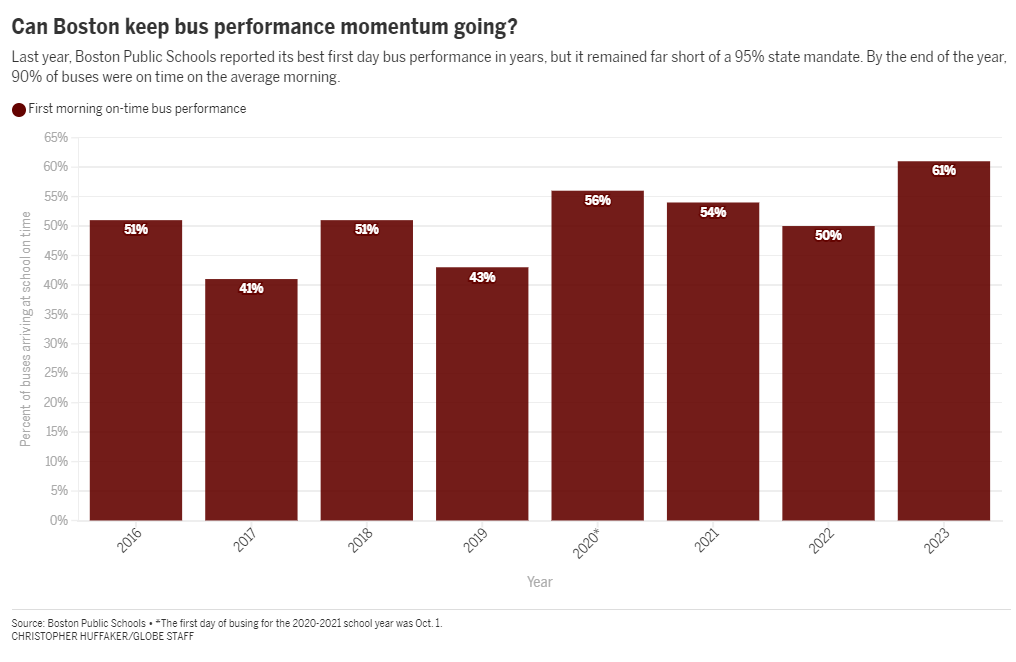
Above: The Boston Globe’s Great Divide team debuted a new section of their weekly newsletter, featuring all things data. This week, data reporter Christopher Huffaker zoomed in on school bus arrival times. Transportation for the first day, however, was apparently an “epic fail.”
PEOPLE, JOBS, & EVENTS
Who’s going where and what’s happening
📰 Career moves: Marina Villeneuve, who won a New England Emmy Award earlier this year for her Boston 25 News investigation into sexual abuse in Massachusetts schools, is joining the Hechinger Report as an investigative reporter. Read about how she reported her Emmy-winning story here. Former Hechinger Report senior editor and bureau chief Lilian Mongeau Hughes, who spent the summer as interim editor of the Seattle Times Ed Lab, is headed to The Oregonian to report on homelessness and mental health. And former LA Times higher education reporter Nina Agrawal will report on health for The New York Times.
📰 Podcasts: Season 3 of the GBH and Hechinger Report podcast “College Uncovered” is coming back next week. The new season will dive into a controversial topic: campus politics.
📰 Sound-off: “Keep a diverse set of sources on all sides of the takeover, so you can get a better sense of the whole story,” Boston Globe Rhode Island columnist (and longtime education journalist) Dan McGowan tells us after the state takeover of Providence schools was extended this week. Another piece of advice for reporters covering state takeovers in their districts? “Pay attention to how any of the decisions made during a takeover change the lives of kids.”
📰 Research & resources: In the wake of the tragedy in Georgia, here are some resources on covering mass shootings: a guide on how to do it better from Nieman Reports and research on the media’s role in promoting imitation in mass shootings. EdWeek is also still updating its school shooting tracker. A report from the Center on Reinventing Public Education gives most states bad grades for transparency about how students are recovering academically after COVID (see The 74, EdSource, K-12 Dive, and Axios for more). A quarter of school districts surveyed by RAND and CRPE reported that none of their chronic absenteeism interventions have been very effective (K-12 Dive). For the Hechinger Report, Jill Barshay reports on findings that show that kids who used ChatGPT as a study assistant did worse on tests. And the Baltimore Banner got a shoutout in a big Poynter report on the current and future state of journalism for its successful investment in education coverage!
📰 New ventures: The Hechinger Report is launching a new climate change newsletter, led by managing editor Caroline Preston. Will Austin, founder and CEO of Boston Schools Fund, who writes a weekly newsletter on Boston education, will be writing a monthly op-ed in the Boston Globe. Lastly, check out Verite News, a new (to me) Black-led news outlet covering New Orleans. It launched in 2022.
THE KICKER
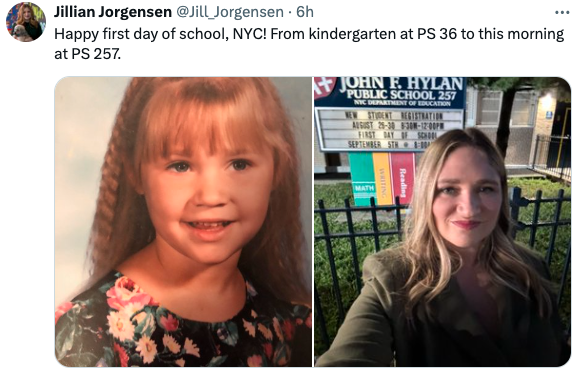
NY1 education reporter Jillian Jorgensen hasn’t changed a bit!