In this week’s newsletter: Two parents and an administrator are facing consequences for their roles in two school shootings. A “coding error” hides the 3,000 days of class missed by homeless students in Houston for illegal suspensions. Business Insider’s Matt Drange is leading the charge on K-12’s #MeToo movement. And top editors for two big education teams are leaving their positions — with one going to the Washington Post.
WHO’S RESPONSIBLE FOR SCHOOL SHOOTINGS?
The big story of the week
Rare celestial events aside, the big story in education this week was the convergence of two damning decisions in separate school shooting cases.
Jennifer and James Crumbley, the parents of the school shooter in Oxford, Mich., were each sentenced to 10-15 years in prison (Detroit Free Press, The Detroit News, New York Times, AP, CNN, The Guardian). They are the first parents in the U.S. to be convicted for a mass shooting carried out by their child.
The judge said the convictions weren’t about “poor parenting,” but rather they “confirm repeated acts, or lack of acts, that could have halted an oncoming runaway train” — which resulted in the deaths of four students in 2021. Their offenses include not securing a gun at home and failing to act upon signs of their son’s deteriorating mental health.
The same day, court documents revealed that a former assistant principal at Richneck Elementary School in Newport News, Va., where a six-year-old boy shot his teacher last year, has been indicted by a grand jury on eight felony counts of child abuse and neglect (Virginian-Pilot, New York Times, NBC News, Washington Post). She has been accused of ignoring several reports that the boy had a gun the day of the shooting (New York Times).
Both cases mark a shift in holding adults accountable for violence committed by children on school grounds. Will this prompt a change in the way we report on school shootings, too?
Check out daily links from @thegrade_ for other big education stories including the solar eclipse, more FAFSA fallout, and schools coping with the upcoming ESSER funding cliff.
ILLEGAL SUSPENSIONS OF HOMELESS STUDENTS
The best education journalism of the week
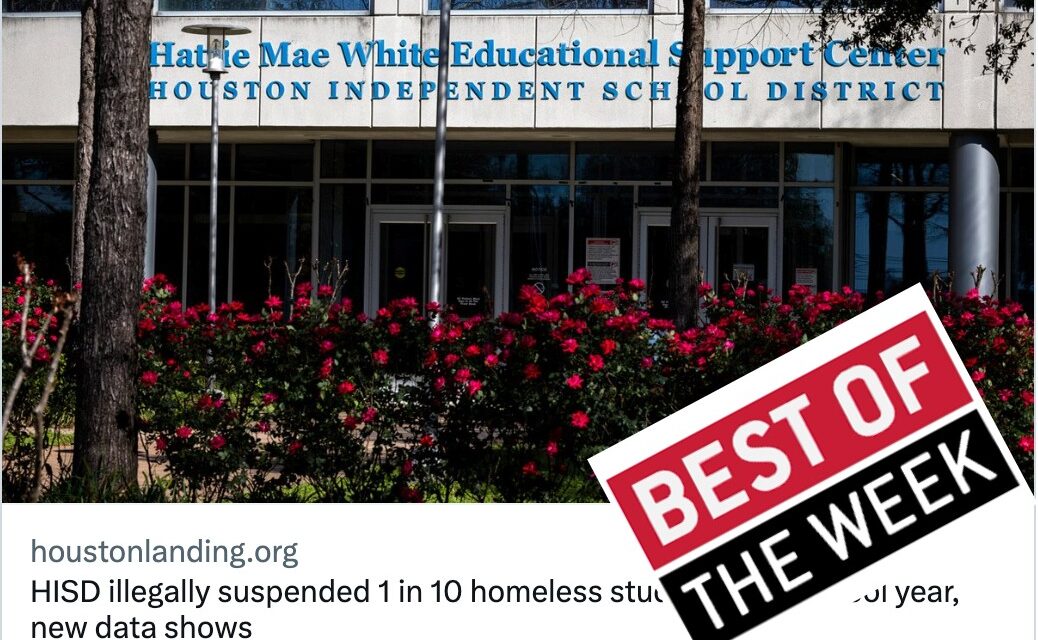
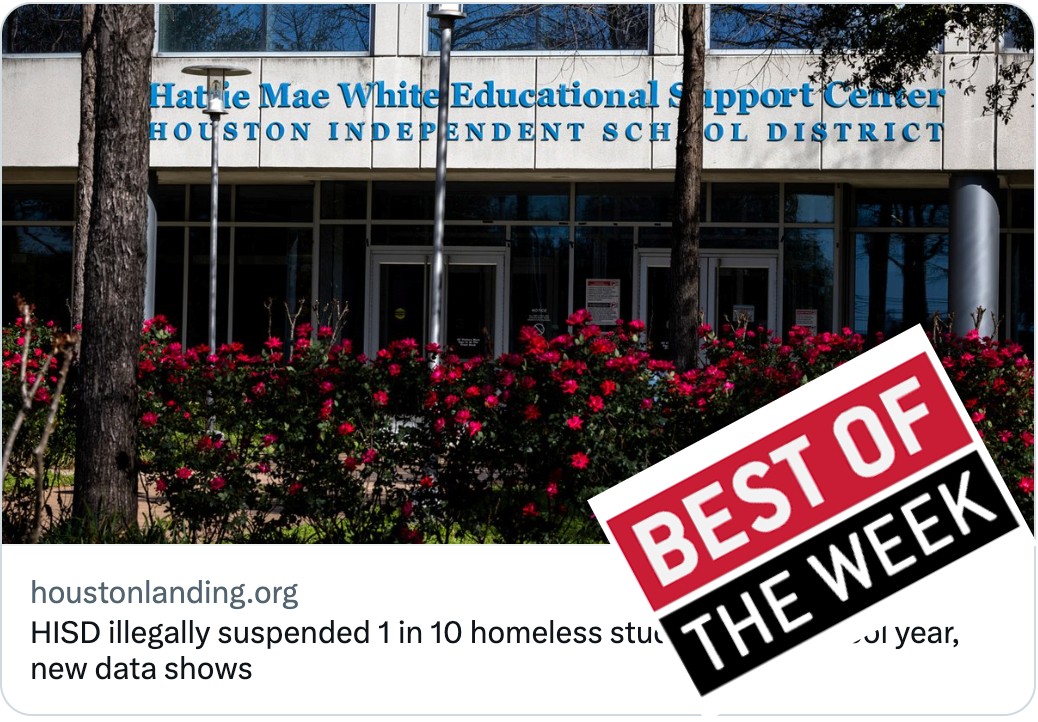
The best education journalism of the week is HISD illegally suspended 1 in 10 homeless students last school year, new data shows by Asher Lehrer-Small in Houston Landing.
Lehrer-Small used public records requests to pry loose the alarming statistics from the 2022-23 school year, laying out how these students missed about 3,000 days of class, a 30-fold increase over an original count in September. Officials said the original low count was due to a “coding error.”
The suspensions, which affected about 725 of HISD’s 7,250 homeless students, are a violation of a 2019 state law that prohibits such actions for all but the most severe cases — offenses like assault or drug possession. Despite admitting the systemic failure, HISD declined to give Lehrer-Small any good explanations, attributing the violations to a previous administration.
His piece is a great example of a journalist simply stepping back and asking why numbers don’t quite line up — then confronting district officials over the discrepancy. That led them to review the numbers, surfacing the error. Lehrer-Small also offers readers the big picture, tying the suspensions to the larger issue of dropouts.
Great watchdog journalism from a reporter who’s stirring the pot in Houston.
Other journalism we admired this week includes a heartbreaking, beautifully designed and illustrated account of the destruction of Gaza’s universities (NBC News), the Heritage Foundation’s plans to overturn Plyler v. Doe (Chalkbeat), a Brooklyn charter school’s experiment with staying open from 7 a.m. to 7 p.m. (New York Times), what happened 20 years after Arkansas started sending home BMI reports (NPR), and a deep dive into why IBM’s Watson supercomputer was a terrible tutor (The 74).
K-12 #METOO MOVEMENT
Our latest columns and commentary
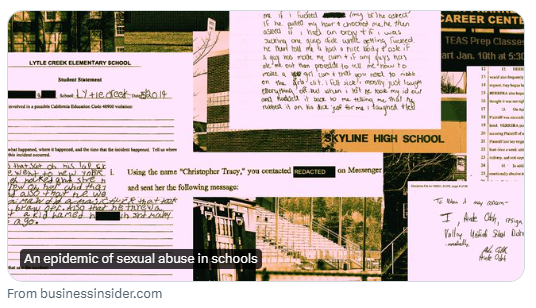
Is 2024 finally the year that journalists dig deep into the pervasive problem of serial sexual predators in schools — and that school systems tighten up their incredibly lax procedures?
If so, Business Insider’s Matt Drange will have had lots to do with it.
In a new interview published this week, Drange discusses the response to his most recent coverage, explains why some districts and states have been so slow to address serial sexual predators in schools, and describes some of the work that local and regional reporters are doing on this difficult topic.
“I started this six years ago reporting on my own teacher, and I did not expect at that point that I would be talking to a roomful of education reporters about similar records in their coverage areas,” Drange told me, in reference to his records-sharing endeavor. “So it was a bizarre journey in some ways.”
PEOPLE, JOBS, & EVENTS
Who’s going where and what’s happening
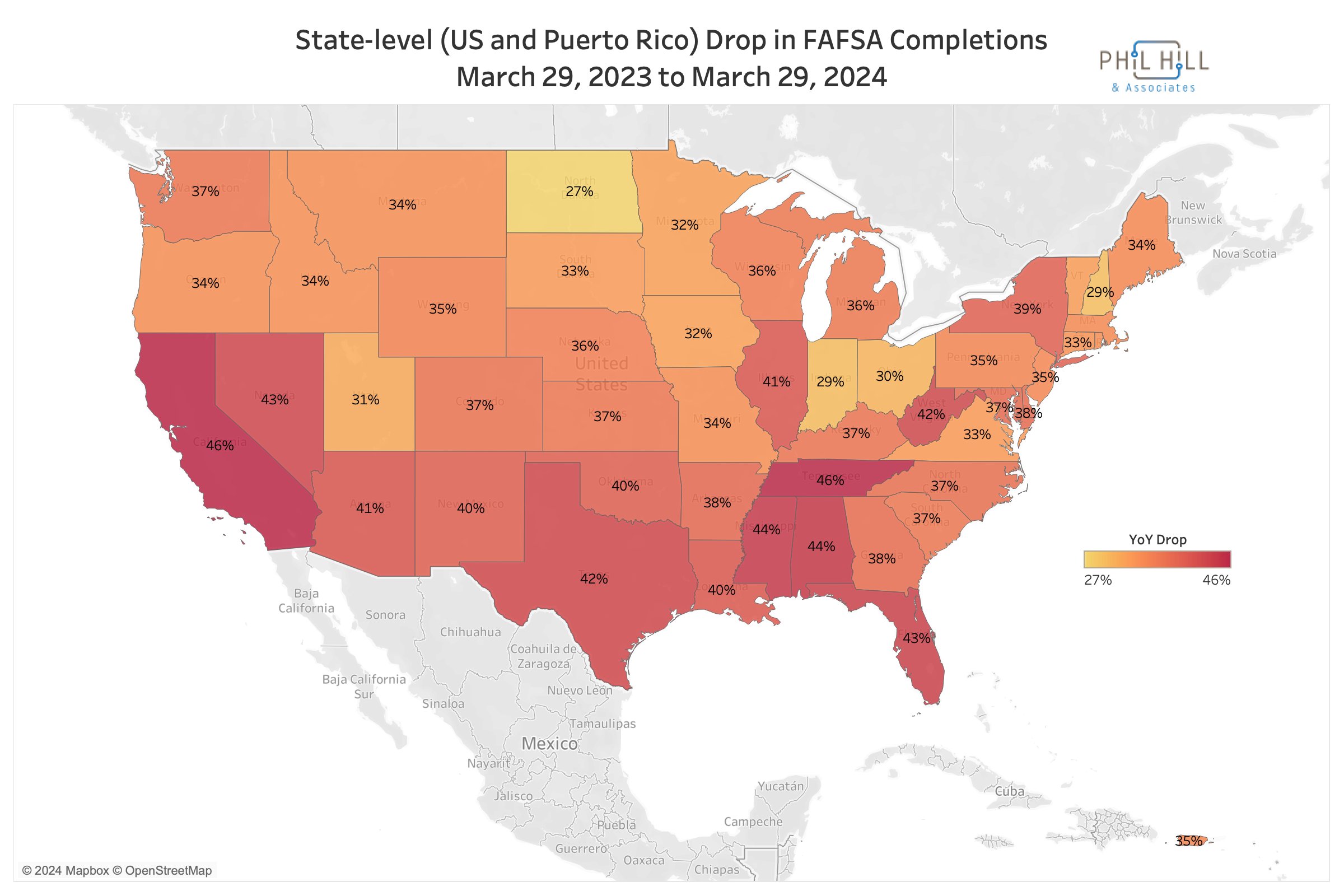
Above: Sometimes a map is the best way to tell an education story — in this case, the havoc that has been wrought by the botched FAFSA rollout. (H/T Phil Hill via Jill Barshay)
📰 Career moves: The Washington Post has a new national education editor — Chastity Pratt, who’s been heading the education team at the Wall Street Journal. Seattle Times Ed Lab editor Katherine Long is also leaving her post to retire after 34 years at the paper. (Apply to be the next Ed Lab editor here.) And fresh off the success of “Sold a Story,” Emily Hanford will now take up the position of journalist-in-residence at the museum Planet Word in D.C. Her first guest for a series of speaking events will be French neuroscientist Stanislas Dehaene, a world-renowned expert on the neuroscience of learning, on April 27.
📰 Podcasts, segments, & appearances: On the New Yorker Radio Hour, Nikole Hannah-Jones faulted media coverage for amplifying anti-CRT and anti-DEI efforts without demanding better evidence or being explicit about critics’ motives and history. The 10th episode of “Sold a Story” came out this week with previous sources reflecting on how the podcast has impacted their lives since its debut. And Chalkbeat Chicago bureau chief Becky Vevea was on WBUR’s “Here and Now” detailing why education advocates in Illinois think school board members should be paid. (See also this fun piece from The News Gazette in Champaign, Ill., about the 25 things you should know about being a school board member.)
📰 Events: The deadline for early-bird pricing for IRE 24 (June 20-23) is April 22, and I spot several promising education-related sessions. Make sure to register! The 74’s Beth Hawkins moderated a session with the Council of Chief State School Officers about how schools can continue programs that were started with COVID funding. Benjamin Herold was in Evanston, Ill., to talk about his book “Disillusioned.” And don’t miss Laura Meckler giving a book talk next week at NYU’s Institute for Public Knowledge.
📰 Research & reports: A new Pew poll on what it’s like to be a teacher in America has some surprising findings, including that only 5% of teachers in high-poverty schools rate the academic performance of their students as excellent or very good. Time also wrote a piece based on the findings about teacher job satisfaction. The Hechinger Report’s Jill Barshay looked at a study on what happens when schools offer pay incentives to hire or keep teachers, finding that it’s not always a simple solution for shortages. A University of Chicago Education Lab study shows that high-dosage tutoring in school can reverse pandemic-era learning loss. Brookings looked at the data about career and technical education, concluding that it’s a hidden weak spot in many high schools’ teacher workforces.
THE KICKER

“I’ve spent the last four days reporting on early childhood in Norway and it has been the most refreshing and fascinating experience of my decade+ as a journalist,” writes current Spencer fellow Jackie Mader, reporting from the Barnehages of Norway.
That’s all, folks. Thanks for reading!
Reply to this email to send us questions, comments or tips. Know someone else who should be reading Best of the Week? Send them this link to sign up.
Using Feedly or FlipBoard or any other kind of news reader? You can subscribe to The Grade’s “feed” by plugging in this web address: http://www.kappanonline.org/category/the-grade/feed/.
Read more about The Grade here. You can read all the back issues of The Grade’s newsletter, Best of the Week, here.
By Alexander Russo with additional writing from Colleen Connolly.