Slate’s Dan Kois reveals how he pulled off his wildly popular interview with a Florida school board chair who fired the principal after students were allowed to see Michelangelo’s ‘David.’
By Alexander Russo
One of the most-shared stories on my social media feed over the past few days has been Slate’s An Interview With the School Board Chair Who Forced Out a Principal After Michelangelo’s David Was Shown in Class.
A charter school — Tallahassee Classical — had failed to warn parents that the art teacher was going to show an image of Michelangelo’s nude sculpture ‘David’ to students. Some parents at the conservative-leaning school had complained. The principal was forced to resign. People had a lot to say.
Published on Thursday afternoon, the Slate interview by staff reporter Dan Kois was shared widely for several reasons, most obviously the outrageous circumstances behind the firing and the jaw-dropping responses from by school board chair Barney Bishop III.
“Teachers are the experts?” said Bishop in the interview. “Teachers have all the knowledge? Are you kidding me?”
Curious about whether there were any lessons for the rest of us from the experience, I direct messaged Kois on Twitter and asked him about how he pulled off his viral story — and whether school culture war coverage is distracting attention from more important issues.
In the following lightly edited interview, Kois describes his willingness to cold call, his ability to conduct what he calls a “semi-combative” interview with the board chair, and the decision to write the piece as a Q&A.
He refutes my questions about outrage-inducing culture wars coverage with frustrating calmness.
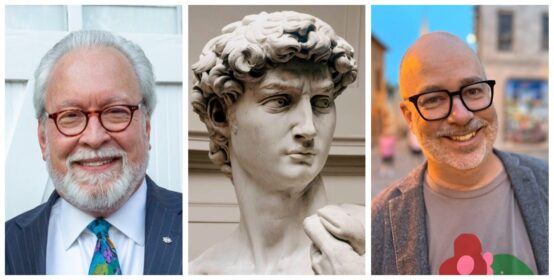
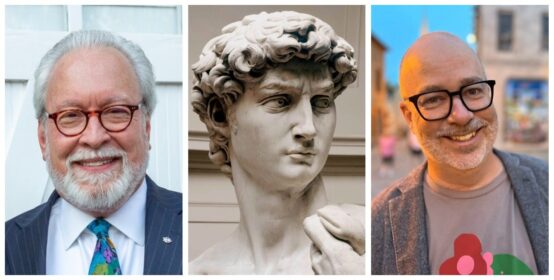
Above, left to right: School board chair Barney Bishop, Michelangelo’s ‘David,’ and Slate reporter Dan Kois
Me: Can you share a couple of behind-the-story insights for The Grade about where the idea came from, how you found the superintendent, and why you chose to do an interview instead of a traditional story?
Dan: When that story crossed my feed Thursday morning it simply seemed so absurd that I wanted to know more. I reached out to basically everyone I could: the former principal, the school’s new interim principal, the school’s parent liaison.
The fact that Bishop had already given at least a few quotes to the Tallahassee Democrat’s Ana Goñi-Lessan made me hopeful he might talk to me. He gave off the vibe of a guy who liked to talk.
He gave off the vibe of a guy who liked to talk.
His cell phone number was right on his company’s webpage, but when I called it, his voice mailbox was full — a sure sign that someone’s getting flooded with journalist calls. I sent him a text, and much to my surprise, he called me back about an hour later.
I pretty much always intended to run it as a Q&A simply because it seemed to me that every reporter on earth must be chasing the same story, and a Q&A is fast. And then the semi-combative nature of the interview, and the way it flowed from subject to subject, made it quickly apparent that was the way to go.
Me: Have you done this quick-strike interview strategy before?
Dan: Yeah, now and then. It’s worth remembering that even though calling people on the phone out of the blue feels weird these days, this is how pretty much all journalism used to happen! I basically view my willingness to pick up the phone and cold-call someone as my one remaining advantage over younger, better journalists. Don’t tell them.
Me: What was the most delicate moment in the conversation for you as the interviewer?
Dan: I don’t know that there were any delicate moments. Even when he got angry with me it was clear he wanted to have his say, so I didn’t get the impression he was going to hang up on me.
My willingness to pick up the phone and cold-call someone is my one remaining advantage over younger, better journalists. Don’t tell them.
Me: Generally speaking, what’s the secret to doing this kind of an interview?
Dan: It seemed apparent to me that it was important to be very upfront about my opinions and view this as a chance to challenge him — and let him challenge me. I do think this was a story that benefited from me giving him a kind of low-stakes debate opponent. Often in interviews like this, I’ve found I’m better off doing that [rather than] trying to veil my position in a bunch of “uh huh”s or “tell me about that”s.
Me: How do you feel about your story getting so much attention, given how relatively little work you put in?
Dan: I’m delighted my story got so much attention! I mostly write about arts, culture, and parenting, so it’s delightful to have a newsy scoop.
While I think I could have done a way better job of the interview — Bishop was so voluble that while he spoke I watched a dozen opportunities for sharp follow ups come and go — I think it’s a pretty good story that casts light on the philosophy driving education at this school and at schools like it around the country.
It was important to be very upfront about my opinions and view this as a chance to challenge him — and let him challenge me.
Me: Do you worry about school culture wars coverage that stereotypes conservative parents and fans liberal outrage?
Dan: Liberals should be way more outraged, in my opinion, about what is happening to educators right now.
Me: I think of outrage-amplifying coverage as the problem, not the goal. Shouldn’t newsrooms be more concerned about what’s happening to kids (learning loss, disengaged from school, can’t read) vs. educators?
Dan: I think it’s a total fallacy to say that newsrooms aren’t concerned about all of those things. I see dedicated, dogged coverage of all those problems with education and more in Slate and across media. But the way that the right wing is treating educators and students is a huge story, and a huge problem.
Newsrooms, and readers, have the capacity to pay attention to both.
Additional resources
Warming Up To Cold-Calling (Study Hall)
Previously from The Grade
‘Just knock on the door’: Mentorship moments that changed these education journalists’ trajectories
How to interview AFT head Randi Weingarten — or any other public official
Tabloid-style education news is all the rage
ABOUT THE AUTHOR
Alexander Russo
Alexander Russo is founder and editor of The Grade, an award-winning effort to help improve media coverage of education issues. He’s also a Spencer Education Journalism Fellowship winner and a book author. You can reach him at @alexanderrusso.
Visit their website at: https://the-grade.org/