In this week’s newsletter: Two new studies reveal the modest impact of $190 billion in ESSER funds on student achievement. The AP education team expands — again. New York City is queued up to be the next large district to ban cell phones in schools, for better or worse. What happens when a small school district experiences an influx of migrant students? You might be surprised. And ed reporters dish on their favorite summer fiction reads.
There will be no newsletter next week. Have a great 4th of July.
INADEQUATE ESSER
The big story of the week
The big K-12 education story of the week is the release of two new studies showing the significant but modest impact of ESSER funds on student achievement. While not surprising, the inadequacy of the massive influx of federal funding is disappointing.
Overall, the data suggest that investing in student achievement leads to positive outcomes — in this case, higher reading and math scores and some gains in learning lost during the pandemic, especially for poor kids. But the nation’s students still have not fully recovered — and the researchers say much more money would be needed and isn’t likely to come (Chalkbeat, Wall Street Journal, The 74, NPR, EdWeek).
Reporters would do well to dig in and find out which interventions worked best in their local districts. For more, check out the studies from the Education Recovery Scorecard and the Calder Center.
Other big education stories of the week include New York City going one step closer to banning cell phones in schools, state and federal Supreme Court decisions on religious charter schools and vaccine exemptions, and compounding district budget crises.
DETAILING NEWCOMER STUDENTS & THEIR TEACHERS
The best education journalism of the week
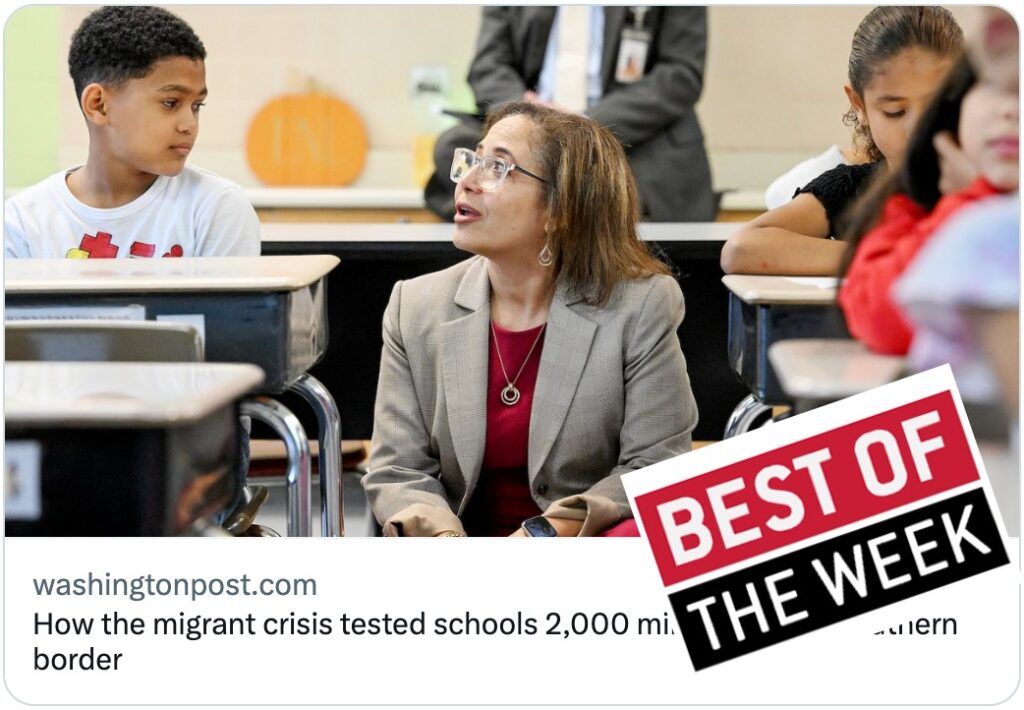
The best education journalism of the week is ‘These are our students’: How a small school district welcomed migrant kids by The Washington Post’s Joanna Slater with contributions from Kevin G. Andrade and Steven Rich.
Slater’s idea is timely but hardly original — she embeds with teachers and families in upstate New York as they deal with a sudden influx of dozens of migrant students from Venezuela, Ecuador, and Colombia. But her story makes real the experiences of educators grappling with their new students and the newcomer students attempting to settle into their new lives.
One English learner teacher is assigned a classroom of migrant students — her first time being responsible for an entire classroom — which fills her with panic as she struggles to keep up with the “rapid-fire Spanish” directed her way by families. A 9-year-old from Ecuador says that she finds her new classroom “beautiful” and shares that she feels safe for the first time after a harrowing journey to the U.S.
While depictions of the so-called immigration crisis can be abstract and alarming, Slater produces a smart, engaging slice of life and balances the focus between educators and families. It’s an approach worth emulating by other journalists.
Other education stories we liked this week: Combating chronic absenteeism by paying students to attend school (SF Chronicle) and by making school fun (Boston Globe), a classroom on wheels for unhoused students (KQED), and lessons from Toronto on immigration (Chicago Sun-Times).
AN ACCIDENTAL EDUCATION REPORTER
Our latest columns and commentary
In a story that has repeated itself nationally, a Minneapolis parent stepped in when there wasn’t anyone covering the school district the way it needed to be covered. In this week’s column, accidental education reporter Melissa Whitler describes how her part-time newsletter developed and lists the stories she wishes traditional newsrooms would cover.
💡 Bonus: Two Washington Post reporters describe how they investigated sexual abuse at Native American boarding schools. School-based sexual abuse of children remains an issue in the present and has proven to be an enormously challenging topic for education journalists to cover.

Above: Becky Dernbach (second from left) was recognized by the Minnesota Society of Professional Journalists for her reporting on education in immigrant communities for the Sahan Journal. It was one of three top awards the outlet took home. Congrats to all!
PEOPLE, JOBS, & EVENTS
Who’s going where and what’s happening
📰 Career moves: The AP just keeps adding to its already top-notch ed team — the latest being former USA Today national reporter and Atlantic ed page editor Alia Wong, who will edit collaborations. The 74 named former CNN digital editor Nicole Ridgway as its new editor-in-chief, replacing Steve Snyder who was recently appointed CEO. While she’s hosted and been a war correspondent before, it’s still strange to hear longtime NPR education reporter Elissa Nadwornyidentified as a reporter covering reproductive rights. EdNC’s Nation Hahn is leaving the outlet he helped found. St. Louis Public Radio is hiring an education reporter. (Former ed reporter Kate Grumke is now covering the environment.)
📰 Appearances, segments, & podcasts: NPR’s “Embedded” podcast has a new series hosted by Nashville Public Radio’s Meribah Knight that explores the aftermath of the Covenant School mass shooting through the stories of three mothers of survivors. “Code Switch” from NPR is also out with a new ed-related series, this one on book bans. PBS NewsHour ran a segment on why fewer young men are pursuing college degrees. EdWeek’s Alyson Klein was on NPR’s “All Things Considered” talking about statewide bans on cell phones in schools. Politico’s “Tech” podcast also chimed in on the challenges of creating cell phone-free schools. And WBUR’s “Here and Now” — which you might have noticed features education stories pretty regularly — dove into the new Louisiana law requiring public schools to display the Ten Commandments in the classroom.
📰 Events: The Boston Globe capped off its series on the 50th anniversary of the busing “crisis” with an event about desegregation, featuring education editor Melissa Taboada, reporters Christopher Huffaker and Ivy Scott, and Mayor Michelle Wu. And Chalkbeat held a virtual “State of Public Education” event featuring co-founder Elizabeth Green, national editor Erica Meltzer, and reporters Aleksandra Appleton and Reema Amin.
📰 Research: For The Journalist’s Resource, Naseem S. Miller details a recent study highlighting the need for a public health approach to reporting on gun violence. This follows the U.S. Surgeon General’s declaration this week of gun violence as a public health crisis. Middle and high school students give their schools a B- grade overall, with lower-income students giving even lower grades, according to a new Gallup poll. Scholars rounded up research on the impact of social media on young people and the effectiveness of phone bans for The Conversation.
THE KICKER
Saving the best for last

Summer fiction recommendations from current and former NPR education reporters? Yes, please. I loved Vinson Cunningham’s “Great Expectations” and am currently reading Miranda July’s “All Fours.” How about you?
That’s all, folks. Thanks for reading!
Reply to this email to send us questions, comments or tips. Know someone else who should be reading Best of the Week? Send them this link to sign up.
Using Feedly or FlipBoard or any other kind of news reader? You can subscribe to The Grade’s “feed” by plugging in this web address: http://www.kappanonline.org/category/the-grade/feed/.
Read more about The Grade here. You can read all the back issues of The Grade’s newsletter, Best of the Week, here.
By Alexander Russo with additional writing from Colleen Connolly.