Happy Friday! Sign up for the newsletter here.
In this week’s newsletter: Coverage diverges on international test scores. Is telehealth a good approach to address student mental health? The highs and lows of covering a teachers strike. Another former education reporter is hired for a top job. And what’s it like to be an education reporter these days, according to ChatGPT?
PISA MELTDOWN
The big story of the week
The big education story of the week is the release of the international PISA scores — and the many different ways that newsrooms chose to cover the results.
The big international wire services tended to emphasize the dismal overall results (Reuters, AP). Mainstream national outlets seemed to highlight the poor showing from U.S. kids, especially when it comes to math (New York Times, Washington Post, Axios).
Several trade publications focused on U.S. results and differentiated between reading and math, noting that U.S. kids did relatively well on reading and science (EdWeek, Chalkbeat).
And a couple of outlets found ways to highlight bright spots in the scores, comparing how the U.S. did compared to other countries (Wall Street Journal, The 74).
For further coverage and analysis, check out Jill Barshay’s initial thoughts, Matt Barnum’s insights, or this interesting Sam Freedman thread about the potential role of second-generation immigrants (among other things).
Other big education stories of the week:
📰 GOOD NEWS ON READING: As part of a lawsuit settlement, California spent $53 million to train teachers in 70 low-performing schools in the science of reading. This week, a study showed that the efforts seem to have paid off. The percentage of third-graders in the program who met or nearly met the state reading standards rose 6 points compared to other similar students (New York Times, Los Angeles Times, CalMatters, Mercury News, EdWeek, Hechinger Report). It’s an impressive gain in a short period — especially during the pandemic — and has lessons for other states and districts where kids are struggling to read.
📰 CONFLICT IN THE CLASSROOM: The Israel-Hamas war continues to create conflicts in some classrooms across the country. Schools and educators are in the hot seat figuring out how to address the issue (Christian Science Monitor). A group of Oakland teachers is facing district backlash for calling for a “teach-in” about the Palestinian struggle (San Francisco Chronicle, New York Times). Meanwhile, in Minneapolis, a teachers union resolution criticizing American support for Israel caused controversy and led to a new resolution a month later (Minneapolis Star Tribune). And in Boston, more than 100 students walked out of the prestigious Boston Latin School in support of Palestine (WBUR).
THE TELEHEALTH SOLUTION
The best education journalism of the week
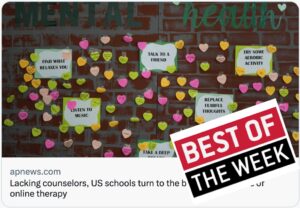
The best education story of the week is Jocelyn Gecker’s AP story Lacking counselors, U.S. schools turn to the booming business of online therapy.
Faced with high levels of concern about student mental health, the story finds that at least 16 of the largest 20 school districts in the nation now offer online therapy sessions through private companies like Hazel.
There’s nothing flashy in terms of how it’s written or presented, and the story carefully avoids taking an obviously pro- or anti-tech position. It balances family anecdotes and interviews with polished tech executives to examine the tradeoffs, giving us a great illustration of how districts pressured to respond to new challenges often resort to relatively inexpensive and unproven virtual solutions.
These programs are already making it harder to hire and keep school counselors, some of whom leave for telehealth jobs with more flexibility. It’s not hard to imagine that AI-provided telehealth will come next — if it isn’t already being tried someplace.
See the LA Times for more about the shortage of mental health counselors and some schools’ questionable efforts to limit suicide contagion among teens.
Other great education stories this week — and why we liked them:
👏 A Maryland district with the troubling habit of sending kids to the ER for psychiatric evaluations is scrutinized in this well-structured investigative piece from Meredith Kolodner and Annie Ma, who carefully trace the institutional failures and behavioral flare-ups that can lead to such a disproportionate punishment (Hechinger Report/AP).
👏 This meticulous and gut-wrenching reconstruction of the Uvalde shooting from Lomi Kriel, Lexi Churchill, and Jinitzail Hernández follows the experiences of a single 4th-grade classroom and the ill-prepared police officers trying to get in to save them (ProPublica/Texas Tribune). There’s also an hour-long PBS Frontline documentary and an explainer on the journalistic decision-making behind this story.
👏 Jenny Gold’s piece about the new rules governing expulsion in California preschools is both comprehensive and specific, gathering perspectives from parents, educators, and researchers to document just how difficult it can be to work with behaviorally unpredictable children (Los Angeles Times).
👏 Jennifer Brown’s uplifting story about a program that helps Colorado foster kids make it through high school shifts seamlessly between vivid examples of the program in action and background on the challenges of life in the foster system (Colorado Sun).

Above, left to right: Oregon Public Broadcasting’s Natalie Pate, the Oregonian’s Julia Silverman, and Willamette Week’s Rachel Saslow.
LESSONS FROM PORTLAND
Our latest columns and commentary
Fresh off Portland’s prolonged school shutdown, three education reporters reveal the highs and lows of covering the strike, including being attacked online for their coverage and juggling parenting responsibilities during a strike that spanned almost the entire month of November.
Reading their accounts, I can’t help but admire their candor — and note how much more thoroughly and deeply they and their colleagues covered the strike compared to strikes in many other places. Questionable claims from the antagonists were generally scrutinized. The concerns of parents, students, classified staff, and local businesses all received careful attention. The coverage exposed differences among parents and rifts among educators. It wasn’t perfect, but it showed what’s possible — and what’s needed.
PEOPLE, JOBS
Who’s going where and doing what
🔥 Career moves: Former Washington Post and Minneapolis Star Tribune education reporter Alejandra Matos is the Houston Chronicle’s first Latina managing editor. Star education reporter Sarah Carr will be contributing to the Hechinger Report’s early childhood education newsletter over the next few months. Lesley Cosme Torres announced she’s leaving her position reporting on education for WNPR in Connecticut. Good luck to all!
🔥 Kudos: Project Censored listed Annie Ma and Meredith Kolodner’s AP and Hechinger Report story on students with disabilities being suspended “off the books” as one of its top 25 censored news stories of 2022-23. Politico higher education reporter Bianca Quilantan was among those chosen for the National Press Foundation’s 2024 Widening the Pipeline Fellowship, along with the Austin American- Statesman’s Fernanda Figueroa and the Salt Lake Tribune’s Michael Lee. Congrats to all!
🔥 Soundoff: “For national outlets to elevate this reporting — and really elevate it, with acknowledgment of where the information came from — is rewarding to me, sure, but hopefully most of all rewarding to the community. National attention can prompt the effects local reports don’t always create,” says Chalkbeat Tennessee’s Laura Testino, whose reporting on a book censorship scandal has gotten shoutouts in outlets like The New Yorker and NBC News. “It should not take national attention for a local story to matter, but perhaps that kind of attention can reflect to a community why it should.”
🔥 Books: “Maybe the only thing more fun than writing ‘Disillusioned’ was reading so, so many great books that helped me understand what American suburbia is all about,” Benjamin Herold posted on X. Check out his fascinating thread on the books that helped him most — including several that have been featured here in the past — and be sure to pre-order his new book, which is out next month. NBC News’ Mike Hixenbaugh’s new book “They Came for the Schools” is also now available for pre-order.
🔥 Job openings: New York Focus is hiring a statewide education reporter. The Seattle Times Ed Lab is hiring a K-12 reporter. WFYI Indiana is hiring a statehouse reporter for education. And WITF in Harrisburg, Penn., is hiring an education reporter. Check previous newsletters for jobs that may still be open.

Above: Mother Jones has a big new multi-part series out (with an excellent GIF) on the education system’s failure to serve students with disabilities.
APPEARANCES, EVENTS, & NEW RESOURCES
What’s happening and new research
⏰ Podcasts, segments, & documentaries: Local cable news outlet NY1 ran an hour-long special yesterday featuring reporting on the migrant crisis, including a great piece from Jillian Jorgensen about a student from Colombia who finds school to be like therapy. In Collaboration with ProPublica and the Texas Tribune, Frontline aired a documentary about the law enforcement response to the Uvalde school massacre. OPB’s “Politics Now” podcast dives into the history of the fight over K-12 funding that led to the recent teachers strike. And coming next year, you can listen to “Sold a Story” in Spanish.
⏰ Events: On Monday, catch an EWA webinar on the promises and pitfalls of teaching during out-of-school time, featuring the Hechinger Report’s Jill Barshay and Education Week’s Sarah D. Sparks. EWA will also make an appearance at SXSW EDU in March with panels on school finance and student data privacy. The Yale Education Leadership Conference is back in April.
⏰ Research: According to a report from the Urban Institute on equity and class size caps in NYC, “the average Black student’s school currently has per pupil funding levels that are 13% higher than the school attended by the average white student and would fall to 10%.” The 74 reported on an Oakland study that found that parents are just as effective as teachers in tutoring young readers, signaling a possible solution to help kids catch up. And Northwestern’s Local News Initiative is out with its 2023 State of Local News Outlook report, with a worrying map showing news deserts across the country.
THE KICKER

“Education reporting in the U.S. can be dynamic and challenging.” — ChatGPT’s response to being asked what it’s like being an education reporter these days (inspired by K-12 Dive reporter Anna Merod’s interview with the AI tool for its first birthday).
That’s all, folks. Thanks for reading!
Reply to this email to send us questions, comments or tips. Know someone else who should be reading Best of the Week? Send them this link to sign up.
Using Feedly or FlipBoard or any other kind of news reader? You can subscribe to The Grade’s “feed” by plugging in this web address: http://www.kappanonline.org/category/the-grade/feed/.
Read more about The Grade here. You can read all the back issues of The Grade’s newsletter, Best of the Week, here.
By Alexander Russo with additional writing from Colleen Connolly and Will Callan.
ABOUT THE AUTHOR
Alexander Russo
Alexander Russo is founder and editor of The Grade, an award-winning effort to help improve media coverage of education issues. He’s also a Spencer Education Journalism Fellowship winner and a book author. You can reach him at @alexanderrusso.
Visit their website at: https://the-grade.org/