In this week’s newsletter: Districts cut budgets and scramble to avoid closures — again. A harrowing account of sexual abuse of Native American children at Catholic schools. In San Diego, a nonprofit outlet stands out by combining tough accountability reporting and parent-centric stories. As in the past, last night’s #EWA24 awards featured some snubs and surprises. And a local outlet finds a unique way to engage with readers about E-D-U-C-A-T-I-O-N.
NEVERENDING CLOSURES
The big story of the week
Once again, the big education story of the week is school closures, budget cuts, and layoffs — partly due to mismanagement of ESSER funds or a lack of planning after they run out in the fall (The 74).
This may well be the big education story of the week for the rest of the summer, if not longer.
As the 2023-24 school year ended, students said goodbye to schools that are closing in Texas, Kansas, and southern Illinois (Axios San Antonio, San Antonio Report, KCUR, St. Louis Post-Dispatch). In Washington state, many districts are also in a budget bind, and Seattle is facing the possible closures of 20 elementary schools (Seattle Times, KOMO News). Other districts, including Boston and Cleveland, are looking for ways to avoid hotly contested closures, including raising property taxes (Boston Globe, GBH, Signal Cleveland).
Districts including Chicago are also taking a hard look at other areas they can cut or re-allocate, like staff (Chicago Sun-Times, Chalkbeat Chicago, Worcester Telegram & Gazette, District Administration). In Florida, public school closures have been sold as a tradeoff for school choice (Politico, Politico).
A handful of districts like Alexandria, Virginia, are growing (Washington Post). But for most places, the tough decisions aren’t likely to ease up any time soon. Even adjusting for the end of the ESSER dollars, schools face enormous future costs for things like building repairs and updates, including those prompted by climate change (Fox 2 Now St. Louis, Washington Post).
Check out daily links from @thegrade_ for other big education stories of the week, including graduation for students who began their high school careers in the COVID pandemic, chronic absenteeism improvements in Massachusetts, and how free school lunch spread across the nation.
ABUSE AT INDIAN BOARDING SCHOOLS
The best education journalism of the week
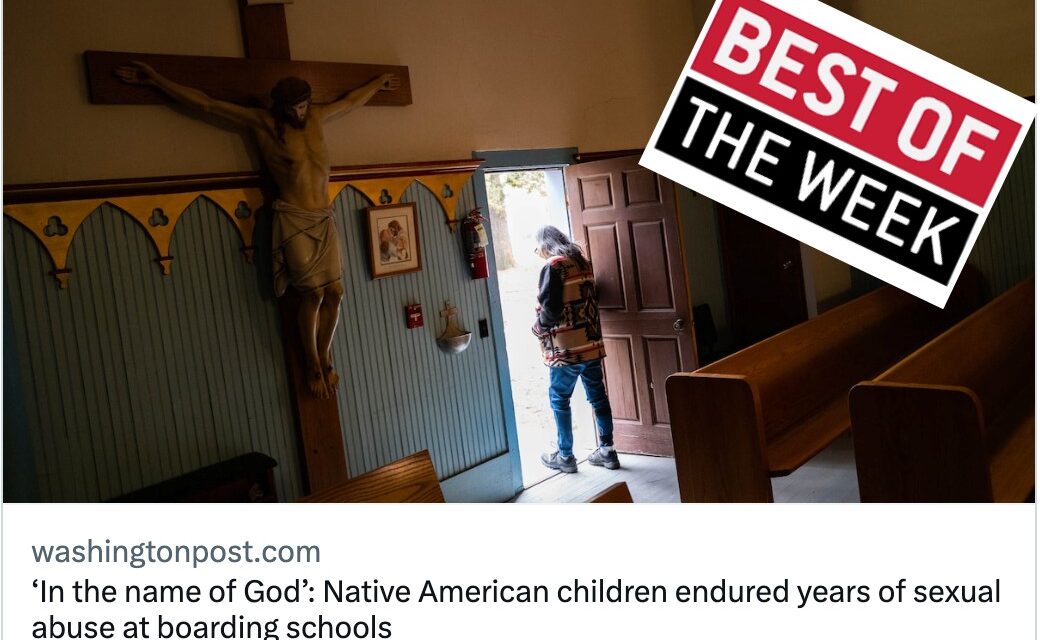
The best education journalism of the week is In the Name of God by The Washington Post’s Sari Horwitz, Dana Hedgpeth, Emmanuel Martinez, Scott Higham, and photographer Salwan Georges.
A massive project even by Washington Post standards, the piece — part of a larger seriesabout American Indianboarding schools — looks at decades of sexual abuse by Catholic school educators and staff against more than 1,000 Native American children in remote regions of the Midwest and Pacific Northwest.
For the investigation, the team looked at work histories for priests who had “credible claims of sexual abuse.” Using these lists, they identified which abusers worked at Indian boarding schools. Focusing on the 1950s and 1960s, they reviewed lawsuits, sworn affidavits, oral histories, and boarding school records and interviewed former students.
The result is a grim, comprehensive look at these schools at a time when the nation’s first Native American cabinet member, Interior Secretary Deb Haaland, is investigating schools operated or supported by her agency.
Rich with photos, maps, and archival material, it’s not an easy read, but one that will stick with readers for a long time. Moving methodically from school to school over the decades, the narrative unfolds in a surprisingly understated fashion, with telling details: one 78-year-old still remembers punishments delivered via the “Jesus rope,” woven with strands of razor-sharp metal strips.
The piece offers little comfort aside from letting the victims, many now elderly, finally tell their stories. Several told The Post they’ve never recovered — and will never recover — from the abuse. “You don’t get over it,” says a 75-year-old victim.
A PBS NewsHour segment features Washington Post reporter Dana Hedgpeth.
Other education stories we liked this week: how one Montana school solved its teacher shortage by opening a day care (High Country News), a report showing that chronic absenteeism is dropping in Massachusetts (Boston Globe), how an Alabama town staved off school resegregation (ProPublica), and how Texas is trying to inject Bible stories into its elementary school reading program (The 74).
A HIDDEN GEM IN SAN DIEGO
Our latest columns and commentary
You may not notice it, but local education news varies widely.
Some outlets and teams are more investigative, while others are more focused on breaking news.
Some are more focused on district policy and politics, while others are focused on school- and classroom-level issues.
This week’s new piece is an attempt to capture what makes Voice of San Diego’s education coverage different, including interviews with current and former reporters Mario Koran, Ashly McGlone, Will Huntsberry, and Jakob McWhinney.
One of my longtime favorites, Voice has been inadequately noticed or celebrated outside of a small group of insiders.
It’s a model for other outlets and teams to consider.
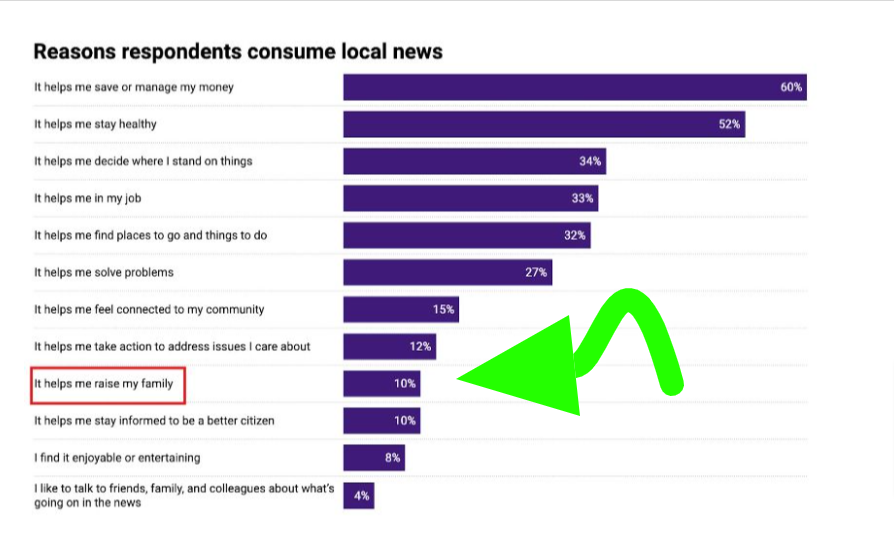
Above: Only 10% of Chicago-area news consumers reported that they consume local news to help them raise their families. Let’s make education news more useful to parents?
PEOPLE, JOBS, & EVENTS
Who’s going where and what’s happening
📰 Awards & impact: The Education Writers Association’s just-announced winners include The 74’s Linda Jacobson, The Texas Tribune’s Kate McGee, and the Dallas Morning News’ Talia Richman (who won the large newsroom category over the Washington Post’s Laura Meckler and AP’s Pulitzer finalist Bianca Vázquez Toness!) for beat reporting. The judges also awarded the large newsroom Investigative & Public Service prize to reporters from ESPN for coverage of Lauren McCluskey’s murder over Business Insider’s Matt Drange (for K-12 sexual assault) and the Globe’s Deanna Pan (for school inequality). Hmm. The Report for America Local News Awards also honored the Green Bay Press-Gazette’s Danielle DuClos for investigative reporting as well as the Mississippi Free Press’ Torsheta Jackson, AL.com’s Alaina Bookman, and WYPR’s Bri Hatch for solutions stories about education. And voters in Idaho approved a plan to replace a crumbling school after a yearlong investigation by the Idaho Statesman and ProPublica about the policies that led the school to such a state of deterioration.
📰 Segments, appearances, & podcasts: Ed reporters — and Grade contributors or interviewees — Mike Hixenbaugh, Laura Pappano, Cara Fitzpatrick, and Justin Murphy were all named in a New Yorker piece for their work covering conservative activists attacking public education. APM Reports’ Emily Hanford was interviewed by NAHJ’s palabra about what her literacy findings mean for English learners. PBS News Weekend ran a segment on sex education. In a podcast from Cleveland Signal, kids talk about gun violence. NPR ran segments recently about teachers intervening in student fights and chronic absenteeism.
📰 Career moves & job openings: Houston Landing announced it’s expanding its education team to include four more reporters in addition to its current lineup of Asher Lehrer-Small, Miranda Dunlap, and editor Jacob Carpenter — and to focus more on reporting and writing in Spanish. The Texas Tribune gained a new education reporter: Jaden Edison, who most recently covered criminal justice and voting rights for the Connecticut Mirror. Danielle DuClos is leaving the Green Bay Press-Gazette to join The Capital Times in Madison as an investigative and enterprise reporter. San Francisco-based schools reporter Ida Mojadad has joined the San Francisco Chronicle as a breaking news reporter. Spencer fellow Lauren Camera has a story on child care access in the Hechinger Report and Ms. Magazine. And if you’re looking for a job, IndyStar is hiring a K-12 reporter.
📰 Resources: Denise-Marie Ordway of The Journalist’s Resource wrote a helpful explainer about what the research shows about school board elections. For more on this topic, don’t forget Ballotpedia, which provides stats on election outcomes and a list of states with education issues on the ballot. And lastly, the Dart Center for Journalism and Trauma has launched a toolkit for trauma-aware journalism.
THE KICKER
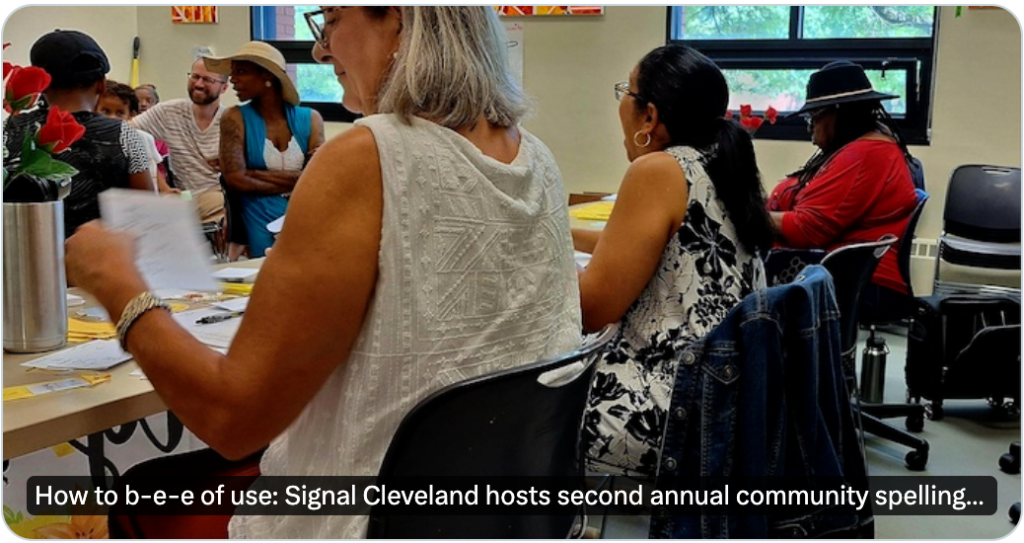
“A low-stakes, high-reward, and fun approach to supporting child literacy in a community that cares deeply about educational opportunities for children” is how the Nieman Lab described Signal Cleveland’s community spelling contest, held just before this week’s National Spelling Bee.
That’s all, folks. Thanks for reading!
Reply to this email to send us questions, comments or tips. Know someone else who should be reading Best of the Week? Send them this link to sign up.
Using Feedly or FlipBoard or any other kind of news reader? You can subscribe to The Grade’s “feed” by plugging in this web address: http://www.kappanonline.org/category/the-grade/feed/.
Read more about The Grade here. You can read all the back issues of The Grade’s newsletter, Best of the Week, here.
By Alexander Russo with additional writing from Colleen Connolly.