A multipronged approach is needed to create positive change for students who feel unsafe in school.
For years, LGBTQ+ issues in schools have been a hot-button topic. As out queer educators, we have faced invalidating and even frightening obstacles, and we have seen our queer and trans students suffer, also. A survey of the literature validates these experiences. What we’ve learned from our experiences, observations, and the literature leads us to recommend best practices to reduce harm and create positive change for the LGBTQ+ community in schools.
We must begin by understanding the harms members of the LGBTQ+ community are facing. LGBTQ+ stands for lesbian, gay, bisexual, transgender, and queer/questioning, with the + referring to the myriad other identities related to gender and sexuality. The past two decades have seen greater visibility for these communities and more research focusing on how to improve the lives of LGBTQ+ children. As Cris Mayo (2017) notes:
In print and in online media, on broadcast news, and in any number of blogs, webpages, or social media posts, people are engaged in an ongoing national conversation about issues that center on sexuality and the lives of people who identify as part of the LGBTQ(+) communities.
While these trends may seem promising for LGBTQ+ students, this community remains underrepresented and underserved in the school system (Block, 2019; Kahn & Gorski, 2016; Steck & Perry, 2018). The Gay, Lesbian, and Straight Education Network’s (GLSEN) 2021 School Climate Survey shows that 68% of LGBTQ+ students felt unsafe at school because of their sexual orientation, gender identity, or expression (Kosciw, Clark, & Menard, 2022). Data from both GLSEN (Kosciw, Clark, & Menard, 2022) and the Centers for Disease Control and Prevention (2023) show that students in the LGBTQ+ community continue to have a harder time in school academically, emotionally, and physically than their straight, cisgender peers.
Discrimination and lack of presence do not just apply to students, they also apply to LGBTQ+ educators. As Michele Kahn and Paul Gorski (2016) note, “Even in school districts or states where LGBTQ educators have employment protections, there is no assurance that they will not be dismissed for heterosexist or sexist reasons, often under the guise of other concerns.” The LGBTQ+ community also is under attack in legislation and in practice (Lavietes & Ramos, 2022; Walker, 2023).
Underlying these difficulties is the culture of heteronormativity in schools. Kahn and Gorski (2016) define heteronormativity as the “normalization of heterosexuality and the demonization of any other sexual orientation or identity.” A growing body of literature demonstrates that this perspective is dominant in the American education system, where anything that is not heterosexual is considered deviant or not the norm (see, for example, Gorski, Davis, & Reiter, 2013; Mayo, 2013, 2017; Meyer, 2007). Educators, administrators, and students continue to uphold these attitudes (Martino & Cumming-Potvin, 2017; Mayo, 2013; Wickens & Sandlin, 2010; Zack, Mannheim, & Alfano, 2010).
The history of heteronormativity in the school system has affected the employment of queer educators and staff, the experiences of queer students, and the representation of LGBTQ+ topics in the curriculum. In the most recent GLSEN school climate survey, 71.6% of student respondents said their classes included no representation of LGBTQ+ topics, and an additional 12.2% said their classes included only negative representation (Kosciw, Clark, & Menard, 2022). Additional research from Steven Camicia and Juanjuan Zhu (2019) found widespread exclusion of the words lesbian, gay, bisexual, and transgender in state social studies standards and, by extension, a lack of recognition of LGBTQ+ individuals, social movements, and issues.

Our perspectives
We are both queer educators of color who are open publicly about our identities despite the discrimination we have faced, continue to face, and will face in the future.
Ferial has been working with queer and trans youth in the Midwest for 22 years. When she saw firsthand the harm her LGBTQ+ students experienced with regard to their mental health, self-esteem, and ability to be proud of who they were, she realized just how much they needed advocacy. In the past two decades, she helped launch a local GLSEN Chapter, co-founded an annual Pride Prom that has been running for 19 years, and co-created (with trans and nonbinary students) a local intergenerational support group for transgender and nonbinary people. She also sponsored a support group for queer and trans students at the university where she teaches and helps organize the annual Lavender Graduation ceremony there. Her own child came out as trans/nonbinary at the beginning of the pandemic, which has made advocating with and for the queer and trans community even more important to her.
Steven is a third-year social studies teacher who is out as nonbinary, queer, and multiracial (Black) to their students and their school system/district. As a K-12 student, they had no out queer or nonbinary/transgender educators to look up to, which caused feelings of isolation and loneliness. This has led them to out themselves constantly as a teacher by saying, “I am Coach Gill; I go by Coach because I am nonbinary and queer.”
Calls to action for educators
The literature and our experiences make clear that while schools have come a long way in becoming places where LGBTQ+ students and staff can thrive and not just survive, there is still much to be done. The recent surge of “Don’t Say Gay’’ bills and other legislation limiting the rights of LGBTQ+ people in many states (Lavietes & Ramos, 2022; Walker, 2023) makes the need especially urgent. What’s needed is a multipronged approach that includes work on the part of researchers, authors, curriculum leaders, school administrators, and teacher educators.
Explicit safe/brave spaces and cultures
Research has consistently shown over the last 20 years that one of the best practices for taking care of LGBTQ+ students is having an extracurricular organization such as a genders and sexualities alliance (GSA) at school (Kosciwm Clark, & Menard, 2022; Swanson & Gettinger, 2016). Offering these safe environments benefits not just LGBTQ+ students but also their non-LGBTQ+ counterparts because they offer a model of “appropriate, respectful behavior” (Wright, Smith, & Whitney, 2019). Having accepting spaces for all students is important, and building a culture of support for such spaces can come from the top down.
Additionally, educators can promote a culture of safety for both their students and their colleagues by correcting people when they use the wrong name for a trans student or colleague (dead-naming) or refer to them using the wrong gender or pronouns. It helps when this happens in front of students because they receive the explicit message that their names and pronouns are honored and respected.
Representation among educators
Studies show that having at least one supportive adult at school saves lives (Kosciw, Clark, & Menard, 2022; Swanson & Gettinger, 2016). We have personally seen how much it helps students and colleagues when we are able to be out and proud about our LGBTQ+ identities in schools and in our communities. Yet educators who are out face discrimination, which prevents some from being open and honest about their sexual orientation or gender identity (Kahn & Gorski, 2016; Wright, Smith, & Whitney, 2019). Both of us have faced invalidating and even scary obstacles in our journeys as out queer educators, and no educator should have to work in such a hostile environment. While we have been willing to do so, we cannot expect others to, especially those who lack the privileges we have.
It is crucial that administrators and other school leaders work explicitly to ensure that schools are places where queer and trans educators can thrive and do the work that they are there to do without fear or hesitation. Administrators can work from the top down to create a culture of acceptance and openness so that LGBTQ+ educators and their allies can feel safe to act as role models and supports for students.
Resources and representation in curricula
Often, when we think of diversity in our curriculum, we think about differences in racial, ethnic, and national origin; however, we believe that diversity encompasses any characteristic, belief, or value that may be viewed as different from the mainstream (Naidoo & Dahlen, 2013). Gender identity, gender expression, and sexual orientation are part of that diversity, and LGBTQ+ stories are glaringly absent from preK-12 libraries and curricula (Burdge et.al. 2013; Crocco, 2008; Gorski, Davis, & Reiter, 2013; Rowell, 2017). Most textbooks barely touch on the LGBTQ+ experience, and some omit it completely (Burdge et.al. 2013; Crocco, 2002, 2008; Gorski, Davis, & Reiter, 2013; Rowell, 2017).
Rudine Sims Bishop (1990) posits that authentic and rich representation of diverse protagonists and stories in young adult and children’s literature is a powerful catalyst for students to discover various cultures and their values, which behaviors are acceptable and appropriate, and how one must function to be a contributing member of society. When students whose identities are sidelined see themselves in texts used in the classroom, they understand that their perspectives and lived experiences are both important and valued by other members of the learning community and society (Holland, Mongillo, & Paterson, 2016; Lopez-Robertson & Haney, 2017). The incorporation of diverse texts and curricula also creates opportunities for students to explore experiences and perspectives that are different from their own. This humanizing knowledge and appreciation for others can combat prejudice and bias while promoting acceptance and empathy (Holland, Mongillo, & Paterson, 2016). By actively exploring literature and curricula by and about people of diverse identities, students learn to embrace their own identities while developing empathy and inclusion for those who do not share those identities. Educators can take this a step further by encouraging students to use the knowledge they acquire to make sense of the world around them and make informed decisions that will allow them to take action and become change agents (Gopalakrishnan, 2011).
Now is always the best time to reduce harm and to work together to create positive change.
Scholars have advocated for LGBTQ+ issues to be included in the preK-12 curriculum for more than a decade (Blackburn & Buckley, 2005; Crocco, 2008; Martino, 2009; Meyer, 2010; North, 2010; Schmidt, 2010). However, this is difficult to put into practice because many educators believe these issues are not appropriate for school and should be addressed instead by caregivers and parents at home (Kumashiro, 2004; Meyer, 2010; Robinson & Ferfolja, 2001). Many others are concerned about job safety due to a hostile political climate (Kumashiro, 2004; Robinson & Ferfolja, 2001; Rowell, 2007). Some worry about imposing their own opinions on the matter onto their students (Bower & Klecka, 2009; Kumashiro, 2004; Robinson & Ferfolja, 2001). Finally, some feel unprepared or underprepared to implement a curriculum that is LGBTQ+ inclusive without rigorous professional development first (Burdge et al., 2013).
Training and professional development for teachers
Even if educators are on board with including LGBTQ+ experiences in their classrooms, many feel ill-prepared to do so correctly and authentically. Therefore, schools, districts, and states need to be proactive about providing quality training to all their educators from preK all the way through the 12th grade (Brant & Wilcox, 2021). This is an area of concern even in communities that support the inclusion of LGBTQ+ topics. For example, even though the California FAIR Education Act requires educators to integrate age-appropriate information about LGBTQ+ Americans in social studies curriculum, teachers did not receive the resources to do so. Instead, the bill relied on individual educators’ compliance and background knowledge (Burdge et al., 2013).
Teacher education programs are another important source of knowledge and tools for LGBTQ+ inclusion (Asher, 2007; Butler, 1999; Kumashiro, 2004). But, disturbingly, research has shown that LGBTQ+ topics receive significantly less class time than other issues, especially race, with one study finding that they are, in fact, eight times more likely than racial topics to be omitted from multicultural teacher educator courses (Gorski, Davis, & Reiter, 2013). Teacher educators may have the same qualms as preK-12 educators about incorporating the topic in their curricula and need more resources to help increase their self-efficacy (Brant & Wilcox, 2021).
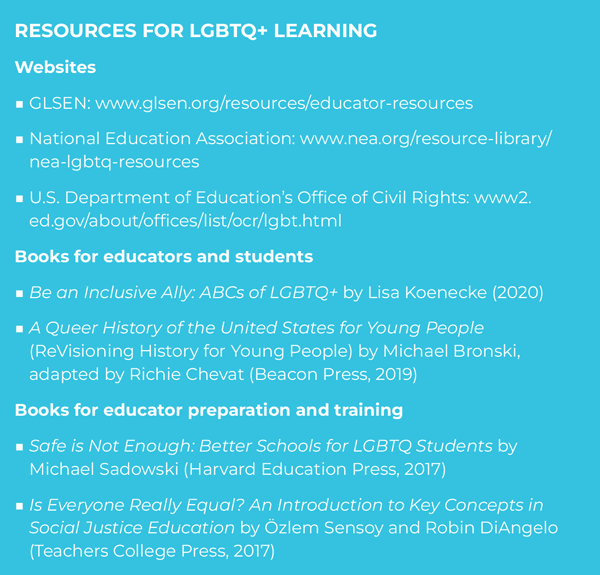
The good news is that resources are available from reputable sources. The following sidebar lists some helpful places to start.
Research and legislative support
We know from existing research that many schools are not safe for LGBTQ+ students or educators, but there are still gaps in the research that would help LGBTQ+ educators and students around the United States. Specifically, there is a dearth of data on schools in the Midwest, rural areas, and elementary and middle schools. Research throughout the U.S. should explore what the climate is like for LGBTQ+ students and school employees, the extent of inclusion in extracurricular activities and clubs, and LGBTQ+ content and perspectives in school curricula. Future research should also take an intersectional approach that considers the experiences of LGBTQ+ educators and students who are people of color, who have disabilities, who come from minoritized faiths, who are immigrants and refugees, who are not native English speakers, and who are experiencing various forms of poverty. This research would inform what additional steps educators should take to create more inclusive, welcoming, and safe schools. It would also help inform lawmakers about how policy and legislation can reduce harm.
Stakeholders at all levels of the educational system can take crucial — even lifesaving — actions to support and celebrate the identities of their LGBTQ+ children, youth, and adults. Now is always the best time to reduce harm and to work together to create positive change. More research, understanding, and conversations must happen if we are to create a more fair, just, and equitable future for all.
References
Asher, N. (2007). Made in the (multicultural) U.S.A.: Unpacking tensions of race, culture, gender, and sexuality in education. Educational Researcher, 36 (2), 65-73.
Bishop, R.S. (1990). Mirrors, windows, and sliding glass doors. Perspectives, Choosing and Using Books for the Classroom, 6 (3), ix-xi.
Blackburn, M.V. & Buckley, J.F. (2005). Teaching queer-inclusive English language arts. International Reading Association, 49 (3), 202-212.
Block, C. (2019). Educator affect: LGBTQ in social studies curriculum. Critical Questions in Education, 10 (1), 1-16.
Bower, L. & Klecka, C. (2009). (Re)considering normal: Queering social norms for parents and teachers. Teaching Education, 20 (4), 357-373.
Brant, C.A. & Willox, L. (2020). Queering teacher education: Teacher educators’ self-efficacy in addressing LGBTQ issues. Action in Teacher Education, 43 (2), 128-143.
Burdge, H., Snapp, S., Laub, C., Russell, S.T., & Moody, R. (2013). Implementing lessons that matter: The impact of LGBTQ-Inclusive curriculum on student safety, well-being, and achievement. Gay-Straight Alliance Network; Frances McClelland Institute for Children, Youth, and Families at the University of Arizona.
Butler, K.L. (1999). Preservice teachers’ knowledge and attitudes regarding gay men and lesbians: The impact of a cognitive educational intervention. Journal of Health Education, 30 (2), 125.
Camicia, S. & Zhu, J. (2019). LGBTQ inclusion and exclusion in state social studies standards: Implications for critical democratic education. Curriculum and Teaching Dialogue, 21 (1-2), 7-20.
Centers for Disease Control and Prevention. (2023). Youth risk behavior survey: Data summary and trends report: 2011-2021.
Crocco, M.S. (2002). Homophobic hallways: Is anyone listening? Theory and Research in Social Education, 30 (2), 217-232.
Crocco, M.S. (2008). Gender and sexuality in the social studies. In L. Levstik & C. Tyson (Eds.), Handbook of research in social studies education (pp. 172-192). Routledge.
Gopalakrishnan, A.G. (2011). Multicultural children’s literature: A critical issues approach. Sage.
Gorski, P.C., Davis, S.N., & Reiter, A. (2013). An examination of the (in)visibility of sexual orientation, heterosexism, homophobia, and other LGBTQ concerns in U.S. multicultural teacher education coursework. Journal of LGBT Youth, 10 (3), 224-248.
Holland, K.F., Mongillo, G., & Paterson, W. (2016). Elementary teachers’ perspectives on the use of multicultural literature in their classrooms. Language and Literacy, 18 (3), 16-32.
Kahn, M. & Gorski, P.C. (2016). The gendered and heterosexist evolution of the teacher exemplar in the United States: Equity implications for LGBTQ and gender nonconforming teachers. International Journal of Multicultural Education, 18 (2), 24.
Kosciw, J.G., Clark, C.M., & Menard, L. (2022). The 2021 National School Climate Survey: The experiences of lesbian, gay, bisexual, transgender, and queer youth in our nation’s schools. GLSEN.
Kumashiro, K. (2004). Uncertain beginnings: Learning to teach paradoxically. Theory into Practice, 43 (2), 111-115.
Lavietes, M. & Ramos, E. (2022, March 20). Nearly 240 anti-LGBTQ bills filed in 2022 so far, most of them targeting trans people. NBCNews.com.
Lopez-Robertson, J. & Haney, J. (2017). Their eyes sparkled: Building classroom community through multicultural literature. Journal of Children’s Literature, 43 (1), 48-54.
Martino, W. (2009). Literacy issues and GLBTQ youth: Queer interventions in English education. In L. Christenbury, R. Bomer, & P. Smagorinsky (Eds.), Handbook of adolescent literacy research (pp. 386-399). Guilford Press.
Martino, W. & Cumming-Potvin, W. (2017). ‘Effeminate arty boys and butch soccer girls’: Investigating queer and trans-affirmative pedagogies. Research Papers in Education, 34 (2), 131-152.
Mayo, C. (2007). Chapter 3: Queering foundations: Queer and lesbian, gay, bisexual, and transgender educational research. Review of Research in Education, 31 (1), 78-94.
Mayo, J.B., Jr. (2013). Expanding the meaning of social education: What the social studies can learn from gay straight allies. Theory & Research in Social Education, 41 (3), 352-381.
Mayo, J.B., Jr. (2017). Sexuality and queer theory in the social studies. In M.M. Manfra & C.M. Bolick (Eds.), The Wiley handbook of social studies research (pp. 254-269). John Wiley & Sons.
Meyer, E.J. (2007). Queering straight teachers: Discourse and identity in education. Peter Lang.
Meyer, E.J. (2010). Gender and sexual diversity in schools. Springer.
Naidoo, J. & Dahlen, S. (2013). Diversity in youth literature: Opening doors through reading. American Library Association.
North, C. (2010). Threading stitches to approach gender identity, sexual identity, and difference. Equity & Excellence in Education, 43 (3), 375-387.
Robinson, K.H. & Ferfolja, T. (2001). ‘What are we doing this for?’ Dealing with lesbian and gay issues in teacher education. British Journal of Sociology of Education, 22 (1), 121-133.
Rowell, E.H. (2007). Missing! Picture books reflecting gay and lesbian families. Young Children, 6 (3), 24-30.
Schmidt, S. (2010). Queering social studies: The role of social studies in normalizing citizens and sexuality in the common good. Theory & Research in Social Education, 38 (3), 314-335.
Steck, A.K. & Perry, D. (2018). Challenging heteronormativity: Creating a safe and inclusive environment for LGBTQ students. Journal of School Violence, 17 (2), 227-243.
Swanson, K. & Gettinger, M. (2016). Teachers’ knowledge, attitudes, and supportive behaviors toward LGBT students: Relationship to gay-straight alliances, antibullying policy, and teacher training. Journal of LGBT Youth, 13 (4), 326-351.
Walker, C. (2023, June 2). In months leading to pride, more than 530 Anti-LGBTQ bills have been proposed across the country in 2023. Truthout.
Wickens, C.M. & Sandlin, J.A. (2010). Homophobia and heterosexism in a college of education: A culture of fear, a culture of silence. International Journal of Qualitative Studies in Education, 23 (6), 651-670.
Wright, T., Smith, N., & Whitney, E. (2019). LGBT educators’ perceptions of safety and support and implications for equity-oriented school leaders. Journal of Educational Leadership and Policy Studies, 3 (2).
This article appears in the December 2023/January 2024 issue of Kappan, Vol. 105, No. 4, p. 46-51.

ABOUT THE AUTHORS

Ferial Pearson
FERIAL PEARSON is an assistant professor of teacher education at the University of Nebraska at Omaha.

Steven Gill
STEVEN GILL is a social studies teacher at Gateway High School, Aurora, CO, and a speech and debate coach at Simpson College, Indianola, IA.