
This four-phase process can help schools evaluate their policies and practices for placing students in standalone reading courses.
Schools seeking to attend to the needs of students who have difficulties with reading often turn to standalone reading intervention classes (hereafter “reading classes”). In many districts, curricular mandates require secondary schools to offer such courses, often as part of an effort to improve educational equity by giving students extra reading support that will improve their outcomes in all their classes. Unfortunately, as educators and researchers, we’ve found that standalone reading classes tend not to be an equitable tool for supporting young people’s reading in secondary schools and can, in fact, be sources of inequity (Brooks & Rodela, 2018; Frankel, 2016; Learned, 2016). To mitigate some of the negative consequences of these interventions, we propose a four-phase process to evaluate and revise how students are placed in reading classes.
Why rethink placement?
Placement policies may appear merely bureaucratic in function. However, in our recent systematic review (or meta-synthesis) of two decades of qualitative research on high school students’ experiences of and perspectives on their reading classes, we found strong evidence to suggest that placement matters (Frankel, Brooks, & Learned, 2021).
When examining the effects of reading intervention placement, it’s important to look at the specific entry and exit criteria schools use (e.g., assessment scores, prior enrollment in intervention), policies for how to apply these criteria, and how those policies are actually implemented in practice. In our meta-synthesis, we identified three common consequences of the most widespread placement policies and practices: confusion, stigmatization, and limited opportunities to learn. And, in many cases, schools’ placement practices have negative implications for students of color.
Confusion
Frequently, across many research studies, students said that they did not understand how they were placed in reading classes. They reported being surprised by their placement because they had not registered for the class and no one had discussed it with them. As a result, many students were unaware of or unclear about the assessments and other criteria used to identify them as needing intervention. Other students said they were aware of their school’s placement policies, but they expressed confusion about how these policies were applied in practice. For instance, a student in Allison Skerrett’s (2012) study reflected:
[S]ince I’ve been in the reading class all my life, I guess they just thought it was regular for me . . . I don’t know why they put me in a reading class this year if I passed the test last year. (p. 69)
In short, students’ confusion about placement reflected a general lack of transparency about policies and inconsistencies in their implementation.
Stigmatization
Over the last 20 years, numerous studies found that students recognized the stigma that sometimes comes with being placed in a reading class and discussed feeling embarrassed, angry, or resentful about their placement. Many viewed their placement as reflecting an inaccurate and limited representation of their literacy abilities. Other students who acknowledged that they had difficulties with certain aspects of reading were frustrated that their reading classes did not actually respond to their specific reading needs and strengths. In both cases, students saw the reading classes as perpetuating a focus on their perceived deficits, rather than helping them grow as readers. For instance, students in one study explained that “being placed in a remedial reading course made them unhappy — they were labeled as remedial when they did not believe themselves to be remedial” (Gomez, Stone, & Hobbel, 2004, p. 401). Finally, some young people reported that other students and educators looked down on them because of these placements.
Limited opportunities to learn
Studies have found that de facto tracking, though less frequently mentioned directly by students, was another consequence of reading placement policies and practices. This manifested in two ways. One type of tracking was vertical — students were enrolled in reading classes across multiple school years (e.g., Brooks & Rodela, 2018), which limited their access to new literacy experiences and electives because reading classes filled those spaces in their schedules. Another form was horizontal, affecting students’ enrollment in other classes while also enrolled in reading. For example, Julie Learned (2016) documented how students in reading classes were clustered together across content-area classes that teachers referred to as “lower skilled” (p. 1292). As a result of both forms of tracking, students in reading classes had limited access to robust educational experiences.
Standalone reading classes tend not to be an equitable tool for supporting young people’s reading in secondary schools and can, in fact, be sources of inequity.
Equity implications
The three consequences described above show how issues of placement are critical for all students, but the consequences for students of color warrant special attention. As researchers and practitioners, we have witnessed how reading classes disproportionally enroll students of color and the role that factors other than those students’ literacy abilities played in placement processes. For example, we have documented Black students being placed in a reading class despite exceeding the cutoff score on the reading assessment (Brooks & Rodela, 2018); teachers using racialized disciplinary data to place students in reading classes (Learned, 2016); and white students leveraging positive relationships with teachers and informal knowledge networks to exit their reading class (Frankel, 2016). Therefore, any discussion of the consequences of placement policies and practices must consider the potential for disproportionate effects on youth of color.
A four-phase approach to rethinking placement
Attending to the consequences of reading intervention placement policies and practices requires transparency and collaboration. To initiate this process, we suggest that schools develop a literacy council made up of a member of the senior administrative team (e.g., assistant principal of curriculum and instruction); relevant instructional specialists (e.g., English language arts and English as a second language teachers, instructional coach, literacy specialist, special education teacher); relevant department heads; a school counselor; and educators who teach reading classes. While the exact composition of the council will vary, a diverse group of leaders and practitioners is necessary to understand the multiple factors that contribute to reading intervention placement policies and practices. In the short term, the council should begin its work by evaluating and revising current policies and practices following the four-phase process outlined in Figure 1 and described below.
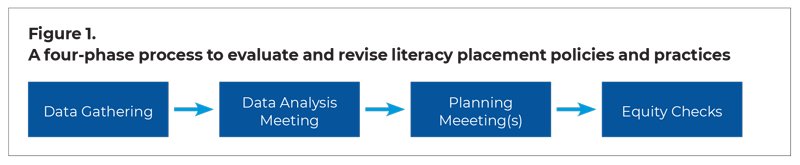
Phase 1. Data gathering
Efforts to improve placement policies are most successful when they respond to the local context. So the council’s work should begin with understanding the conditions at their school. As a first step, subgroups of the council should begin gathering data to ensure that the council’s decisions are attuned to the particularities of their school. We propose that teams gather data in three focal areas that enable them to make transparent and collaborative decisions, with a goal of improving equity.
Placement policies and practices. The first area is guided by two questions:
- Over the past four years, what have been the stated policies, including specific criteria, for placing students in and exiting them from reading classes?
- How have these policies been implemented in practice?
Data sources for answering these questions might include written policies; conversations with reading intervention teachers, counselors, and other school personnel involved in placement decisions; and school records of students who were placed in and/or exited from reading classes.
Impact on students’ opportunities to learn. The second focal area has three guiding questions that will enable the council to understand to what degree inequitable practices and vertical and horizontal tracking are present in their school’s reading placements:
- Over the past four years, how have the racial/ethnic demographics of students in reading classes compared to the overall student population?
- When examining enrollment data for two reading classes during each of the past four years, how many students have taken them for one, two, three, or more years?
- When examining the schedules of students in two reading classes during each of the past four years, what patterns do you observe about students’ access to other courses across the school day?
Community perspectives. The third focal area facilitates collaboration with youth and their caregivers, who are rarely consulted about placement decisions. Individual conversations, surveys, and focus groups with students and caregivers can give council members valuable insights into how reading classes are perceived by the very people they are meant to serve. It is especially important to prioritize students who have experienced multiple years of reading classes, and who can provide unique knowledge about what is and isn’t working. Data gathering in this area is guided by two questions:
- What do youth who are placed in reading classes and their caregivers think about their experiences?
- How do they believe placement policies and practices could be improved?
Once the data-gathering subgroups have collected information, we recommend that they create a written summary report for the full council, showing their findings for each of the guiding questions in all three focal areas.
Phase 2. Data analysis meeting
The purpose of this meeting is for the full council to discuss the summary report from the data-gathering subgroups in detail. We recommend that the council explicitly address four specific issues:
Existence of placement policies. First, the council should review any articulated polices about who enters and exits reading classes. In our experience, most schools have entry policies but do not have corresponding exit policies. Exit policies require educators to define what it means to be a successful reader in their local context, and they provide students with insights into how they can meet those expectations. If such policies do not exist, then it is important to identify what informal (or unarticulated) practices have been used.
Students said that they did not understand how they were placed in reading classes.
Nature of entry/exit criteria. Next, the council should review the available data to determine whether the existing entry/exit criteria provide an accurate representation of students as readers. For example, placement decisions should use multiple measures so that a single low grade or assessment score will not cause a student to be automatically enrolled in a reading class. Exit policies should include multiple pathways for students to leave a reading class, particularly when the class is not serving them effectively. All criteria and measures should be informed by council members’ expertise and robust conceptualizations of literacy, and information unrelated to students’ reading (e.g., behavioral records) should not be included as part of the criteria. In this part of the analysis, it is essential to elevate data on students’ perceptions of how well the placement criteria represent them as readers.
Implementation of policies. The council should next turn to the implementation of the school’s placement policies (both those that are clearly articulated and those that were previously unarticulated), with an emphasis on how bias can affect how policies are applied. If the council identifies a disconnect between stated policies and how they are implemented, members should consider the reasons for this disconnect and its impact on students. For example, the council might explore whether horizontal or vertical tracking is associated with placement in a reading class or examine how placement policies appear to affect students from different racial and ethnic groups. Considering these types of issues requires council members to engage in an honest discussion about disproportionality and the de facto tracking that can restrict students’ access to rich learning opportunities both across the school day and across years of schooling.
Communication of policies. Finally, the council should focus explicitly on how information about placement policies is communicated to students and their families. Depending on existing methods of communication, the council might need to refine processes or create new ways of engaging youth and their families in placement decisions.
Phase 3. Planning meeting(s)
After the data analysis meeting, the council should schedule at least one follow-up planning meeting. Separate meetings for data analysis and planning ensure council members have sufficient time to think about what they learned through the analysis process, reflect on those findings, and consult with other stakeholders (e.g., students, teachers, caregivers) before proposing or enacting evidence-based changes. The purpose of the planning meeting(s) is, first, to determine placement policies (e.g., entry and exit criteria) and, second, to create a system of “equity checks” (detailed below) for implementing those policies that attends explicitly to areas of actual or potential bias, limitations on students’ opportunities to learn, and ways of increasing the transparency of communication with students and their families.
Phase 4. Equity checks
After new or revised placement policies have been implemented, the council should convene to engage in equity checks each semester to ensure that placement processes continue to be enacted as envisioned and designed. These check-ins are also opportunities to revise placement policies, particularly in cases where unintended consequences emerge that need to be rectified. They help maintain focus on equity through transparency and collaboration. To this end, equity checks should include two key review processes:
- The evaluation of selected class periods to ensure that placement policies (including both entry and exit criteria) have been implemented as planned and with explicit attention to possible racial/ethnic disproportionality and tracking.
- The collection of reports from student conversations, surveys, or focus groups about their experiences with the placement process and with their reading classes more generally.
Council convenings that focus on these questions can become a routine opportunity for equity in action by ensuring that review and discussion of placement policies and practices is an ongoing process that includes youth, their families, and multiple other stakeholders.
Looking toward the long term
This process is only the start of the literacy council’s work. While this four-phase process provides a pathway for addressing students’ and families’ confusion about placement, at best it will only mitigate students’ experiences of stigmatization and limitations on their opportunities to learn. Therefore, while we believe that the short-term work of the council will help to ameliorate some of the day-to-day inequities that students tend to encounter in reading classes, we also hope that it will lead to a longer-term agenda to reimagine literacy teaching.
In the longer term, the council should contribute to schoolwide efforts to move away from standalone reading classes and toward robust, authentic, and embedded literacy learning within content-area classes. We encourage education leaders who are ready for this next step to work alongside their literacy councils to support teachers in creating these opportunities.
References
Brooks, M.D. & Rodela, K.C. (2018). Why am I in reading intervention? A dual analysis of entry and exit criteria. The High School Journal, 102 (1), 72-93.
Frankel, K.K. (2016). The intersection of reading and identity in high school literacy intervention classes. Research in the Teaching of English, 51 (1), 37-59.
Frankel, K.K., Brooks, M.D., & Learned, J.E. (2021). A meta-synthesis of qualitative research on reading intervention classes in secondary schools. Teachers College Record, 123 (8), 1-14.
Gomez, M.L., Stone, J.C., & Hobbel, N. (2004). Textual tactics of identification. Anthropology and Education Quarterly, 35 (4), 391-410.
Learned, J.E. (2016). “The behavior kids”: Examining the conflation of youth reading difficulty and behavior problem positioning among school institutional contexts. American Educational Research Journal, 53 (5), 1271-1309.
Skerrett, A. (2012). “We hatched in this class”: Repositioning of identity in and beyond a reading classroom. The High School Journal, 95 (3), 62-75.
This article appears in the March 2022 issue of Kappan, Vol. 103, No. 6, pp. 41-45.

ABOUT THE AUTHORS

Maneka Deanna Brooks
MANEKA DEANNA BROOKS is the associate dean for academic affairs and educator preparation in the College of Education and an associate professor of reading education in the Department of Curriculum and Instruction, Texas State University. She is the author of Transforming Literacy Education for Long-Term English Learners: Recognizing Brilliance in the Undervalued .
Katherine K. Frankel
KATHERINE K. FRANKEL is an assistant professor of literacy education in the Department of Language and Literacy Education, Boston University, MA.
Julie E. Learned
JULIE E. LEARNED is an associate professor in the Department of Educational Theory and Practice, University at Albany, State University of New York.