| 🏆 BEST: The best story of the week is New Data Reveal a 432-Hour In-Person Learning Gap Produced by the Politics of Pandemic Schooling by Asher Lehrer-Small in The 74. Lehrer-Small dissects data provided by school reopening tracker site Burbio to show just how much politics influenced back-to-school decisions across 460 districts. From September to May, students in states that voted for Trump in 2020 were given the option of learning in person nearly 75% of the time. Students in states that voted for Biden had that option only 38% of the time. The differences were largest in the late fall and early winter. Lehrer-Small, who is based in Providence, Rhode Island, noted that his Democratic state bucked the trend with local leadership pushing hard for reopening earlier than most. But despite some outliers, there was a distinct pattern to reopening: “It started to look like an electoral map pretty intensely by the mid- to late fall,” Burbio cofounder Dennis Roche told Lehrer-Small.🏆 RUNNER-UP: This week’s runner-up is Can honors and regular students learn math together? A new approach argues yes. by Laura Meckler in the Washington Post. Meckler looks at the math curriculum debate raging in California, where the state has recommended overhauling the “tracking” system that sorts students into different levels of ability. In California and other places where tracking is prevalent, white and Asian students are more likely to be in the higher tracks, while Black and Latino students are more likely to be in the lower tracks. The LA Times, EdSource, and other California outlets have been following the story, too, but Meckler points out what’s at the heart of the debate: “Where some see a long overdue reckoning with systemic racism, others see an unsettling and overly broad focus on matters of race, and a threat to children who are succeeding in the current system.”
To get daily education headlines and education news events, follow @thegrade_.
|
FAMILIES STAY HOME, DISTRICTS LIMIT REMOTE
The big story of the week, according to us.
|
|
|
The big story of the week is the families who are choosing to continue remote learning — or dropping out of their districts altogether. At the same time, some districts are narrowing or eliminating remote options for next year.
🔊 After a tough year, schools are axing virtual learning. Some families want to stay online. (USA Today)
🔊 LAUSD’s Planning A Full-Time Reopening In Fall — But Many Black Families Prefer Distance Learning (LAist)
🔊 Some Black parents see less bullying, racism with online learning and are keeping kids home (LA Times)
🔊 For Asian Americans Wary of Attacks, Reopening Is Not an Option (NYT)
🔊 Schools and trust: What works for communities of color (CS Monitor)
🔊 One Big Reason Schools Are Ditching Remote Learning: The Cost (EdWeek)
🔊 CA schools move ahead with fall distance learning plans despite limitations (EdSource)
🔊 Districts roll back plans after lawmakers failed to extend the life of virtual schools (Dallas Morning News)
🔊 Schools to fully reopen in fall in PG County, with option for youngest students (Washington Post)
🔊 They Rage-Quit the School System—and They’re Not Going Back (Wired)
Did someone forward you this newsletter? You can sign up here.
RETHINKING K-12 EDUCATION COVERAGE
New from The Grade |
|
|
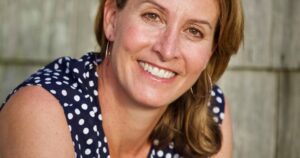
Reporter Jenny Anderson (above) covered finance for 15 years before switching to the education beat, where she was shocked to discover the extent to which education was perceived as a beat “written by women for women in charge of making sure the children are OK” — and how under-resourced it was in terms of reporters and editors.
In a new column for The Grade, Anderson reimagines what national education coverage could look like. Her ideas include enlarging national education teams to make them look more like the health and climate change teams at big outlets, and reenvisioning the education beat as a learning beat beyond K-12 and postsecondary schooling.
In the aftermath of the pandemic, “we can’t afford to re-relegate education coverage to a ‘soft’ topic that’s covered by just a relative handful of full-time K-12 national education reporters and a revolving door of national education editors,” Anderson writes. “The beat is too big and too important for that.”
“Felt that in my bones,” tweeted the Washington Post’s Moriah Balingit in response to Anderson’s description that education “is treated with the same sexism that dominates the care economy: written by women for women in charge of making sure the children are OK.”
She was not alone among education reporters. NPR’s Anya Kamenetz tweeted out the column and tagged her bosses. The Detroit Free Press’ Lily Altavena praised the piece and added another perspective: “I also someday hope we can stress the importance of local ed journalism, too, and interrogate the dynamics in local newsrooms around education.” |
|
| DEBUNKING MEDIA COVERAGE OF RANDI WEINGARTEN |
|
|
American Federation of Teachers head Randi Weingarten has made headlines lately touting her full-throated support of school reopening in the fall. But “don’t be fooled by her victorious, revisionist narratives” — or by misleading media coverage of her efforts, freelance parent advocate Rebecca Bodenheimer wrote in a column for The Grade last week.
“We know that neither Weingarten nor the unions led school reopening efforts,” Bodenheimer writes. “And we’ve seen how prestigious media outlets have been complicit, consistently giving Weingarten a platform to take credit.”
|
MEDIA TIDBITS
Thought-provoking commentary on the latest coverage.
|
|
|
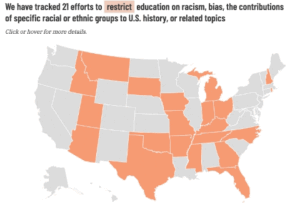
ABOVE: Twenty-one states are moving to restrict instruction about systemic racism while nine are moving to enhance it, according to Chalkbeat’s Efforts to restrict teaching about racism and bias have multiplied across the U.S.
📰 CONTEXTUALIZING CRITICAL RACE THEORY COVERAGE: There’s lots of debate about how race is taught in schools — and lots of coverage of the conflict. But some of it appears to be part of a coordinated political strategy, and some of the coverage runs the risk of amplifying the conflict as much as it’s explaining the debate. This isn’t the first time that concerns about progressive education have generated backlash, so education reporters need to do all they can to contextualize the conflict and reality-check everybody’s claims. This Tennessean story is a good example of how an education reporter can cover the story: Critical race theory isn’t taught in Tennessee schools. Here’s what is being taught about race. Here’s a May EdWeek explainer that is also very good: What Is Critical Race Theory, and Why Is It Under Attack?. “You should look at how the AJC is covering it,” noted Tracy Brisson. “It’s joint stories between the ed reporter and politics. Then they have an Ed columnist with her own takes on her Facebook page.” For example: Considering race and racism in Georgia classrooms: Here are some helpful definitions. “Is CRT currently taught in Georgia schools?” AJC staff wrote. “It is unlikely that CRT itself is being taught in schools, but the concept may have influenced teachers as they wrote their own curriculum and led classroom discussions.” The anger and feelings are real. The story is legitimate to cover. But there’s no good reason to take part in amplifying what seems like a moral panic.
📰 TEACHER SHORTAGE HYPE COVERAGE: This recent NBC News story is a good reminder that we should all try to make teacher shortage/mass retirement stories smarter this summer and fall. Too often, they’re speculative and alarmist, overstating the available information and omitting the historical record. Their effect is to reinforce the notion that teachers are endangered and exhausted and to short-circuit a deeper discussion about improving the supply of high-quality teachers. Increasingly, these stories are being called out. “I don’t want to pick too much on this piece, but it is really emblematic of some not-great ‘teacher shortage’ news coverage,” tweeted Matt Barnum.
📰 COVERING EDUCATION SPENDING: Covering school spending is going to be one of the main challenges for education reporters this summer and fall. We’ve got a piece in the works about how to do this well. Meantime, read up on some of the coverage that’s already been produced — some of it quite good! New Education Guidance Aimed at Ensuring Equity in Coronavirus-Relief Spending (US News), Pandemic relief money is flowing to class-size reduction but research evidence for it isn’t strong (Hechinger Report).
📰 ARE WE THERE YET? Yes, according to US News: Schools Creep Closer to 100% Providing K-8 In-Person Instruction. But that’s based on what districts are offering for some grades and some kids. Only 54% of districts currently give students in all grades the option of full-time, in-person instruction, according to the New York Times, and a million kids are still learning virtually in just NYC and LA. For a third perspective somewhat between the two, check out EdWeek’s description: For the First Time in the Pandemic, a Majority of 4th Graders Learn in Person Full Time.
Did someone forward you this newsletter? You can sign up here.
|
PEOPLE, JOBS
Who’s going where & doing what?
|
|
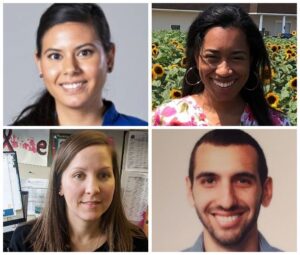
| ABOVE: Clockwise from top right, Gabrielle LaMarr LeMee, Jacob Carpenter, Jacqueline Rabe Thomas, and Ana Ley.🔥 Comings and goings: Chalkbeat data editor Gabrielle LaMarr LeMee is the latest to leave the outlet. “I have loved collaborating on some really fun data projects with Chalkbeat’s incredibly smart reporters on important education topics across the country,” she wrote. “I have also been impressed by Chalkbeat’s eye toward growth in terms of types of storytelling, DEIB efforts, and coverage expansion.” Jacob Carpenter is leaving the Houston Chronicle to move to Boston. After helping launch the CT Mirror 12 years ago, Jacqueline Rabe Thomas is leaving the outlet to join the investigative team at WNPR. I profiled her for The Grade. No word yet on whether they’re going to replace her. Ana Ley is now supervising the ed desk at the Virginian-Pilot.
🔥 Reshuffle at the LA Times: As you may have seen, Sonali Kohli is leaving the LA Times to work on a YA nonfiction book and “figure out how to create good journalism for young people that actually reaches them.” Melissa Gomez filled in and will stay on the beat and continue covering youth culture. Paloma Esquivel has been promoted to education investigative reporter, a new position that “recognizes how the post-pandemic education world is going to require rigorous digging and accountability journalism.” Education editor Stephanie Chavez tells us that higher ed reporter Nina Agrawal is now on maternity leave, with Colleen Shalby filling in. Veteran Howard Blume continues to cover LAUSD, and Teresa Watanabe covers the University of California system.
🔥 Jobs: The Post-Courier in Charleston is launching an Education Lab! That means jobs. The 19th is hiring an education reporter to “tackle the gender and racial disparities, challenges and success stories in our nation’s K-12 schools, as well as the pipeline to post-secondary education.” Connecticut Public Radio is hiring an education reporter. The Chronicle of Higher Education is hiring a staff writer and engagement editor. And Chalkbeat is hiring for multiple positions, including reporters in Indiana, Chicago, and Tennessee.
🔥 Kudos: In NYC, NY Daily News reporter Michael Elsen-Rooney got the scoop that everyone else tweeted about this week with his story on the ending of the controversial absent teacher pool (aka “rubber room” teachers). Elsen-Rooney is one of the city’s most dogged local education reporters, and if you’re not following him, you should.
🔥 Books! Former Spencer Education Journalism Fellow Annie Murphy Paul’s latest book, “The Extended Mind,” is out. Here’s a review from WSJ. Former Washington Post education reporter Karin Chenoweth, now at the Education Trust, has a new book called “Districts that Succeed”: “At the heart of these districts are educators who believe in the capacity of all kids to learn, grow, and achieve — and in the responsibility of adults to help them do so.” And freelancer Danielle Dreilinger’s book “The Secret History of Home Economics” was included on Civil Eats’ list of 34 noteworthy food and farming books for the summer and praised for its “eye-opening” quality. Congrats to all!
|
EVENTS
What just happened & what’s coming next?
|
|
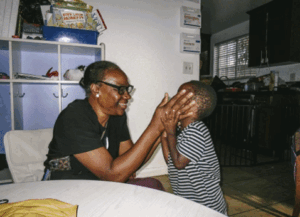
| ABOVE: LAist unveiled a lovely photo essay package this week on early education and child care. Called “Child Care Unfiltered,” the series gives a look at all the roles that child care providers play and how their work has changed in the pandemic. Catch KPCC early childhood reporter Mariana Dale talking about the series at a virtual event on June 17.⏰ Conferences: The IRE 2021 conference is June 14-18, and it will be virtual again (register here). Don’t miss the Monday noon Eastern panel on investigating educational inequities with the Dallas Morning News Ed Lab editor Eva-Marie Ayala, Oaklandside’s Ashley McBride, and EdWeek’s Daarel Burnette II. And if you’re a member of NAHJ, you can join their international training conference and career fair June 16-17.
⏰ Awards: Winners of the just-announced Livingston Awards for young reporters include Washington Post reporter Hannah Dreier for her portrait of a teen seeking asylum from Honduras. We profiled her work as a ProPublica immigration reporter a few years ago. Detroit News higher ed reporter Kim Kozlowski was named journalist of the year by the Society of Professional Journalists Detroit branch. And SPJ Detroit named Chalkbeat’s Koby Levin one of its young journalists of the year. The Pulitzers will be announced shortly — will there be any education stories recognized?
⏰ ICYMI: In this morning’s The Daily podcast, the New York Times celebrated commencement in this follow-up to the Odessa series. And former NYT labor reporter Steven Greenhouse and ProPublica’s Alec MacGillis appeared on a panel titled “COVID-19 and How Teachers Unions and School Districts Responded to the Pandemic.”
THE KICKER
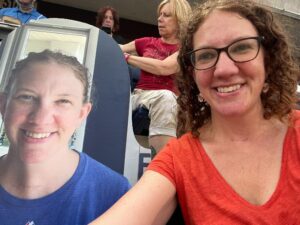
|
“Sitting next to myself at the ballpark and it’s not at all weird,” tweeted Philadelphia Inquirer education reporter Kristen Graham.
|
|
|
That’s all, folks. Thanks for reading!
By Alexander Russo with additional writing from Michele Jacques and Colleen Connolly.
|
|
|
|
|
|
|
|
|
|
|
|
|