In each edition of Kappan, we ask our Educators Rising students to answer questions related to our editorial focus, and we run those answers in our Students Speak column. For this issue, with Understanding Today’s Students as our focus, we asked them:
“What do you wish adults in your school understood about students’ lives today? What do you think would change at school if more adults really understood what your lives are like?”
We got a large number of responses to the questions. These high school students and first-year college students are from different parts of the country: big and small districts, rural areas, suburbs, and cities. Despite their differences, their answers were remarkably similar:
- They feel daily pressure to achieve and fit in.
- They want us to understand how different schools are from when we attended and make room for change.
- They need more flexibility and understanding about their emotional and mental states.
- They’d like more emphasis on mental health in schools.
- They need permission to rest.
I urge you to read the Students Speak column carefully.
In “Stressed, tired, and yearning for support,” authors Denise Clark Pope, Sarah Miles, Megan Pacheco, and Caitlin Ciannella analyzed data from the 2024 Challenge Success Student Voice Report. Much of what they found mirrors what our Educators Rising students told us: They face unhealthy levels of stress, and they want adults to help them.
Even classroom teachers can find it hard to find the time to tune into their students beyond instruction. Administrators and other educators, including those in higher education, are farther away from the classroom and today’s students. However, they make decisions that impact students’ lives, so they, too, need to hear what students are saying.
Just as crucial as asking and listening is making visible changes based on students’ ideas and concerns. These students aren’t just venting or letting off steam; they are asking for our help.
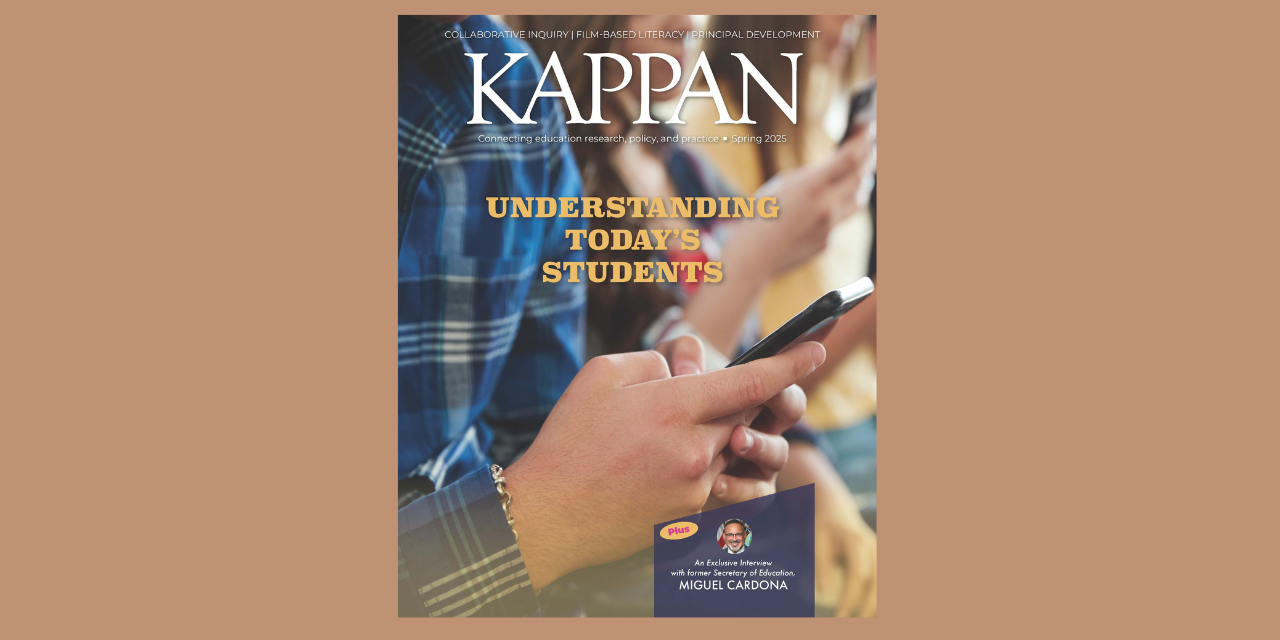
This issue also features an interview by PDK CEO James Lane with former Secretary of Education Miguel Cardona. The two spoke in an episode of PDK’s podcast, There’s Power in Teaching, available on the PDK website or on the usual podcast platforms.
If you are a Kappan print subscriber or PDK member, you might notice some changes with this issue. Lane wrote in his December column that Kappan is changing its frequency this year. You can expect new print issues to arrive in March, May, September, and December. Since Kappan is now a quarterly publication, we are renaming these issues as Spring, Summer, Fall, and Winter.
These double issues will deliver the same amount of content as before, and we are posting new articles at Kappanonline.org before they are published in print. Our digital-first publishing approach is designed to ensure our readers have access to our most recent articles while also enjoying the print edition.
I will end with a particularly salient response from our Educators Rising students. Ivy Grace Smith, who is a freshman at The University of Alabama, wrote:
“Change is inevitable, and education is a catalyst for change. We should let change do its thing.”
This article appears in the Spring 2025 issue of Kappan, Vol. 106, No. 5-6, p. 4.

ABOUT THE AUTHOR

Kathleen Vail
Kathleen Vail is editor-in-chief of Kappan magazine.
Visit their website at: https://pdkintl.org/