The December 1983 Kappan featured the story of Clinch School in Hawkins County, Tennessee. The student body comprised only 161 students in 12 grades, the building was old and decrepit, the curriculum included only one science class and no math beyond algebra. Author Faith Dunne explained that a new high school had been built 28 miles away in Rogersville, but only five of the 50 high school-age students in Clinch Valley chose to attend, and the community was ready to “declare political war to protect” their small local school (“Good government vs. self-government: Educational control in rural America,” p. 253).
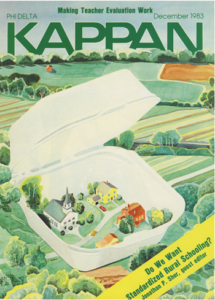
December 1983
Today, the Clinch School is still open as a K-12 school serving 140 students, according to its website. Its story, as presented in Kappan, encapsulates many of the questions surrounding rural schools that have been covered in the magazine over the last 100 years.
The purpose of school
The students who left the Clinch School in favor of the large high school were those with college aspirations. But, as Dunne explained, many Clinch School parents understood that their children would probably stay in the community, and they saw little value in sending them to a school where they might be looked down on as “hicks.” This speaks to the question of whether schools are intended to help students live in their present communities or to give them a way out.
In November 1922, Geo. A. Works (“Economic aspects of rural education”) observed that the general consensus of the day was that rural schools were meant to instill in young people an appreciation for rural life and a desire to remain on the farm. Works, however, espoused a different view:
The school system should never be used to hold children in the country because it is their place of birth any more than it should be an instrument for fixing other class distinctions based on occupation or social standing of parents. The basic factor that should and does determine the number of people on farms is an economic one. (p. 9)
The declining population in rural areas, he explained, was not a crisis or a sign rural schools were doing something wrong. It was merely a byproduct of the mechanization of agriculture, which meant fewer people were needed to do the work of farming and people were more likely to find work in population centers. People would go where the opportunities were, and schools should be equipped to prepare students for those opportunities.
But the desire to encourage young people to stay in their rural communities persisted. In April 1943, L.G. Ligutti (“Keep youth on the land”) took a romantic view, waxing eloquent about the virtues of living on the land or creating a home there: “The ones who have a real sense of values, who love independence, who want stability and security, who desire to live on through future generations — in other words, the best will remain on the farm” (p. 147). In the same issue, Frank Cyr (“The public school and rural youth”) was more pragmatic, but agreed that schools should focus on areas that were likely to be of value to rural students, most of whom would not attend college:
All young people should have opportunity to study and understand democracy, its ideals and organization; the social and economic life of their own country and how it is carried on; and the forces which are playing upon and reshaping the local community and the world. And each youth upon finishing high school should have a first-hand knowledge of occupations in his community and be on his way toward vocational competence in some occupation. (p. 162)
By the 1950s, it was clear that the migration away from rural areas was not likely to cease, and this left rural schools with what M.L. Cushman described in October 1954 as “ the unique problem of educating for rural living these children who will remain there plus the problem of educating for the urban environment the 40 to 60 per cent who ultimately will live in cities” (“The reality of rural education,” p. 5).
Consolidation and community
One reason the Clinch School was under threat was its small size, which made it difficult to offer the more robust education needed to prepare students for both the rural and urban environments. As populations in rural areas declined and expectations for what schools should provide grew, a movement to consolidate small (often one-room or one-teacher) rural schools came to the fore. But, as in the case of the Clinch school, many communities resisted this trend, fearing the loss of a key community asset.
In April 1937, C.L. Eggert (“Modern trends in rural education”) explained that early efforts at consolidation were clumsily managed, with leaders attempting to build schools that did not take rural ideals into account. And the time students had to spend on buses, traveling to and from consolidated schools, was already beginning to show up as a problem. Overall, however, Eggert endorsed the idea of consolidating at least some functions of school, such as teacher certification, which could be better handled at the state, rather than the county, level.
“The needs of these schools can be ignored only by dropping the pretext that the education of every child matters.” — Marty Strange, March 2011
Larger consolidated schools were able to offer more services to students, families, and communities, as Maurice Seay described in October 1954 (“Community schools as rural centers”). His ideal was that such schools could be available not just to educate students but to support the community, offering space and leadership for both educational and recreational activities. However, this would only be possible if consolidation plans considered actual community boundaries:
When school districting is done arbitrarily according to political or administrative boundaries, important community boundaries may be and frequently are ignored. All too often school bus routes reach into several different communities and take the school age children to an open space not identified with any community. Obviously the study and solution of problems existing in an actual community are difficult in such a school. (p. 17)
In June 1969, Horace Aubertine (“The rural student speaks out”) shared college students’ perspectives on their rural high schools and found that their smaller size brought both advantages and disadvantages. Students appreciated the ease of forming relationships, including across races, in their small schools, and they enjoyed the opportunity to participate in athletics and extracurricular activities that might be limited to top students in a larger school. But they found that the curriculum was too limited, particularly in the sciences, and this affected their choices when it came to college majors.
The question of control
The people of Clinch Valley wanted a say in their children’s education. As Dunne noted in 1983, this desire was rooted in a Jeffersonian ideal in which individuals and localities managed their own fates, with limited interference by the government:
Scattered across the country are small, generally homogeneous communities that still try to run their political lives as though the United States were not a massive nation-state with a single, centralized culture, fostered by a common kind of schooling and cemented by universal access to the monolithic messages of television and McDonald’s. (p. 254)
In October 1995, Alan DeYoung and Barbara Kent Lawrence (“On Hoosiers, Yankees, and mountaineers”) explored why rural citizens tend to be suspicious of outside experts and their ideas for improving schools. Many saw these experts as trying to lure children away from their communities and into cities. They fought consolidation efforts because they believed “closing schools or making them independent of local communities . . . erodes the meaning of community and whatever traditional culture remains” (p. 111). However, their fight often turned out to be “a losing war over the control of their local schools and of the purpose toward which their children’s education is directed” (p. 105). But, even if rural communities retained control, the question of what they want for their schools is not easy to answer. DeYoung and Lawrence found that some rural citizens believed rural life was preferable to urban life, and others were interested in urban opportunities but lacked the resources to get there.
The reality is that there may be no single curriculum, structure, or governance style that will work equally well in every rural community and for every rural student. As Marty Strange wrote in the March 2011 Kappan (“Finding fairness for rural students”):
These communities and the schools that serve them are a lot more complex than those who succumb to rural stereotypes want to acknowledge, let alone understand. But with one-third of U.S. public school students in rural or small-town schools, some of them in the poorest communities in the nation, the needs of these schools can be ignored only by dropping the pretext that the education of every child matters. School funding systems should reflect the real differences among rural school districts, just as they should reflect the differences among all districts. “Rural” is not per se a favored class. But neither is it a category to dismiss as bygone or backward or insignificant, as has too often been the case. (p. 15)
This article appears in the December 2021/January 2022 issue of Kappan, Vol. 103, No. 4, pp. 5-6.

ABOUT THE AUTHOR

Teresa Preston
Teresa Preston is an editorial consultant and the former editor-in-chief of Phi Delta Kappan and director of publications for PDK International, Arlington, VA.
Visit their website at: https://prestoneditorial.com/