
In New York City, the Mastery Collaborative is working with more than 40 public schools to implement competency-based learning.
Ask students in a traditional classroom what they’re working on and why, and they might respond, “We’re doing a worksheet on the French Revolution, and we need to hand it in to get a good grade.”
Ask the same of students in a mastery-based classroom, and they will likely be able to tell you specifically what skills they are building, and how this activity fits into the overall arc of learning for the course. In fact, two students working on the same assignment might inform you that they’re focusing their respective efforts on different learning goals, according to what each has already mastered and what objectives still lie ahead for each. One may be analyzing primary and secondary sources, while another may be focused on evaluating the quality of supporting evidence.
These learners are working (often at their own pace) to gain independent mastery of a set of learning goals that are explicit and shared from the start. The learning goals — also called outcomes, learning targets, competencies, objectives, or proficiencies — become the coin of trade for everything that happens in the classroom. Every assignment, lesson, assessment, and project builds independent mastery of the learning goals.
A revolution of a different sort
In mastery classrooms, many learning goals are skills-based. The focus is on supporting students to build durable skills they can use in life after high school. In that unit on the French Revolution, students still learn about the storming of the Bastille, but the focus may be on identifying what societal forces catalyze a revolution — and less on memorizing names and dates. The content gets its due, but the main focus of learning is to build skills that students can take with them into their lives beyond the building.
En route to building mastery, students often collaborate on projects and presentations, but each learner moves at a flexible pace toward mastery. The feedback they receive from the teacher and their peers is primarily about the intended outcomes, and it helps them develop metacognition about where they are in the learning arc and what they need to do next to improve. Figure 1 shows how mastery-based learning differs from traditional learning.

We in the Mastery Collaborative (www.masterycollaborative.org) have found that a mastery-based approach can make teaching and learning:
- More transparent because all expectations are shared.
- More intentional and focused because learning activities, feedback, and next steps are all pegged to progress on clear learning outcomes.
- More metacognitive and multidimensional, reaching higher into Bloom’s Taxonomy because demonstrating independent mastery requires rich assessment opportunities and because students learn to keep their goals, strengths, and challenges in mind as they proceed.
- More objective because criteria for success are shared from the outset. In mastery-based learning, a student and teacher discuss specific next steps to gain better footing on the path to mastery.
- More based in a growth mindset because earning a “not yet” or “approaching mastery” empowers learners to understand that putting in focused effort is the path to success and that everyone can succeed.
The Mastery Collaborative
So who are we, and how do we know this approach works? In June 2016, the Mastery Collaborative completed its first year as an official program, working with more than 40 public middle and high schools across the five boroughs of New York City to improve, document, and advocate for mastery-based teaching and learning. Our mandate — to support the implementation of mastery shifts in dozens of schools — makes our workdays fascinating. The schools we visit are wildly complex microorganisms, each peopled by some of the most thoughtful, effective, brave, and student-centered educators one could hope to encounter.
Who we serve
The New York City Department of Education has more than 1,800 schools and 1.1 million students — nearly twice as many students as the next largest district, Los Angeles. So while working with more than 40 schools might seem like a lot, we know our community is relatively small — but it is growing steadily. Schools join the Mastery Collaborative via a rolling admission process. The program is run by a small team, just three of us from the Department of Education’s Office of Postsecondary Readiness.
About 15,000 students attend the 42 member schools in the Mastery Collaborative. Of those students, 74% live below the poverty line, 17% have recognized disabilities, and 21% are English language learners. Our students are 21% black, 50% Hispanic, 13% Asian, and 13% white. About a quarter of the schools are international schools that serve students from other nations who speak dozens of native languages other than English and who come to our schools with a huge variety of life and academic experiences. Some students lack prior formal education experiences. A mastery approach has to work for all of them.
Several principles underlie our work. We want to level the playing field for students, increase transparency, boost student agency, build skills that prepare students for postsecondary life, promote a shared understanding of learning goals, and offer a personalized focus on the learners’ path to mastery. To do so, we knew we would need an explicitly culturally responsive approach to mastery innovations, and we knew this lens would be every bit as important as the more academics-focused aspects of our work. Under this approach, each school is challenged to design practices that interrupt inequity and that contribute toward creating an ever clearer, fairer, and more equitable learning environment.
Another distinctive feature of New York City’s huge district is that schools largely cut their own path toward continuous improvement. Each school is accountable for getting students to success; each school determines its schedules, budgets, and philosophy. The Department of Education supports this enormous number of schools by creating opportunities that schools can opt into for various kinds of collaboration and support. The Mastery Collaborative is one of those opportunities.
Our approach
Our community relies heavily on sharing ideas, practices, models, resources, and conversations. We begin every Mastery Collaborative gathering with an activity called speed rounds, in which participants share quick responses on specific mastery-related topics. It wakes us all up and focuses us, and it’s a great way to meet people from other schools. Here are some questions we’ve asked educators to respond to:
- Which students feel most at home in your school? How do you know?
- Describe one obstacle your school has faced in implementing mastery-based practices.
- My favorite way to keep students focused and motivated is _______________.
- To design an effective system of outcomes, adults in our school need ________________.
- Why does mastery work for the students in your school?
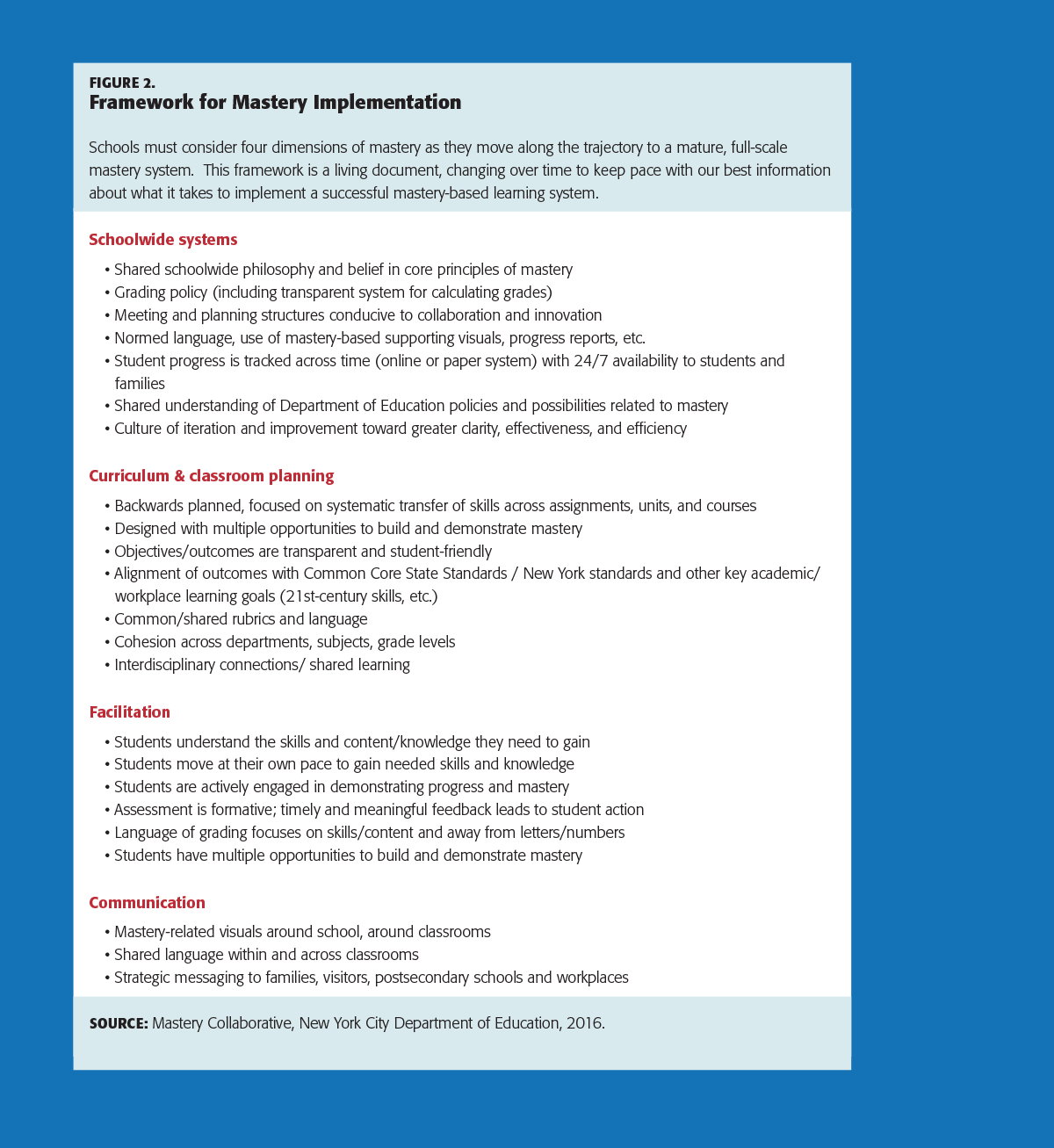
Before the school year begins, a team at each school sets goals to improve aspects of their mastery work. Our Framework for Mastery Implementation (see Fig. 2) provides a common language and structure for discussion and planning. When we meet, intentionally paired or grouped schools give each other feedback about goals and implementation.
Our community has eight Living Lab schools that practice schoolwide mastery and have something exemplary about their practice that others can benefit from. Teachers and school leaders from our Living Lab schools are our sounding board, our critical friends, and our codesigners of professional development.
They’re also our hosts. The Living Lab schools held a series of visits last spring, with each school presenting on an aspect of mastery and giving visitors the opportunity to experience life in Living Lab mastery-based classrooms. Visitors came from other Mastery Collaborative schools, the central office of the Department of Education, education graduate schools around the city, and even from other states. The visits were rich and useful, so we’ll be doing Living Lab visits again this coming spring.
Most Mastery Collaborative schools are known as Active Members, who may be earlier on in the progression toward schoolwide mastery or who may have schoolwide systems up and running but don’t have the bandwidth to take on a leadership role in the community. Our Active Member schools add valuable resources, practices, questions, and ideas to our ongoing, collective investigation about how to get better at this.
All schools add resources to a community wiki, posting rubrics, sets of outcomes, student handbooks about mastery, and examples of mastery-based grading policies. Schools can also post more privately in our member sandbox and seek feedback from others on resources that are still in draft. Because our schools are across the five boroughs of New York City, we run monthly online conversations about focused topics. It’s easier to participate by logging on rather than hopping on a subway at the end of a long day of teaching.
We ask all Mastery Collaborative schools to create a mastery team of four to eight educators (a school leader and teachers who lead the mastery work). At most schools, this team meets monthly. We sit in on the Living Lab school monthly meetings so we can document their work. We spend a good deal of time traveling to all our member schools, learning from them, conversing, coaching, visiting classrooms, talking with students, and documenting important shifts that can light the path for others.
In their own words
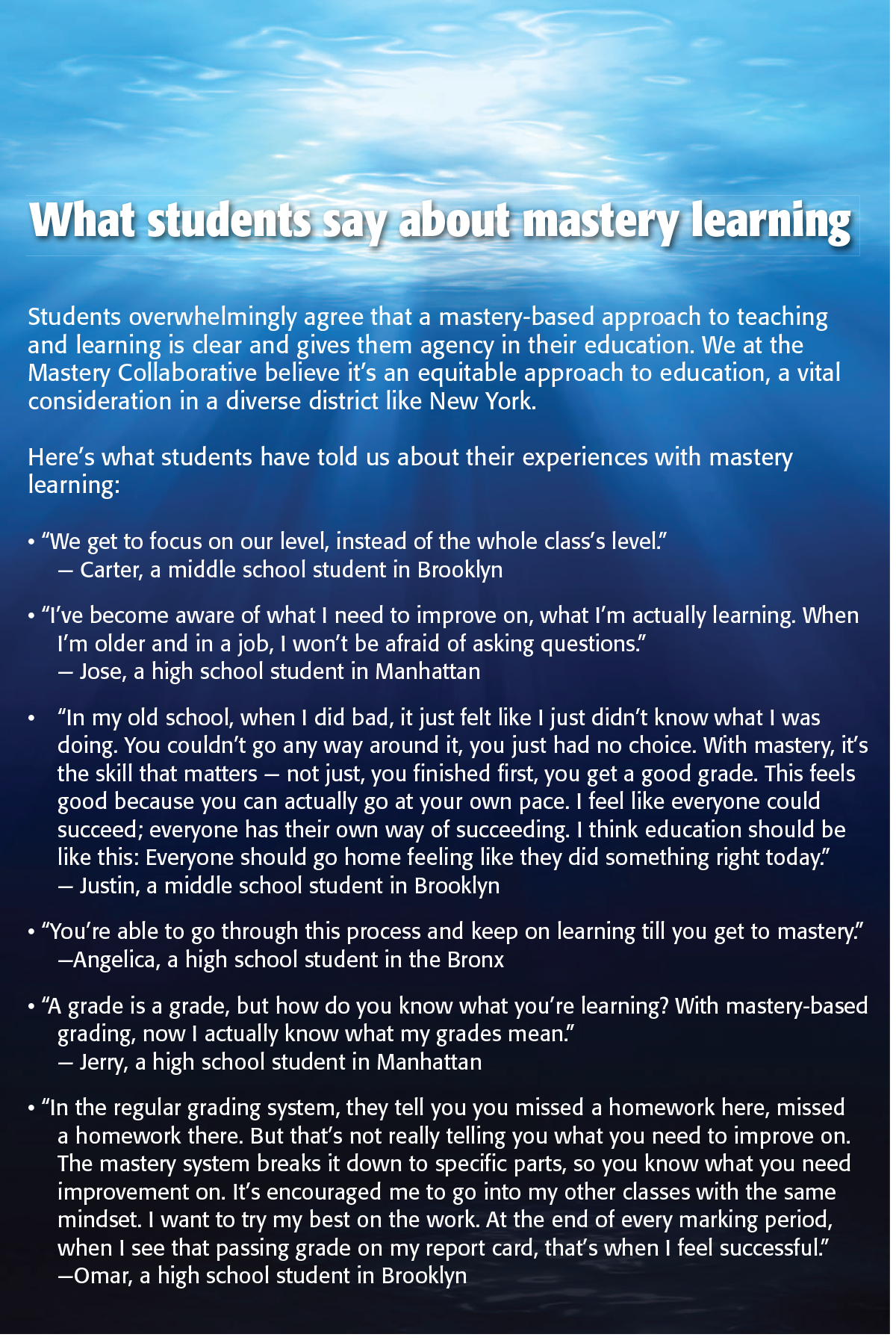
Both students and teachers with whom we’ve worked at Mastery Collaborative schools offer impassioned reasons why this is a powerful way to teach and learn.
What teachers have to say
Christy Kingham is a lead teacher at The Young Women’s Leadership School of Astoria, one of our eight Living Lab schools. She began teaching at the school five years ago and was “dropped,” as she put it, into the deep end of the school’s mastery-based grading system. She explains the school’s approach:
Each department had designed a set of 10 outcomes for student learning — 10 skills we wanted our students to practice and master all year. The rating scale made sense to me. If you were on target, you got an MS (meeting standards). Students surpassing the expectations would earn an ES (exceeding standards), and students who hadn’t yet mastered that skill earned an NY (not yet). The most striking aspect of this system was that a “not yet” was moveable — when students didn’t meet expectations, they got a much different, more useful, and optimistic message from their teachers. It was “not yet” instead of “you failed.”
Kingham notes that at the previous school she worked in, students needed to return to certain skills again and again — collaboration skills, debate skills, writing skills — and that the traditional grading structure didn’t help either her or her students focus on these skills. In a skills-based, mastery-based grading system, however, her feedback “instantly became targeted on those transferable skills, and communication with students became much more real.” A shift to mastery, she said, “can be a shift to true, honest feedback.”
Kingham is now a member of the outcomes grading team at the school. Every grade and subject area uses larger 21st-century skill “buckets,” such as communicating, arguing, being precise, and innovating. Within each category, each subject department has agreed-on outcomes that may cross content areas but that are geared toward the types of skills most often mastered in that subject area. “There are only 9 to 15 targets per course,” Kingham explains, “so the skills are carefully selected using a myriad of sources, including state standards, 21st-century skills, and student work.”
Kingham knew the outcomes system was working for her when she conferenced with one of her students, discussing the student’s communication in writing. “Both her social studies teacher and I had noticed she needed to work on coherency within and across paragraphs, a target we share under the ‘communicate’ outcome,” said Kingham. “The student’s eyes lit up in that ‘I got it’ way. She shared some transitions she’d learned from her social studies teacher that would apply perfectly to the writing we were looking at.”
The largest aha moment for Kingham was this: Focusing on the mastery of discrete skills helps students access rigorous content and engage with it in lasting ways. Insists Kingham, “Transfer is real in a competency-based system.”
Flushing International High School in Queens, N.Y., is another Mastery Collaborative Living Lab school. The school, which serves new immigrant students, always used project-based learning but didn’t use a mastery-based approach until four years ago.
Math teacher Maria Eloisa Villanueva has had great success with the approach. Eighty-four percent of her students passed the Common Core Algebra 1 Regents exam this year, and 94% passed her math class. She explains the broader perspective of mastery-based learning, that “it doesn’t focus only on math-specific outcomes but also on language and work habit skills. Our math outcomes are vertically aligned from 9th through 12th grade. This gives our students time to work at their own pace on the path to mastery.”
She’s also revised her approach to having students struggle. “This is a huge step I decided to take when I started the mastery-based approach,” she said. “Students get a chance to become responsible for their own learning. I let them struggle but also give them strong support. Students realize that teachers are not the only source of their learning.”
Or consider KAPPA International High School in the Bronx, N.Y., yet another Living Lab school. KAPPA shifted to mastery-based teaching and learning three years ago. History teacher Viraj Desai describes what mastery looks like in his classroom:
It pushes for more skill-based learning, such as proficient and clear writing, rather than focusing primarily on content. This skill-based approach is a major shift toward genuine college readiness that colleges and universities are seeking — and that all too often our students are lacking. It’s challenging to stick to the skill-based approach, but it has greater impact because students need these skills in classes beyond my own.
Desai has found that with a mastery-based approach, “learning is not a competition and not a race — and we don’t need to weed out students who require more work and practice to reach full mastery.”
Takeaways from Year One
Here’s some shop talk from our first year of work with dozens of schools. We hope these “moment in time” observations will be useful to others as they embark on mastery learning.
- It’s a whole school effort. A move toward mastery asks everyone — from administrators, teachers, students, to parents — to deeply examine assumptions and existing practices to make way for more meaningful learning.
- It’s about human connections. Practitioners need time and meaningful connections to share ideas, models, and best practices across schools. Mastery requires a lot of planning and preparation for teacher teams and individuals, but it gets less intensive over time as one builds a growing set of resources and protocols.
- Mastery gives teaching and learning traction and focus. Educators target and clarify previously vague aspects of teaching and grading. Students develop metacognition and motivation. And school leaders operationalize structures that support a thriving mastery system.
- Learning is not a competition. Mastery is a philosophical pivot away from the idea that education is a race and away from practices that have sorted and labeled students, marginalizing and disenfranchising many in the process.
- Mastery-based education must be combined with culturally relevant education to address disproportionate outcomes for students. We base our work with schools around such questions as how can competency education create a move toward clearer, fairer, and more equitable practices?
- Durable skills reign. To help learners prepare for college and careers, we need to think carefully about how to promote and assess such cross-cutting skills as questioning, synthesizing, and digital literacy, along with discipline-specific learning outcomes.
- Mastery learning requires sustained and conscious effort. This calls for willingness to operate in progress, staying open to new ideas.
- Mastery learning requires a student-centered, growth mindset. This makes the system accessible to all learners.
Looking ahead
We’re just starting Year Two of the Mastery Collaborative. We’re currently accepting applications to grow our program by a few more New York City public middle and high schools and will cap membership for this year at 50 schools.
During Year Two of the Mastery Collaborative, we are piloting an initiative called the Mastery Incubator, which will bring the collective wisdom of our community to bear in supporting a small number of schools trying to create a schoolwide mastery system. We’ll document how these schools — each with different strengths and needs — are making the shift. We hope this will both help these particular schools and build our capacity to help others move more speedily along a path to mastery-based teaching and learning. And with our schools’ active involvement, we will continue to document and advocate for this exemplary approach.
Citation: Nolan, J. (2016). Growing mastery in NYC. Phi Delta Kappan, 98 (3), 41-48.
ABOUT THE AUTHOR

Joy Nolan
JOY NOLAN is codirector of the Mastery Collaborative for the New York City Department of Education.