
Preparation for conversations between school districts and digital vendors can ensure that purchased products meet student and district needs.
What should a school district procurement officer ask when he or she sits down with a sales representative from a vendor of digital education products? Who else should be at the table? How do districts and providers become partners in instruction rather than adversaries in negotiation? These are increasingly critical questions as public school districts in the U.S. are under more pressure than ever to buy digital services and products.
Current policy contexts incentivize and at times require digital education tools such as online courses and assessments as well as extended digital learning opportunities such as tutoring (Davis, 2011; Sheehy, 2012). The signs of this surge are evident everywhere. As of 2011, 63% of U.S. public school districts with more than 10,000 students contracted with an outside organization to provide online courses (Queen, Lewis, & Coopersmith, 2011). K-12 spending on classroom hardware reached $13 billion worldwide in 2013 and is projected to exceed $19 billion by 2018 (Nagel, 2014). Contracts between school districts and private vendors have serious implications for collecting and using student data generated through such instructional programs.
Public debate about increasing technology use in schools has focused on implementation challenges — the technology doesn’t work, or adults and students don’t know how to use it. But the backstory to the digital surge deserves equal and careful scrutiny. Digital education is nested in a broader trend where public schools and governance structures have come under increasing pressure to contract out core functions. In schools, this means teaching, learning, and assessment. This mirrors a rise of privatizing initiatives in other public sectors, such as health and corrections.
Public schools and governance structures have come under increasing pressure to contract out core functions. In schools, this means teaching, learning, and assessment.
By design, digital education creates financial opportunities for large for-profit and nonprofit vendors to do more business with public schools. It also creates opportunities for vendors to have more political influence on what gets taught, how it gets taught, and how performance is measured. As we argue in Equal Scrutiny: Privatization and Accountability in Digital Education (Harvard Education Press, 2014), given these stakes, we must start paying more attention to the role of the vendor in all aspects of digital education — data, assessment, curriculum, and instruction.
Key questions
The ultimate goal for districts is to buy the best product and service for their students. This means buying high-quality programs accessible to all students that won’t waste scarce resources — money and the time of teachers and administrators — or use student data for purposes other than instruction and assessment.
To this end, districts and vendors should consider four questions in any formal or informal contract for digital education:
- What (or who) drives the digital curriculum?
- What (or who) drives digital instruction?
- What (or who) drives assessment and access to data?
- What can vendors and districts do to ensure that commercial or political interests don’t trump student interests?
For example, who or what drives instruction in an asynchronous software-based instructional program — that is, one without live interaction between students and instructors? And is the instruction adapted to students’ particular needs? Or, who maintains formative assessment data on students — the vendor and/or the teacher using the program in her classroom? These questions provide a structure and strategy for demanding equal scrutiny of the vendors, programs, and digital instructional spaces comparable to the scrutiny that public schools are under for increasing student achievement.
Case studies in contracting
We have studied the role of vendors in three areas of digital education — digital courses, digital schools, and digital tutoring — and found the following:
#1. Digital education can be an asset for public schools by offering, for example, access to additional types of courses or instructional time beyond what a classroom teacher can provide.
#2. But the potential won’t be realized absent incentives and regulations for digital education vendors — for-profit and nonprofit — to commit resources to provide quality instruction to students, especially from low-income settings. Digital education initiatives can exacerbate the digital divide when vendors don’t consider the full cost of implementation for all stakeholders. For example, our research illustrates how students and families may have to make up the difference when regular Internet access is not available to complete web-based assignments, or classroom teachers have to take time to interpret and troubleshoot software-based instructional programs with students.
#3. There should be a dialogue between districts and vendors, as well as other stakeholders that focuses on how vendors and schools can find common ground in bringing innovative digital instruction to scale for all students. A contracting process that reflects authentic dialogue around curriculum, instruction, assessment, and data must include a formal role for stakeholders with the greatest knowledge of student needs and experiences — teachers, parents, and building-level administrators.
#4. Absent this dialogue and informed action, commercial interests and policy politics will trump the potential of digital education and instead may drain precious funds and time from districts and schools.
Figure 1 translates these key questions and findings into a practical tool that districts and vendors can use to determine whether a digital education program fits student needs.
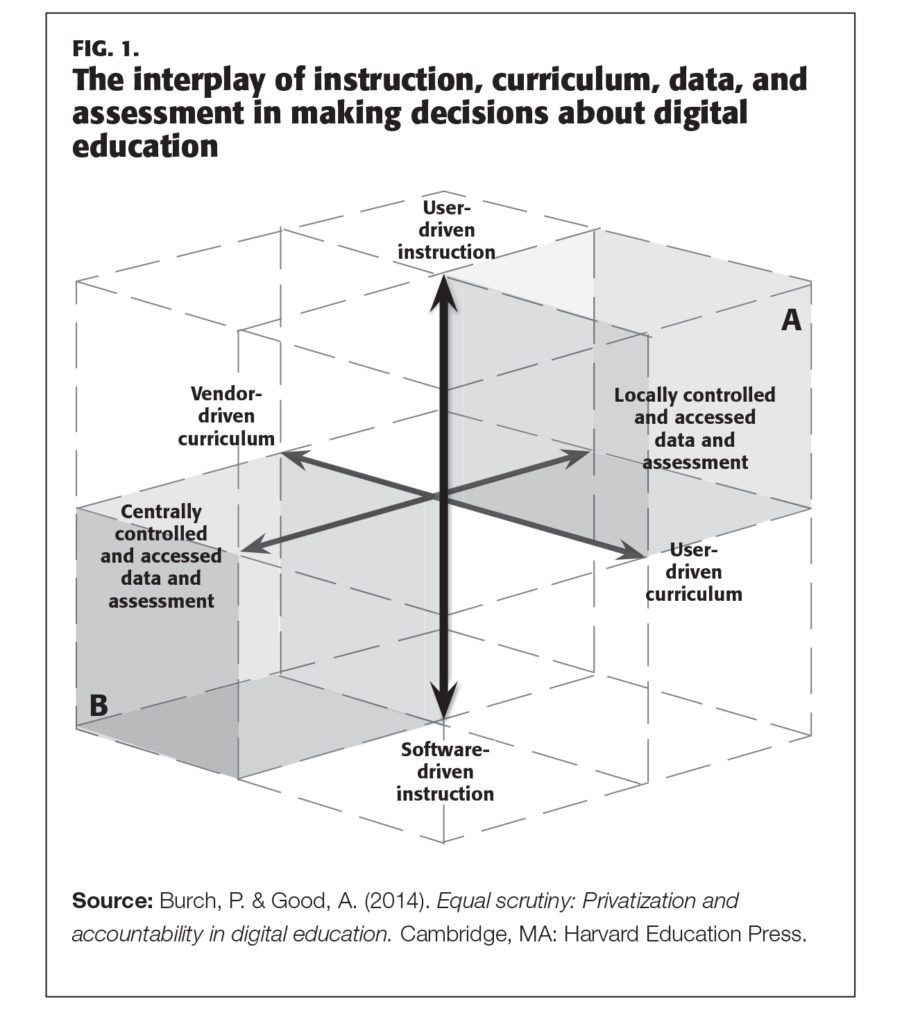
Each axis (instruction, curriculum, and data and assessment) is an arena in which vendors influence quality and access to instruction. For example, programs with a live instructor who drives instruction (situated in quadrant A of the figure) may work better for students with particular disabilities who need frequent adaptations and greater scaffolding for assignments. On the other hand, software-driven asynchronous programs (situated in quadrant B) may be better for migrant students who frequently come in and out of a district and may not have regular access to the Internet. The diagram maps out the spectrum of each element (curriculum, instruction, data), as well as how the three interact to create very different digital instructional spaces. These nuances are important in understanding how best to serve student needs and ensure transparency and accountability in program implementation.
Applying the framework
The answer to the question of what drives assessment and access to data is especially important for districts in terms of protecting privacy. Districts are facing lawsuits because they let confidential data in the cloud slip into the hands of companies who by federal law should not have access. Simultaneously districts are facing increasing pressure to buy products and services that will manage online assessment data from Common Core State Standards.
Districts face increasing pressure to buy products and services that will manage online assessment data from Common Core State Standards.
However, the extent to which data and assessment are locally controlled and accessed versus centrally controlled and accessed by those selling or legislating use of technology across a wide jurisdiction is not simply a technical detail under the domain of “user permissions.” Decisions of these sorts can make an enormous difference in whether and how end users such as teachers are able to see and assess student progress and review and use data generated by digital education platforms to better adapt instruction to students’ needs.
Digital education has the potential to be transformative. Through new technologies, the assessment feedback loop can be faster. A student completes an assignment, and the results are sent to the teacher to help him or her better discern where the student needs help. Digital education also creates the opportunity for archiving assessment data in a more structured way, providing a record of student progress that teachers, parents, and students can access.
But districts and vendors must be proactive about addressing these questions around assessment and data use. Do assessments measure learning in appropriate ways for students and districts? Who has access to data in a digital setting? What is the quality of the data? What decisions can districts and vendors make to support teacher use of data in the classroom?
Example of a proactive vendor
Accelerated Blended Learning (ABL) is an example of a vendor from our book that takes a proactive approach to transparency by answering the four key questions above. ABL (a pseudonym) contracts with districts to provide blended online middle school courses taught by certified teachers. These courses are designed to replace district language arts classes for middle school students. They provide an accessible assessment system that tracks student progress based on individual student goals created by instructors and allow students, teachers, district coordinators, and parents to have regular access to the data. Students submit their work, receive feedback from ABL teachers, and choose whether to revise and submit the work again based on the feedback. At both the midterm and final phases of the ABL courses, students assemble a portfolio of their revised work, which includes annotated reflections on strengths and weaknesses of that work.
Through frequent communication, feedback, self-reflection, self-assessment, and a structured revision process, students and teachers coconstruct the ABL assessment system. To a certain extent, they decide through a dialogue with one another which data matter in figuring out how much a student has grown and in what areas.
ABL is proactive about data access by providing reports on multiple levels to multiple stakeholders — instructors, students, programwide — and expects school-level coordinators to regularly access the online digital platform. In other words, they aren’t providing data and assessments because the contract requires it. The vendor creates a dialogue around the critical issues of data and assessment between itself and districts hiring its services.
Aggregated data on learning goals as well as student feedback are reported back to teachers for their own course and professional development so that, for example, they can set their annual instructional goals. Each ABL instructor receives a one-page summary report for every quarter they teach, which includes data for the specific teacher compared to the average of all ABL teachers in areas related to instructional goals and student satisfaction. On a programwide aggregate level, data collected about enrollment, student self-assessments of growth from pre- and postsurveys, and instructors’ summative assessments are frequently disseminated back to teachers and school-level partners. ABL engages districts, schools, teachers, students, and parents in real dialogue around its curriculum, instruction, assessment, and data and then adapts its program as needed. It takes the initiative to make its program fully transparent and readily provides data on student growth and satisfaction through the year and in multiple formats — not because it is contractually obligated, but because ABL feels it makes for a better and more accessible program.
We must start paying more attention to the role of the vendor in all aspects of digital education — data, assessment, curriculum, and instruction.
Where we need to go
Scrutinizing digital education turns on a serious dialogue around the role of private vendors in curriculum, instruction, assessment, and data use. It would be wonderful if the ABL example was one of many, but it is not. Instead, much of what is being sold to districts and schools creates a murky picture of what types of student data are generated and for what purpose. So, here we are again with a story that has played out repeatedly in education reform over the last century: There is a disconnect between the upstream policy makers and CEOs’ vision (“Technology can save our schools”) and the downstream, street-level practitioners (“Technology should come in when and only when it improves the quality of teaching and learning”).
What are we going to do? We might put up our hands and say, “Here we go again, what a mess!” and ask teachers to again absorb these tensions and challenges as best they can. We can accept the tide toward contracting digital education without pushing back and, yet again, leave schools serving low-income students with less than adequate opportunities to learn in truly transformative instructional settings. We can swing in the other direction and adopt a singular view, rejecting digital education contracts as simply another attempt by corporations to profit from public education.
Or, as we suggest, we can engage in a critical, structured, and research-based dialogue between each of these ideas. There are places where we can stem the tide of fragmented, rushed, top-down approaches to digital education and capitalize on the strengths of the technology, people, and policies to think more deeply about how the digital era is changing teaching and public policy.
Digital education clearly is here to stay, given the power and influence of those driving it and the clear financial incentives of those selling it. But, what is it that we are getting, and what is its actual value for students and schools with limited financial resources? Around this issue, there is enormous uncertainty and minimal action on the part of policy makers and industry leaders. In the absence of sustained scrutiny and informed action, we lose the potential of digital education to push a broader agenda for increasing access to quality instructional opportunities. This would be an enormous loss.
References
Burch, P. & Good, A. (2014). Equal scrutiny: Privatization and accountability in digital education. Cambridge, MA: Harvard Education Press.
Davis, M. (October 17, 2011). States, districts move to require virtual classes. Education Week. www.edweek.org/tm/contributors/michelle.davis.html
Nagel, D. (2011, June 11). Spending on instructional tech to reach $19 billion within five years. THE Journal. http://thejournal.com/articles/2014/06/11/spending-on-instructional-tech-to-reach-19-billion-within-5-years.aspx
Queen, B., Lewis, L., & Coopersmith. J. (2011). Distance education courses for public elementary and secondary school students: 2009-2010. Washington, DC: U.S. Department of Education.
Sheehy, K. (2012, October 24). States, districts require online ed for high school graduation. U.S. News & World Report. www.usnews.com/education/blogs/high-school-notes/2012/10/24/states-districts-require-online-ed-for-high-school-graduation
CITATION: Burch, P. & Good, A. (2015). More important than the contract is the relationship. Phi Delta Kappan, 96 (6), 35-39.
ABOUT THE AUTHORS

Annalee Good
ANNALEE GOOD is an associate researcher at the Wisconsin Center for Education Research, University of Wisconsin-Madison.
Patricia Burch
PATRICIA BURCH is an associate professor at the Rossier School of Education, University of Southern California, Los Angeles, Calif.