An innovative project makes a veteran education reporter rethink expectations about newsroom collaboration and dedicated beat reporters.
By John Mooney
As an education reporter in New Jersey for almost 30 years, I have seen a lot of different incarnations of the beat. There were flush years when I worked on an education team of six people and we had beats within beats, and also the years when there was just barely one education writer left, if that.
So now, working at NJ Spotlight News, a public media news organization that lies somewhere in between, the idea of a collaborative news project centered on racial segregation in New Jersey’s schools was an intriguing notion.
In this age of leaner coverage but bountiful topics to cover, what could we do together to tell a story that we can’t do on our own?
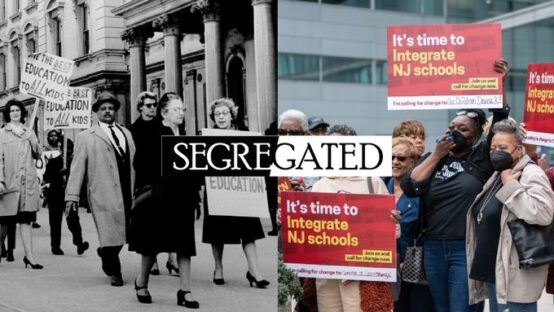
The result is an ongoing project launched in July titled Segregated, where we have teamed up with WNYC Public Radio and other New Jersey news outlets — big and tiny — and coordinated some of our coverage for not just a day but for several weeks, if not potentially months, with no end date yet in sight.
What could we do together to tell a story that we can’t do on our own?
So far, more than a dozen news organizations have signed up, and their contributions have been quite the interesting mix – with some valuable lessons for education journalism in general.
For one, collaborations pose challenges of their own in terms of coordination, workflow, and communication. But the rewards also have been many and given me faith that we can bring together a multitude of journalists to address significant issues in new and different ways.
Done well, they can also bring together different backgrounds and perspectives — including from those who don’t typically cover education — and bring fresh eyes to the topic.
We can bring together a multitude of journalists to address significant issues in new and different ways.
The project started with a conversation among a few longtime editors and publishers about how we could work together on some of New Jersey’s many pervasive issues. The choices were many, but we looked for one with a news peg.
Leading the list was the issue of racial segregation in schools, where New Jersey is among the guiltiest states. By a number of measures, white students largely go to school with whites and Black and Hispanic students are in schools that were overwhelmingly non-white.
The peg was an ongoing legal challenge over the state’s responsibility to address the imbalances, which violate a New Jersey constitutional provision barring segregation in schools.
Casting the net far and wide to established news organizations, from one-person sites to larger public media organizations like ourselves, we decided that we’d each write, broadcast, or use whatever means to explore the issue in our respective public schools and do so at about the same time, under the same banner, and with the same mission of spurring conversation and raising consciousness.
There were no requirements on what angles would be covered, just what we each thought were most interesting and valuable to our respective audiences. It could be anything from in-depth analyses to quick Q&As or even op-eds, whatever worked best. Same with the platform, just pick the one that serves your audience best.
We did have a couple of broad parameters: Content would be available to the public and not behind a paywall. Each piece would reference the collaboration, and all would also be listed on a single landing page. Not wanting to cannibalize each other’s traffic, we left it open to whether we would post each others’ work or just link to it.
But even those rules were loose, as we mostly just hoped that many of us reporting at once was really what mattered most.
We mostly just hoped that many of us reporting at once was really what mattered most.
As the pieces have come out, what’s most notable about them is their very distinct perspectives and approaches, providing a lesson to how this very familiar topic plays out very differently in different communities.
Locally, the Montclair Local wrote a lengthy piece on segregation within a very diverse high school.
The Village Green in South Orange/Maplewood chronicled a long history of integration efforts in its communities.
Central Desi, covering the South Asian community in central New Jersey, conducted a Zoom-cast around how Asian students fare.
And the Jersey Bee, a local information site out of Bloomfield, N.J., contributed an ongoing survey of the community’s own experiences and insights around segregation and integration.
Statewide, we at NJ Spotlight News provided a data hub, creating charts and graphs for every district in the state and offering them to both publishers and readers to explore.
I wrote a story about the various models both inside New Jersey and elsewhere to address segregation, and our broadcast partners at NJ PBS brought the power of television to get Gov. Phil Murphy on the air and on the record.
WNYC Public Radio and its digital partner Gothamist provided an analysis of the role that housing plays, and they continue to bring the power of talk radio to not just explore the issue but also the journalism project itself.
Now in its third week, the beauty of the project is that it remains ongoing, with more contributions coming every week. But what has been eye-opening in the coverage so far is the different ramifications of segregation in different communities, as seen by the journalists who know them best.
New Jersey celebrates its growing diversity, but the reality is the isolation among different races remains acute. And despite a history of court challenges in a half-dozen communities, the state government has taken few significant steps to address it.
As the pieces have come out, what’s most notable about them is their very distinct perspectives and approaches.
We have had some challenges, to be sure, as herding cats is nothing compared with herding journalists, especially those who are consumed every day by the more immediate deadlines of their news cycles.
As you can see in the depth and breadth of the work so far, project management skills are critical, as the details and deadlines are many.
(For those venturing into it, I highly recommend the Center for Cooperative Media at Montclair State University for guidance and help. Not only does it have a talented crew that’s great to work with, but its resources and playbooks around project and collaborative management are invaluable.)
For example, just picking a name for the project was itself a test in democracy, with the core group brainstorming — and debating — a host of names before coming to a consensus over several Zoom calls. Deadlines were tricky, too, especially with the court challenge and its ruling a big uncertainty. The judge’s decision remains pending, and we ultimately decided to start without it.
Just picking a name for the project was itself a test in democracy.
But bottom line: Does this collaborative model work in covering complex and nuanced topics like school segregation? Yes, I believe so, but maybe not in the ways that I once held near and dear as a longtime education writer.
Unlike the traditional models, it is not the Project concept — with a capital P — that comes out in a single day or week with a big splash (and hopefully journalism prizes). But to me, that’s not necessarily a bad thing.
It has proven to be more an organic one that evolves with partners coming in and out with their contributions. No doubt, that makes it an unpredictable and hard to schedule adventure that can make for some discomfort among traditionalists like myself. But the creativity and innovation from that process is a welcome tradeoff, as stories indeed came from the ground up and with a wide range of perspectives on what is newsworthy.
For example, the Jersey Bee survey of a North Jersey community not only provides local and very personal insights, but it also provides a template for other communities to tap into their residents, too.
The online conversation among Asian families was another example where a community-based news organization could connect with issues better than a statewide one. (And prove that reporters who don’t come from the education beat can more than capably cover the topic, bringing new perspectives that we veterans lack.)
Reporters who don’t come from the education beat can more than capably cover the topic.
Maybe most rewarding has been the sense of cooperation and teamwork.
Breaking down the distinct cultures of different newsrooms is often cited as the biggest obstacle to collaboration, but we have found the opposite.
For example, small news sites have welcomed the opportunity to amplify their stories statewide, and statewide ones to find new local audiences. And there has been no hesitation to help each other, whether it’s with data, expertise, or even editing.
An award-winning political columnist from New Jersey’s Gannett group called to ask to be part of the project, saying he envied the list of partners. (To the no-pay-wall rule, his editor agreed to let us reprint his contribution in full.)
WNYC Public Radio has interviewed not just key players in the issue, but the journalists who told their stories.
There’s more to come, too, with partners planning everything from a podcast of students talking about segregation in a city that has seen 50 years of integration efforts to a piece just posted by Chalkbeat Newark on the racial makeup of teachers in Newark.
And now the project has a built-in second life when the state court rules, especially if the state must address the imbalances.
Breaking down the distinct cultures of different newsrooms is often cited as the biggest obstacle to collaboration, but we have found the opposite.
We will surely debrief in the coming weeks and months ahead about ways to improve and other lessons learned.
But from the perspective of a reporter who started out at a two-newspaper city on Boston’s North Shore, where competition over breaking news was fierce, this has been a welcome opportunity to reap the benefits of having multiple journalists covering the same topic at the same time.
John Mooney is executive director of NJ Spotlight News, the digital news operation of NJ PBS. He has been an education reporter for almost 30 years, including at the Bergen Record and the Newark Star-Ledger and as a contributing writer for The New York Times.
ABOUT THE AUTHOR

The Grade
Launched in 2015, The Grade is a journalist-run effort to encourage high-quality coverage of K-12 education issues.